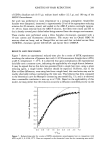
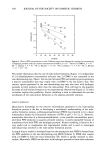
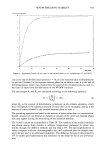
INDO-ANILINE DYE FORMATION 303 aniline formation (Figure 2). Kinetic data of indo-aniline decomposition were separately obtained by using indo-aniline as reactant, which was synthesized from the oxidation of the corresponding diphenylamine. The rate of the indo-aniline decomposition was mon- itored at its maximum absorbance (Xma x = 525 rim) as a function of reactant concen- trations. The reaction has first order kinetics on both indo-aniline and hydrogen per- oxide in pH = 9.2 buffer solution. At t = 30 minutes, estimated loss of indo-aniline by peroxide decomposition can only account for 1% of total indo-aniline concentra- tion. A group of experiments was conducted to simultaneously monitor both initial rates of indo-aniline formation and rates of PPD depletion as a function of [PPD]. Concentration of hydrogen peroxide used for this purpose was chosen such that indo-aniline concen- tration is linearly accumulated as a function of time. Over a tenfold change in [PPD], the rate of indo-aniline formation was found to be comparable to the PPD depletion rate shown in Figure 3. Evidently, PPD depletion is the rate-limiting step in the overall indo-aniline formation process. Additional experiments were conducted to study the influence of [H202] on the rate of PPD consumption. A set of such data is plotted in Figure 4. Although data are scattered due to the low accuracy caused by a small depletion of PPD under experimental con- ditions used, it is evident that within the range of [H202] used in this study, the rate of PPD depletion increases as [H202] increases. A fractional order of •0.5 on [H202] was obtained, which indicates that the hydrogen peroxide molecule is not directly responsible for the oxidation of PPD. If a molecule of hydrogen peroxide reacted with PPD in the rate-determining step, the effect of the peroxide concentration on the rate of PPD disappearance should be first order. lx10-1 1 xl 0-2 1 xl 0-3 1 xl 0-4 lx10-5 ........ ' ........ ' ' ' ' 0.1 1.0 10.0 [PPD]x104/M Figure 3. Comparison of the indo-aniline formation rates to the PPD consumption rates as a function of [PPD] under the constant concentration of hydrogen peroxide, [H202] = 1.8 X 10 -2 M, and pH. O, Rates of indo-aniline formation &, rates of PPD consumption.

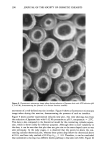
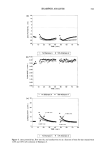
304 .JOURNAL OF THE SOCIETY OF COSMETIC CHEMISTS 7.7 i i i [ [ i [ 7.6 7.õ 7.4 7.$ 7.2 7.1 I I I I I I I I 0 10 20 $0 40 õ0 80 70 80 Time/min. Figure 4. Plots of PPD concentration vs time. Different curves were obtained by varying the concentration of hydrogen peroxide under the constant concentration of PPD (7.6 X 10 -4 M) and 2,6-DMP (1.5 X 10⁻³ M). V, [H202] = 4 X 10 -3 M /•, [H202] = 2 X 10 -2 M [•, [H202] = 1.3 X 10- • M O, [H202] = 2.1 X 10 -• M. The earlier observation that the rate of indo-aniline formation (Figure 1) is independent of 2,6-dimethylphenol concentration indicates that 2,6-DMP is not consumed in the rate-determining step. Hence, the reaction between PPD and oxidative species generates a reactive intermediate that may couple with 2,6-DMP in the fast kinetic step. The reactive species generated in the rate-determining step may also react with hydrogen peroxide to form products other than the indo-aniline. This will lead to the apparent decreases of indo-aniline formation in our experimental observations (Figure 2). In order to further explore this possibility, kinetic modeling is used to understand the reaction mechanism of the indo-aniline formation in the aqueous peroxide solution. KINETIC MODELING Quantitative knowledge on the reactive intermediates generated in the indo-aniline formation process is the key to developing a mechanistic understanding of the indo- aniline formation process. p-Benzoquinonediimine (PBDI) was reported to be a major intermediate formed by ferricyanide oxidation of PPD at pH 8.5 (2,3). However, quantitative detection of p-benzoquinonediimine, or any possible intermediates gener- ated from PPD oxidation in aqueous peroxide solution, is nearly impossible because of interference from both PPD and hydrogen peroxide. Kinetic modeling is found to be a very useful tool to complement the experimental studies and is used to investigate individual steps involved in the indo-aniline formation process. A simple kinetic model is developed based on the assumption that PBDI is formed from the PPD oxidation in the rate-determining step (RDS) (Scheme I). PBDI then couples with 2,6-DMP to form the leuco-indoaniline (II), which is rapidly oxidized to indo- aniline. Meanwhile, PBDI can also react with hydrogen peroxide to form other unknown
Purchased for the exclusive use of nofirst nolast (unknown)
From: SCC Media Library & Resource Center (library.scconline.org)