j. Soc. Cosmet. Chem., 45, 309-336 (November/December 1994) Fingerprinting of cosmetic formulations by dynamic electrokinetic and permeability analysis. I. Shampoos j. JACHOWICZ* and C. WILLIAMS, Clairol Inc., 2 Blachley Road, Stamford, CT Received January 6, 1994. Synopsis The interaction of shampoos with human hair was studied by employing an instrument that can perform simultaneous analysis of electrokinetic parameters (streaming potential and conductivity) and the perme- ability of fiber plugs. The experimental protocol included the measurements of a newly formed hair plug and its treatment with a solution of a shampoo or a model compound, followed by rinsing with the test solution. Electrokinetic and permeability data collected during the rinsing stage allowed detailed analysis of the dynamics of change in the ionic character of hair surface produced by the adsorption of a conditioning agent. The variation in the thickness of surface deposits could be evaluated from the flow-rate measure- ments. Several types of formulations were analyzed, such as nonconditioning shampoos based on anionic surfactants, and conditioning systems containing cationic polymers, cationic surfactants, and silicone oils. It is shown that a combination of experimental traces, including streaming and zeta potentials, conduc- tivity, and flow rate (permeability) as a function of time, is unique for each investigated formulation. Multiple treatments with the same formulation were allowed to estimate the extent of buildup of condi- tioning layers. The ability of nonconditioning compositions to remove polymer and surfactant residues was analyzed by consecutive application of conditioning and nonconditioning formulations. INTRODUCTION Shampoos are complex mixtures of surfactants, oils, polymers, and preservatives. Their primary function is to clean hair by removing excessive amounts of sebum, residues of cosmetic treatments, and dust and grime accumulated from the air (1). There is a variety of commercial formulations with components selected from hundreds of surfactants, lather boosters, conditioning agents, thickeners, opacifiers, preservatives, and other ingredients (2). All these materials can interact with each other in a shampoo compo- sition, forming a variety of colloidal structures such as micelies, mixed micelies, poly- mer-surfactant complexes, surfactant-surfactant complexes, emulsions, lamellar phases, etc. Depending on the composition, the shampoos can clean or condition hair to various degrees by interacting with the soil on the fiber, as well as with the fiber itself, by adsorption/desorption of surfactants, polymers, and complexes, and by solubilization or deposition of oils. All these processes occur during lathering and rinsing of the treated hair by an excess of water. In this paper, we present the data demonstrating that a new * Present address: International Specialty Products, 1361 Alps Road, Wayne NJ 07470. 309

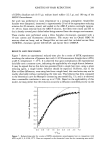
310 JOURNAL OF THE SOCIETY OF COSMETIC CHEMISTS technique, Dynamic Electrokinetic and Permeability Analysis (DEPA) (3), can provide detailed information about the process of shampooing. It is shown that a set of streaming potential, conductivity, permeability, and zeta potential data obtained in the process of the treatment and rinsing of a hair plug gives a unique insight into dynamics of the interactions of various components of a shampoo formulation with hair fibers. The concentration of anionic and cationic sites on the surface of hair (in terms of zeta potentials), kinetic parameters of surfactant rinseout, and the thickness of deposited surface layers could be estimated from these results. Detailed analysis of compositions based on anionic and amphoteric surfactants with cationic polymers (such as cationic guar gum and cationic cellulose), silicone oils, and cationic surfactants as conditioning agents is presented. The technique was also used to explore the effect of multiple treatments of hair involving conditioning and nonconditioning shampoos. These exper- iments allowed for quantitative assessment of practical problems such as the removabil- ity of adsorbed cationic surfactants and polymers by subsequent shampooing, or the build-up of polymers or polymer-surfactant complexes as a result of consecutive use of conditioning compositions. EXPERIMENTAL INSTRUMENTATION The schematic diagram of the experimental setup is presented in Figure 1. The details of the design, including the control diagram, were discussed previously (3). The device consists of a streaming potential cell, a conductivity meter, a pressure transducer, test and treatment solution reservoirs, a flow interruptor, an electronic balance, and several electric and manual valves that control the flow of solutions through the measurement cell, maintain air pressure in the system, and allow easy handling of solutions. The key features of the instrumentation are the following: (a) on-line positioning of test- and treatment-solution reservoirs, allowing fiber treatment within the streaming potential cell, (b) the pulse method of measuring the streaming potential (the timing of the pulses is effected by the flow interruptor), (c) simultaneous measurement of the streaming potential, conductivity, and flow rate (permeability of the plug), (d) special software allowing flexible design of the experiment, i.e., timing of treatment and test cycles, control of pressure, control of timing of the flow interruptor, forward and backward flow of the solutions through the plug, and data collection. The measuring cell is equipped with two perforated silver electrodes. One gram of hair fibers chopped into pieces 2-4 mm in length was used to form the plug. The distance between the electrodes could be adjusted in the range from 1.0 to 1.5 cm, which corresponds to hair plug densities of 0.72 g/cm 3 and 0.48 g/cm 3, respectively. The dynamic electrokinetic and permeability measurements described in this paper were obtained for the hair plugs at the concentration of 0.58 g hair/cm 3. The conductivity of the solution in the plug was measured by means of an Orion Model 101 conductivity meter at a frequency of 1 kHz. In all experiments the aqueous solutions were prepared from water purified by using the Barnstead NANOpure system. It was characterized by an initial conductivity of 5 x 10⁻⁸ (mho/cm). The operation of the instrument, data collection, and handling was performed by using an IBM AT computer.
Purchased for the exclusive use of nofirst nolast (unknown)
From: SCC Media Library & Resource Center (library.scconline.org)