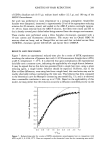
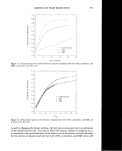
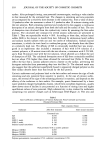
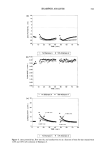
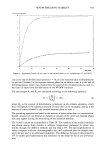
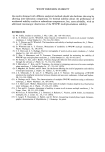
296 JOURNAL OF THE SOCIETY OF COSMETIC CHEMISTS Table V Smoothed Curves for the Various Experimental Reaction Behaviors That Have Been Observed Normalized time Type 1 Type 2 Type 3 Type 4 Type 5 0.1 0.08 0.08 0.04 0.02 0.05 0.2 0.15 0.13 0.06 0.04 0.09 0.3 0.21 0.18 0.10 0.06 0.13 0.4 0.26 0.23 0.14 0.09 0.18 0.5 0.31 0.28 0.19 0.13 0.23 0.6 0.36 0.33 0.24 0.18 0.29 0.7 0.40 0.38 0.30 0.25 0.34 0.8 0.44 0.42 0.36 0.32 0.40 0.9 0.47 0.46 0.43 0.40 0.45 1.0 0.50 0.50 0.49 0.49 0.49 1.1 0.53 0.54 0.55 0.57 0.53 1.2 0.55 0.58 0.61 0.64 0.56 1.3 0.57 0.61 0.66 0.70 0.59 1.4 0.59 0.64 0.70 0.75 0.61 1.5 0.61 0.67 0.74 0.78 0.63 1.6 0.63 0.69 0.77 0.81 0.64 1.7 0.64 0.72 0.79 0.83 0.65 1.8 0.65 0.74 0.81 0.84 0.66 1.9 0.66 0.76 0.83 0.85 0.67 2.0 0.67 0.77 0.84 0.86 0.67 2.1 0.68 0.79 0.85 0.86 0.67 2.2 0.69 0.80 0.86 0.87 0.68 2.3 0.69 0.81 0.86 0.87 0.68 2.4 0.70 0.82 0.87 0.87 0.68 2.5 0.70 0.83 0.87 0.87 0.68 3.0 0.73 0.85 0.88 0.87 0.69 3.5 0.75 0.86 0.88 0.87 0.69 4.0 0.77 0.88 0.88 0.87 0.69 During our studies, we have so far been able to identify the presence of five regularly occurring kinetic pathways based on the shapes of the reduced-time plots. These are shown in Table V and also pictorially in Figure 15. The two experimental behaviors that were obtained with the Japanese hair at pH 9 using cysteamine and ATG have been termed Type 1 and Type 2. It is also observed that there is more than one type of sigmoidal mechanism that can be obtained. The behavior shown in Figure 13 is termed Type 3 meanwhile, another sigmoidal behavior has also been obtained when using ATG, termed Type 4. This second type of sigmoidal mechanism has also been obtained when using cysteine as a reducing agent, and can be approximated quite well by Wickett's moving boundary mechanism up to ot•0.85 (Figure 16). A weaker sigmoidal behavior has also been obtained when using cysteamine as a reducing agent, and this behavior is termed Type 5. Again it is noted that with the exception of the contracting cylinder mechanism, none of the models shown in Table I are found to be applicable to the reduction of hair. CONCLUSIONS Although, in general, the heterogeneous kinetic models do not seem to be appropriate to hair/reducing agent interactions, the reduced-time technique is very useful in allow-

KINETICS OF HAIR REDUCTION 297 1.0 0.9 0.8 0.7 0.6 0.5 0.4 0.5 0.2 0.1 //.• ,, - - TYPE //')/,'/ --- TYPE TYPE t I I I I 0.0 0.5 1.0 1.5 2.0 2.5 •/•0.5 0.0 • • 3.0 3.5 4.0 Figure 15. Reduced-time plot showing a summary of the various experimental kinetic behaviors that have been encountered during this work. 1.0 0.9 - 0.8- 0.7- 0.6 - 0.5 - 0.4 0.5 0.2 0,1 0.0 0.0 TYPE 4 Moving Boundary 0.,5 1.0 1.5 2.0 2.5 ,.3.0 ,3.5 t/to. 5 Figure 16. Reduced-time plot comparing the Type 4 experimental behavior to the theoretical curve for Wickett's moving boundary model. ing us to identify the various experimental behaviors that we may encounter. At present, we have been able to identify the presence of five different behaviors, but we have been unable to determine their significance, or predict when a given behavior would be expected to occur. We have looked for relationships between characteristics of the hair fibers (diameter, cystine content), the rate of the overall reaction (i.e., "easy to perm"/
Purchased for the exclusive use of nofirst nolast (unknown)
From: SCC Media Library & Resource Center (library.scconline.org)