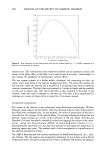
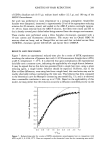
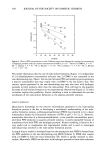
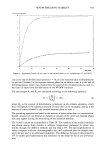
304 .JOURNAL OF THE SOCIETY OF COSMETIC CHEMISTS 7.7 i i i [ [ i [ 7.6 7.õ 7.4 7.$ 7.2 7.1 I I I I I I I I 0 10 20 $0 40 õ0 80 70 80 Time/min. Figure 4. Plots of PPD concentration vs time. Different curves were obtained by varying the concentration of hydrogen peroxide under the constant concentration of PPD (7.6 X 10 -4 M) and 2,6-DMP (1.5 X 10⁻³ M). V, [H202] = 4 X 10 -3 M /•, [H202] = 2 X 10 -2 M [•, [H202] = 1.3 X 10- • M O, [H202] = 2.1 X 10 -• M. The earlier observation that the rate of indo-aniline formation (Figure 1) is independent of 2,6-dimethylphenol concentration indicates that 2,6-DMP is not consumed in the rate-determining step. Hence, the reaction between PPD and oxidative species generates a reactive intermediate that may couple with 2,6-DMP in the fast kinetic step. The reactive species generated in the rate-determining step may also react with hydrogen peroxide to form products other than the indo-aniline. This will lead to the apparent decreases of indo-aniline formation in our experimental observations (Figure 2). In order to further explore this possibility, kinetic modeling is used to understand the reaction mechanism of the indo-aniline formation in the aqueous peroxide solution. KINETIC MODELING Quantitative knowledge on the reactive intermediates generated in the indo-aniline formation process is the key to developing a mechanistic understanding of the indo- aniline formation process. p-Benzoquinonediimine (PBDI) was reported to be a major intermediate formed by ferricyanide oxidation of PPD at pH 8.5 (2,3). However, quantitative detection of p-benzoquinonediimine, or any possible intermediates gener- ated from PPD oxidation in aqueous peroxide solution, is nearly impossible because of interference from both PPD and hydrogen peroxide. Kinetic modeling is found to be a very useful tool to complement the experimental studies and is used to investigate individual steps involved in the indo-aniline formation process. A simple kinetic model is developed based on the assumption that PBDI is formed from the PPD oxidation in the rate-determining step (RDS) (Scheme I). PBDI then couples with 2,6-DMP to form the leuco-indoaniline (II), which is rapidly oxidized to indo- aniline. Meanwhile, PBDI can also react with hydrogen peroxide to form other unknown

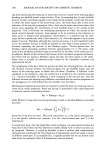
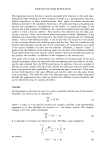
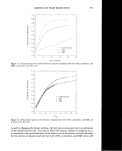
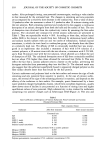
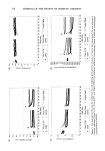
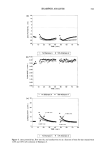
INDO-ANILINE DYE FORMATION 305 Scheme I PPD H202 RDS kl H202 PBDI Undesired Products (1) (2) +l• c• 2,6-DMP kt •. v v 'o I Fast • Indo-aniline (3) N...•% H•O• •. v T '0 k4 Decomposition (4) products. Although more chemical reactions may be involved in indo-aniline formation, this kinetic model includes only those reactions that are kinetically significant to affect the rates of the indo-aniline formation. All kinetic parameters included in Scheme I were obtained either experimentally in the present study or taken from the literature (2,3). Therefore, quantitative prediction of indo-aniline formation using this kinetic model is possible. The rate constant for reaction between PBDI and hydrogen peroxide (reaction 2) was obtained from conducting supplementary experiments to study kinetics of reac- tion between PBDI and hydrogen peroxide in pH = 9.2 borax buffer, using the spectrophotometer. PBDI was quantitatively synthesized by mixing one mole of PPD and two moles of K3Fe(CN) 6 (4). The coupling rate constant between PBDI and 2,6- DMP, k 3 (rate constant of second order reaction), in aqueous solution was obtained by J. F. Corbett (2). Figure 5a plots the calculated values of indo-aniline formation (lines) at three different [H202] using Scheme I and their corresponding experimental data (symbols). In gen- eral, predicted indo-aniline concentration using Scheme I is much higher than that of the corresponding experimental values. The differences between the calculated values of indo-aniline concentration and the experimental data increase as [H202] is increased. Clearly, reaction 2 in Scheme I is not sufficient to account for the loss of quantity of PPD consumed in the indo-aniline formation process.
Purchased for the exclusive use of nofirst nolast (unknown)
From: SCC Media Library & Resource Center (library.scconline.org)