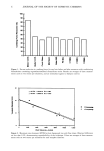
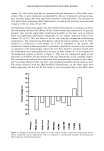
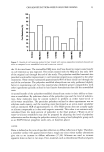
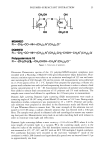
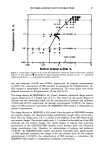
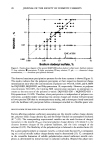
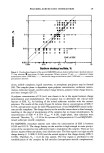
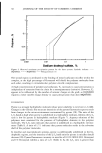
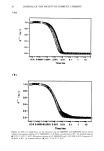
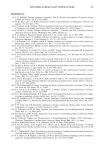
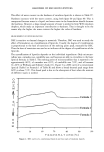
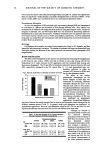
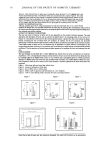
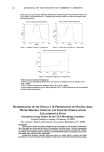
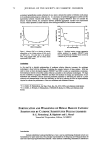
ORGANOFUNCTIONALIZED SILICONE RESINS 13 100 90 80 • 70 = 60 ._o 50 n, 40 o 30 • 20 0. Figure 5. Results of curl retention studies for hair treated with various organofunctionalized siloxysilicate resins as compared to an unmodified resin and a water-set control. the 24-hr time frame. The unmodified MQ resin itself was found to impart some benefit in curl retention as was expected. The tresses treated with the MQ resin lost only 30% of the original curl through the end of the study. The polyether-modified material also provided a noticeable improvement in curl retention properties as compared to the other treatments. These tresses maintained approximately 80% of their initial curl through the end of the evaluation. The polyether-modified siloxysilicate not only performed slightly better in maintaining curl, but this material also exhibited greater compatibility with other ingredients typically utilized in hair fixative formulations than did the unmodified resin. A second benefit of the polyether-modified siloxysilicate resins is their ability to func- tion as emulsifiers. By judicious choice of the polyether type and the level of substitu- tion, these molecules may be custom tailored to perform as either water-in-oil or oil-in-water emulsifiers. The particular polyether utilized in these experiments was an ethylene oxide moiety, and the resulting resin functioned as an oil-in-water emulsifier with an estimated HLB of approximately 12. (The HLB system does not actually apply to silicone compounds as it does with organic materials. This value is an estimate only, calculated from the mole percent of polyether in the final product.) Water-in-oil or water-in-silicone emulsifiers may also be prepared by adjusting the level of polyether substitution and/or altering the polyether moiety by using a less hydrophilic group such as an EO/PO blend, propylene oxide only, or butylene glycol. LUSTER Shine is defined as the ratio of specular reflection to diffuse reflection of light. Therefore, a smoother surface will appear shinier than a rough one since minor surface aberrations give rise to an increase in diffuse reflection (37,38). Silicones are used to increase apparent shine on hair in two ways. First, materials such as dimethicone fluids and gums

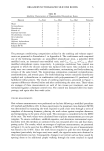
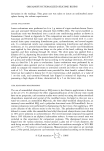
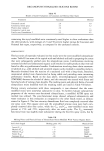
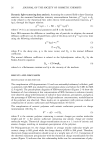
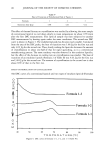
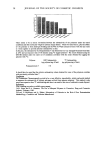
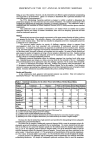
14 JOURNAL OF THE SOCIETY OF COSMETIC CHEMISTS are used to provide conditioning benefits, resulting in increased fiber alignment, thus producing a smoother surface from which to reflect light. This in turn, provides an increase in specular reflection, making the hair appear more lustrous. Cyclomethicones may be used in this application, but the effect is transitory since cyclomethicones will volatilize from the hair. The second, more widely utilized, method is to coat hair with a material of relatively high refractive index, closer to that of the hair cuticle. The reason for this is that incident light is believed to be reflected by the underlying melanin granules. Thus, by coating the fiber with a material whose refractive index is close to that of the hair cuticle, incident light will scatter less as it passes through the various cuticle-cuticle, or cuticle-cortex interfaces. This will result in an increase in specular reflection, making the hair appear to be glossier or more lustrous (27). Thus, minimizing the difference in refractive index between the coating material and the cuticle scales maximizes the increase in apparent luster of the hair (39). The refractive index of dimethicone fluids ranges from 1.3970 for a 5-cst fluid to 1.4035 for fluids of 5,000 cst viscosity and higher, as shown in Table V. The mechanism by which dimethyl fluids function as luster-enhancing agents is through increasing fiber alignment, providing a smoother surface from which to reflect incident light as men- tioned above. Phenyltrimethicone, a fluid commonly used for shine enhancement in hair gloss sprays and cuticle coat products is characterized by a refractive index of 1.459- 1.461. Phenethyl or styryl modification of the siloxysilicate resin was found to yield a fluid of refractive index of 1.505, substantially higher (and much closer to the refractive index of the hair cuticle) than that of other silicone fluids. It was therefore envisaged that this fluid would be beneficial in hair shine enhancement applications. The styryl-modified siloxysilicate resin was formulated into a cuticle coat conditioning product as shown in Formulation 2 listed in Appendix A. This composition was used in luster evaluations on Caucasian and Oriental hair types, being compared to tresses treated with 1) a commercial shine spray comprising dimethicone gum, cyclomethicone, and several organic oils, 2) a commercial cuticle coat containing dimethicone and phenyltrimethicone, and 3) a protein-based shine-enhancer product. The results of luster evaluations are presented in Table VI. It can be seen that the commercial cuticle coat product provided no improvement in shine as observed by the panel. The commercial shine spray product offered a minimal improvement in shine of 6% and 14% for the Oriental and Caucasian hair types, respectively, as compared to the untreated controls. The protein-based shine-enhancer composition actually reduced hair luster by approxi- mately 10% according to the panelists. The cuticle coat formulation containing the phenethyl-modified siloxysilicate, however, was found to produce a dramatic increase in apparent luster for both hair types evaluated. The hair treated with the composition Table V Refractive Index of Various Silicones Material nD (25øC) PDMS (350 cst) 1.40' Phenyltrimethicone 1.460 Phenethyl siloxysilicate 1.505 * Refractive index of dimethyl fluids ranges from 1.3970 for a 5-cst fluid to 1.4035 for fluids of 5,000 cst viscosity and higher.
Purchased for the exclusive use of nofirst nolast (unknown)
From: SCC Media Library & Resource Center (library.scconline.org)