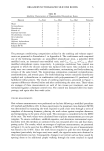
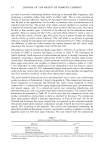
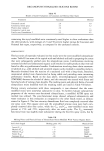
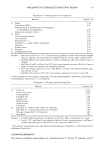
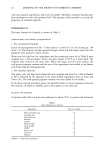
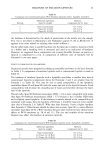
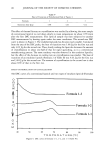
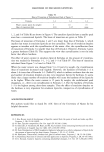
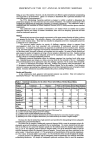
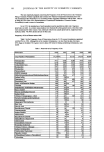
42 JOURNAL OF THE SOCIETY OF COSMETIC CHEMISTS with most lipstick ingredients, which are oil-soluble. Therefore, emulsion lipsticks have been developed to solve this problem (8,9). The purpose of this research is to study the properties of emulsion lipsticks. EXPERIMENTAL The basic formula of a lipstick is shown in Table I. COMPOUNDING AND MIXING OF INGREDIENTS 1. For conventional lipsticks: Castor oil and pigments (red No. 7) were mixed in a ratio of 2 to 1 by stirring (p. 146 of ref. 11). The mixture was then passed through a three-roll mill many times until the pigments were ground to about 20 pm. Waxes and oils (the first five ingredients and the remaining castor oil in Table I) were weighed into a 500-ml beaker, which was then heated to 85øC in a water bath. The contents were stirred at the same time. When the waxes and oils were molten, the well-ground pigment mixture and the rest of the ingredients were added to the beaker and mixed together homogeneously. 2. For emulsion lipsticks: The waxes, oils, and Span 60 (or Span 80) were weighed and mixed in a 500-ml beaker at 85øC, followed by the addition of the water-soluble ingredients (such as water and Tween 20). The well-ground pigment mixture was then added to the beaker. In the above mixing procedure, great care should be taken to avoid trapping air because the existence of small air bubbles gives a bad quality to the lipsticks. MOLDING THE LIPSTICKS A lipstick mold with ten holes was preheated to about 45øC to prevent the formation Table I Basic Formula of a Lipstick Ingredients Parts by weight Microcrystalline wax 10 Carnauba wax 5 Candelilla wax 6 Beeswax 2 Lanolin 10 Oleyl alcohol 10 Cetyl alcohol 2 2EPH* 10 Stearic acid 2 Castor oil 50 Pigment 8 *2EPH = 2-ethyl hexyl palmitate.

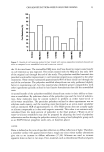
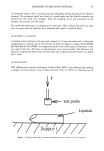
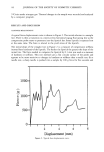
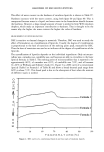
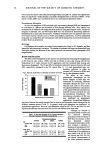
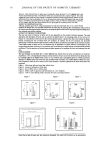
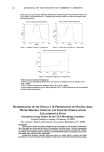
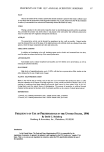
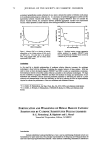
HARDNESS OF EMULSION LIPSTICKS 43 of unsmooth surfaces due to cooling and rapid shrinkage during pouring of the lipstick mixture. The preheated mold was tilted to a small angle and the lipstick mixture was poured into the mold very carefully. Thus the trapping of air was prevented as the mixture was poured into the mold. The mold was then kept in a refrigerator for one hour. After cooling, the mold was split into two parts and the lipsticks were removed and stored in lipstick bases. MEASUREMENT OF HARDNESS A lipstick with a diameter of 8 mm and a length of 35 mm was subjected to diametral compression at a testing rate of 30 mm/min, as shown in Figure 1, using a SUN RHEO METER (Model CR-2000D). A compression probe with a flat surface of diameter 5 mm was used in the test. The force vs displacement curve was recorded. The hardness of a lipstick is represented by the force exerted when the compression probe moves to a depth of 0.1 mm. DSC MEASUREMENT DSC (differential scanning calorimetry Perkin Elmer DSC7) was performed by heating a sample cell (with about 4 mg of lipstick) from 30øC to 120øC at a heating rate of test probe Lipstick pport Figure 1. Lipstick subjected to diametral compression at a testing rate of 30 mm/min.
Purchased for the exclusive use of nofirst nolast (unknown)
From: SCC Media Library & Resource Center (library.scconline.org)