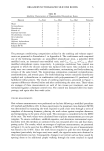
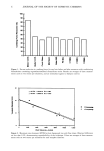
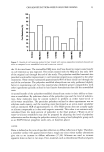
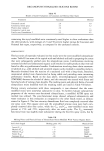
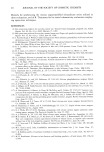
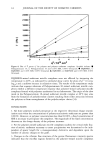
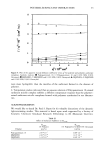
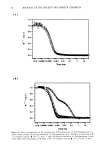
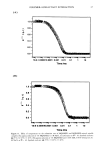
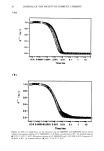
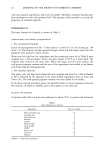
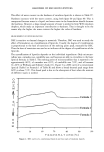
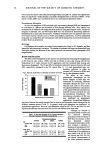
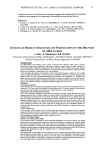
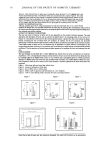
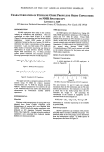
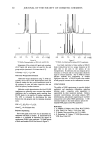
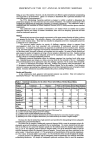
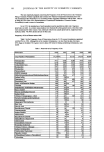
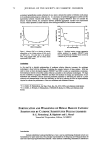
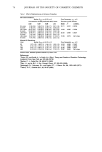
48 JOURNAL OF THE SOCIETY OF COSMETIC CHEMISTS Table V Heat of Transition of Endothermal Peak of Figure 4 Formula 1 2 3 Transition heat (J/g) 5.98 4.63 4.12 The effect of thermal history on crystallization was studied by allowing the same sample of conventional lipstick to cool down slowly to room temperature (at about 10øC/min) after the first DSC measurement. This lipstick sample was then subjected to another DSC measurement by heating again under the same conditions. The second-run DSC curve is shown in Figure 3. The endothermal peak has become much smaller. Calculated from the area of the DSC peaks, the heat of transition was 5.98 J/g for the first run and only 3.02 J/g for the second run. Thus, slowly cooling the lipsticks decreases the amount of crystallization to about one-half of that for rapid quenching, as in a conventional manufacturing process. The same tendency was also observed in the emulsion lipsticks, but the effect of the decrease in cooling rate on crystallization was smaller. The heat of transition of an emulsion lipstick (Formula 2 of Table II) was 4.63 J/g for the first run and 3.84 J/g for the second run. The amount of crystallization in the second run is thus about 83% of that in the first run. EFFECT OF FORMULATION ON CRYSTALLIZATION The DSC curves of a conventional lipstick and two types of emulsion lipstick (Formulae o :z I,.,d 40 Formula 1-3 Formula 1-2 Formula 1-1 f I i I 50 60 70 80 T F' •'• P F' RAT U R F' (øO) Figure 5. DSC curves of formulae 1-1, 1-2, and 1-3 (Table IV). 100

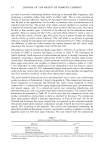
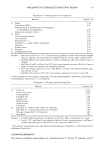
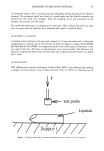
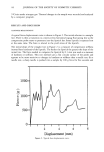
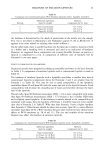
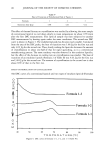
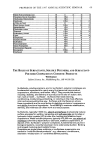
HARDNESS OF EMULSION LIPSTICKS 49 Table VI Heat of Transition of Endothermal Peak of Figure 5 Formula 1-1 1-2 1-3 Water content (parts by weight) 5 10 15 Heat of transition (J/g) 4.63 4.35 none 1, 2, and 3 of Table II) are shown in Figure 4. The emulsion lipsticks have a smaller peak area than a conventional lipstick. The heats of transition are given in Table V. The heats of transition of Formulae 2 and 3 are lower than that of Formula 1, which implies that waxes in emulsion lipsticks are less crystalline. The use of emulsion droplets appears to interfere with the crystallization of the waxes. Also, the crystallization (heat of transition) of Formula 3 is smaller than that of Formula 2. However, Formula 3 gives a greater hardness (Table II). This supports the view that crystallization is not the only factor that affects hardness. The effect of water content in emulsion lipstick formulae on the amount of crystalliza- tion was studied for Formulae 1-1, 1-2, and 1-3 of Table IV. The heat of transition calculated from Figure 5 is listed in Table VI. When the water content was changed from 5 to 10 parts by weight, the crystallization (heat of transition) decreased only slightly. However, the hardness of Formula 1-2 is about 1.6 times that of Formula 1-1 (Table IV), which is indirect evidence that the size and number of emulsion droplets are also very important factors for hardness. It seems likely that a larger number of emulsion droplets will cause the hardness of the lipsticks to be higher. When the water content is 15 parts by weight, the endothermal peak disappears, i.e., there is no crystallization in Formula 1-3. But the hardness of Formula 1-3 is the highest among these three samples. Thus the effect of emulsion droplets on the hardness is very important for emulsion lipsticks, irrespective of crystallization of waxes. ACKNOWLEDGMENT The authors would like to thank Dr. A N. Gent of the University of Akron for his helpful discussion. REFERENCES (1) I. Iida, Recent trend of development of lipsticks viewed from the point of touch and make-up effect, FragranceJ., 20, 22-28 (1992). (2) N. Sato, Lipcolor composition, Eur. Pat. App/. EP 585,981 (1994). (3) G. Schneider, S. Teichmann, M. Klier, and M. Aul, Cosmetic sticks containing beeswax and wax esters for prevention of chapped lips, Ger. Often. DE 4,306,068 (1994). (4) M. Fujii, Development of DGS (isopalmityl diglyceryl sebacate) as a vehicle component of lipsticks for the purpose of protecting lips from dryness, FragranceJ., 22, 31-37 (1994). (5) M. Mamyama, Characteristic hardness and gloss of natural waxes, FragranceJ., 18, 52-58 (1990). (6) A. Harashima, Functions of silicones and their application to lipsticks, FragranceJ., 20, 50-56 (1992). (7) D. G. Krzysik, Cosmetic lipsticks containing alkylmethyl siloxanes, U.S. Pat. US 5,288,482 (1994).
Purchased for the exclusive use of nofirst nolast (unknown)
From: SCC Media Library & Resource Center (library.scconline.org)