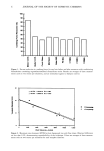
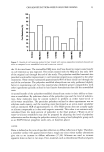
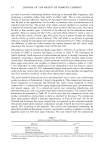
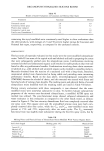
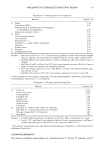
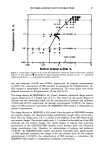
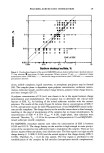
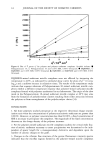
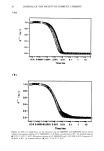
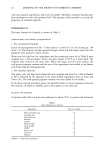
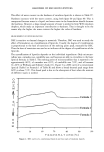
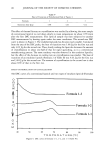
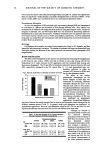
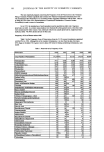
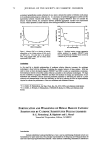
28 JOURNAL OF THE SOCIETY OF COSMETIC CHEMISTS 1.1.1 z z o 0.1 0.01 o o' o o o- ß --o o o o-o-ooo--o o o o o o o , o--,--C,,, • ........ 0.001 0.001 0.01 10 CMC of SDS 0.1 i Sodium dodecyl sulfate, % Figure 3. Pseudo-phase diagram of the system MQNNED/sodium dodecyl sulfate/water. Symbols indicate: O clear solution ß precipitate © slight precipitate [] hazy solution [] gel ...... theoretical charge neutralization -- maximum precipitation observed. The observed maximum precipitation patterns for the three systems is shown (Figure 5). The results indicate that the polymers precipitate at their respective theoretical charge neutralization ratio when the concentrations of polymer are •0.010, 0.020, and 0.200% for DQNNED, MQNNED, and Polyquaternium 10, respectively. However, at polymer concentrations •0.010%, the limiting SDS concentration necessary to precipitate in- creases as the structure of the polymer is varied: DQNNED-SDS MQNNED-SDS Polyquaternium 10-SDS. Therefore, when precipitation is independent of polymer con- centration, a polyelectrolyte containing two cationic charges per residue will precipitate at lower percent SDS than its monoquaternary analog, and a monoquat closely associated with the backbone will precipitate before a monoquat attached to a flexible spacer arm. PRECIPITATION STUDIES WITH SDS AND OCTOXYNOL Factors affecting polymer-surfactant association are the micelie surface charge density ((y), polymer linear charge density (•), and the Debye-HQckel ion atmosphere thickness (K -1) (25). The corresponding experimental variables are the mole fraction of charged monomers in the micelie (Ysr)s), structural polymer charge density (l/b) where b is the distance between charges on the polymer backbone, and the ionic strength of the solution (I) (25). The flexibility of the polyelectrolyte is believed to be another factor (4). For a given polyelectrolyte at constant I and b, a critical mole fraction (Yc) correspond- ing to a critical micelie surface charge density may be determined (25). Yc corresponds to the reversible formation of soluble polyelectrolyte-mixed surfactant micelie com- plexes as determined by initial increase in solution turbidity. Beyond this phase tran-

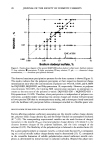
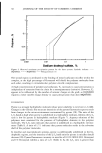
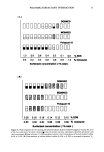
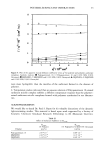
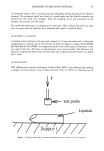
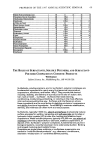
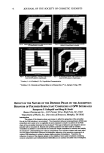
POLYMER-SURFACTANT INTERACTION 29 c• LU Z Z 0.1 0.01 0.001 0.001 0 • • o:m nm _.•, o..0o o .== o . n o o - 0•/• 0 0 B 0 0 B 0 0 .'•_...0" • 0 0 0 B B 0 '"• I CMC of SDS ..---'. 0.01 0.1 1 Sodium dodecyl sulfate, % Figure 4. Pseudo-phase diagram of the system DQNNED/sodium dodecyl sulfate/water. Symbols indicate: O clear solution ß precipitate '© slight precipitate [] hazy solution [] gel ...... theoretical charge neutralization when 1 SDS adds ........ theoretical charge neutralization when 2 SDS add -- maximum precipitation observed. sition, soluble complexes, liquid coacervate, or amorphous precipitate may be formed (26). The complex phase is dependent upon polymer concentration, surfactant concen- tration, molecular weight, micelie surface charge density, polymer linear charge density, and ionic strength (26-27). A polymer concentration of 1% (w/v) was chosen to be in the region between charge neutralization and resolubilization. The purpose was to determine the critical mole fraction of SDS, Yo for binding of the mixed surfactant micelies with the cationic polymers. The results of this study (Figure 6) indicate that at concentrations of SDS • 0.15%, precipitation occurs for both Polyquaternium 10 and MQNNED mixed surfac- tant micelie complexes. The charge density on the micelies causes them to bind strongly, resulting in the onset of precipitation of the complex due to charge neutralization. At concentrations of SDS • 0.15% (YsI)s • 0.28), single-phase, clear solutions were observed. Therefore, Yct= 0.30 for the systems of Polyquaternium 10 and MQNNED- mixed surfactant micelie complexes. For DQNNED, two-phase systems exist when the concentration of SDS is between 0.50% and 0.11%. The charge density on the micelies is high enough to cause precipi- tation of the complex but not sufficiently high to resolubilize the complex. There are two distinct regions where one-phase, clear solutions exist. The first region is at high micelie charge density (1 • SDS • 0.6%) and the second region at low charge density (SDS • 0.10%). Therefore, Yc = 0.22 for this system. The first region is attributed to the resolubilization of the complex by full micelies (interpolymer-micelle complexation).
Purchased for the exclusive use of nofirst nolast (unknown)
From: SCC Media Library & Resource Center (library.scconline.org)