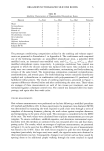
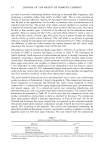
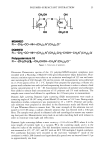
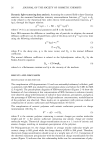
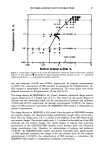
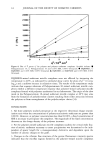
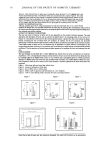
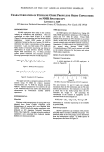
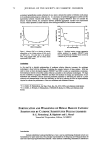
26 JOURNAL OF THE SOCIETY OF COSMETIC CHEMISTS Dynamic light-scattering data analysis. Assuming the scattered field to have Gaussian statistics, the measured homodyne intensity autocorrelation function, g(2) (q,t), is di- rectly related to the theoretical first order electric field autocorrelation function, (q,t), through the Siegert relation: g(2) (q,t) = 1 + B(1 + flgO) (q,t)[2) (1) where f (•1) is an instrumental parameter and B is the baseline. Since DLS measures the diffusion or tumbling rate of particles in solution, the mutual diffusion coefficient can be obtained from a plot of the decay rate of g(•) (q,t) versus time using the following relationships: g0) (q,t) = e -rt (2) I • = q2D m (3) where F is the decay rate, q is the wave vector, and D m is the mutual diffusion coefficient. The mutual diffusion coefficient is related to the hydrodynamic radius, Rh, by the Stokes-Einstein equation: D m = kT/6•rwlR h (4) where k is a Boltzmann constant and x I is the viscosity of the medium. RESULTS AND DISCUSSION PRECIPITATION STUDIES WITH SDS The complexation of Polyquaternium 10 and two aminoalkylcarbamoyl ceIlulosic graft co-polymers with SDS was studied by precipitation above and below the CMC for SDS (2.4 mg/ml). The pseudo-phase diagrams of SDS/water/polymer (Figures 2•4) show the formation of clear solutions at low concentrations of SDS. Increases in solution viscosity were observed along with formation of turbid or hazy solutions, precipitates, and gels as the percentage of SDS was increased. At high surfactant concentrations, resolubilization of the polymers was observed. These results are in agreement with previous studies of complexation of anionic surfactants and Polyquaternium 10 (8,10). The complexation of cationic polymers with anionic surfactants proceeds via charge neutralization (10) (Eq. 5). pn+ +nD • PDn (5) where P is the cationic polymer containing n cationic charges per residue molecular weight and D- is the anionic surfactant containing one anionic charge per residue molecular weight. Theoretical charge neutralization occurs at a 1:1 ratio of cationic and anionic charges, resulting in maximum precipitation of the polymer. For Polyquaternium 10, the charge density or average residue molecular weight per cationic charge is 689 g/mol while the charge density of SDS is 288 g/mol. Therefore, theoretical charge neutralization should occur at a weight ratio of 2.3:1. Comparison of the observed maximum precipitation with the theoretical charge neutralization for this system (Figure 2) indicates that this relationship holds true for concentrations of poly-

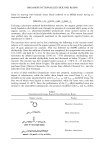
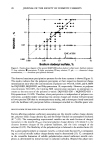
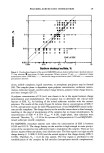
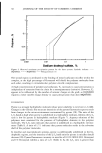
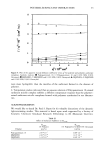
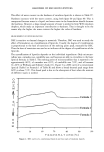
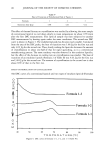
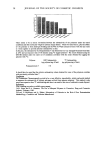
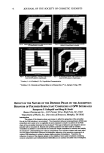
POLYMER-SURFACTANT INTERACTION 27 0.1 0.01 o.ool o oo o o [3o o oo o ..-o [] oO o-' o o oO' ,C,,,• 0.1 0.001 0.01 10 CMC of SDS Sodium dodecyl sulfate, % Figure 2. Pseudo-phase diagram of the system Polyquaternium 10/sodium dodecyl sulfate/water. Symbols indicate: O clear solution ß precipitate ¸ slight precipitate '.g• hazy solution [] gel ...... theoretical charge neutralization -- maximum precipitation observed. mer and surfactant •0.200 and 0.100%, respectively. At polymer concentrations 0.200%, the concentration of SDS necessary to precipitate the Polyquaternium 10- SDS complex is independent of polymer concentration. This result agrees with results observed previously for Polyquaternium 10 and SDS (8,10). The charge density for MQNNED is 467 g/mol. therefore, theoretical charge neutral- ization should occur at a weight ratio of 1.6:1. The results for this system (Figure 3) indicate that this relationship holds true for concentrations of polymer and surfactant •0.020 and 0.015%, respectively. At polymer concentrations •0.010%, the concen- tration of SDS necessary to precipitate the MQNNED-SDS complex is independent of polymer concentration. The charge density for DQNNED is 569 g/mol. Since the graft on DQNNED contains two cationic charges, two theoretical charge neutralization weight ratios can be calcu- lated. The first weight ratio, 2.0:1, is related to the addition of one SDS molecule per two cationic charges. The second weight ratio, 1:1, is related to the addition of two SDS molecules per two cationic charges. The results (Figure 4) indicate that maximum precipitation of the DQNNED-SDS complex occurs between these two theoretical charge neutralization lines. Therefore, for concentrations of polymer and surfactant •0.010%, the DQNNED-SDS complex precipitates maximally when approximately 1.5 SDS molecules neutralize the charge of the two cationic sites. At low polymer concentrations (0.010%), the concentration of SDS necessary to precipitate the DQNNED-SDS complex is independent of polymer concentration.
Purchased for the exclusive use of nofirst nolast (unknown)
From: SCC Media Library & Resource Center (library.scconline.org)