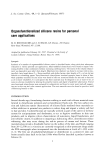
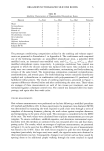
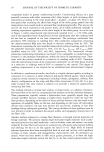
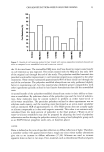
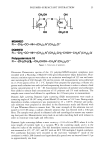
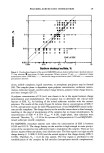
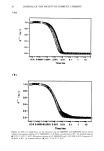
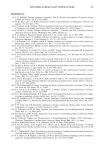
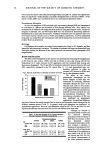
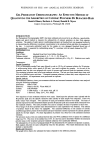
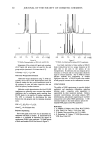
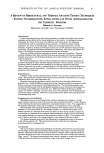
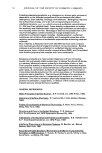
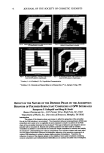
60 JOURNAL OF THE SOCIETY OF COSMETIC CHEMISTS 85 80 75 70 65 60 Fi•ttr½ •.V '•C NlvlR ofhomopol?m•s: a) PoeG-440 b) PPG-?2$ Integration of the primal, (62 ppm) and secondary (65-67 ppm) end group areas are used for the end group analysis (assumes # of initiator sites 2). %Primary=(I/Ip+l•) x 100 Molecular Weight Determination Molecular weight calculations using nC NMR are typically not as fast as MW determinations from the hydrox2,'l number but they avoid interferences such as the presence of water and other impurities that can effect the hydrox3'l number titrations. Molecular weight determinations for block EO-PO copolymers are generally more accurate than random copolymers due to overlapping peaks resulting from EO-PO dyacls in the spectra of random copolymers. The MW is calculated by determining the ratio between the end group(s) and the repeating monomer units. where F•, = # of initiator sites Polymer Sequencing One of the goals of this work was to determine if a copolymer was block or random. ff determined to be random it is desirable to determine the degree of randomness (DOR) in the copolymer. nC NMR spectra of block and random EO-PO are shown in Figure V. 85 80 75 70 65 60 PP.%5 Figure V '3C NMR of a) block and b) random EO-PO ½opobxners In a block copolymer a finite number of EO-PO dyads exists.gi•4ng rise to a unique resonance at 69 ppm that is not seen in the spectra of the homopolyrners. By definition, the area integrals of the resonance at 69 ppm and the end group(s) should be equal in a block copolymer. The nC NMR of a block polymer confirms this relationship. In random copolyrners the ratio of EO-PO dyads to the number of end group(s) increases as the randomness increases. CONCLUSION The ability of NMR spectroscopy to pro•"ide detailed qualitative and quantitative information regarding ethylene oxide - propylene oxide copolymers is unparalleled by other anal3•cal methods. Relative monomer concentrations, end group analysis, MW determinations, and polymer sequencing are available using proton and carbon NMR spectroscopy. I refer interested readers to the listed reference articles for detailed NMR papers on EO-PO copolymers. References 1. A. Mathais, N. Melior, Anal. Chem. 38, 472 (1966) 2. M.A. Carey, P.A. Turey, J. Cell. Plast. 1985 3. F. Heatley, Macromolecules. 21, 2713 (1988) 4. E. Breitmaier, W. Voelter, •SCNMR Spectroscopy, VCH, New York, 1987

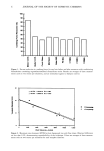
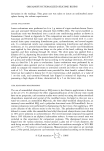
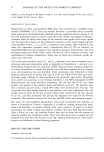
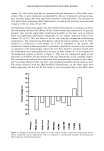
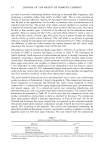
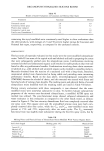
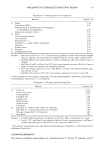
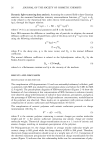
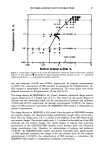
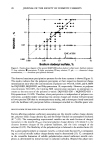
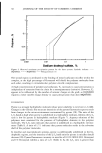
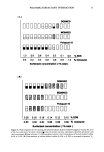
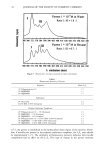
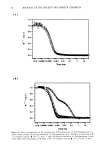
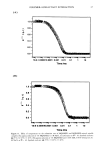
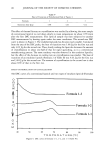
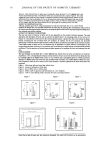
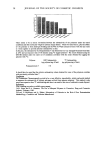
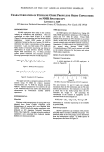
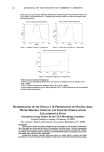
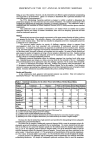
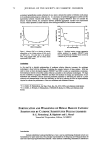
PREPRINTS OF THE 1997 ANNUAL SCIENTIFIC SEMINAR 61 A REVIEW OF RHEOLOGICAL AND THERMAL ANALYSIS TESTING TECHNIQUES - TESTING CONSIDERATIONS, APPLICATIONS AND NOVEL APPROACHES FOR THE COSMETIC INDUSTRY Deborah A. Gerenza Rheometric Scientific, Inc., Piscataway, NJ 08854 Introduction Conducting experiments in any testing environment requires knowledge of the testing technique and the effects of the testing conditions on the results. In rheological testing techniques, the choice of test type, test conditions, and test geometry are important considerations, with the combinations being numerous. In thermal analysis testing techniques, the choice of thermal proffie, sample size and sample preparation are key elements. Together, rheology and thermal analysis can provide necessary characterization, processing, and application behavior information of materials. This paper will explore the utility of a combined rheological and thermal analysis test technique. There are combined analytical techniques currently being used in industry. Thermal analysis techniques have been combined with mass spectroscopy and Fourier transform infrared spectroscopy and rheological techniques have been combined with optical and dielectric methods. The material components used in cosmetic formulations and the cosmetic formulations provide a challenge for these and other testing techniques. Flow properties are key to the handling of these materials and are modified by the material's structural nature(1). Thermal properties are useful in understanding the thermal stability and phase behavior of these complex cosmetic formulations. Considerations in making measurements on these materials will be discussed. Experimental A 50% by weight alcohol ethoxylate (Shell Neodol tm 25-3) solution was prepared for this study. This material was chosen based on known phase behavior characteristics of nonionic surfactants that occur with temperature (2). Rheological testing was performed using a controlled stress rheometer (Rheometric Scientific, Inc., Model SR 5000) equipped with 40 mm diameter parallel plate geometry and a Pe]tier environmental system for controlling temperature. Thermal measurements were recorded simultaneously with the rheological measurements by a thermal cell embedded in the testing surface [Rheometric Scientific, Inc., Differential Thermal Rheometer (DTR) option, U.S. Patent 5,520,042]. Dynamic shear tests were performed with the following test parameters being controlled: deformation magnitude (stress), deformation rate (frequency) and thermal ramp rates. Background on Test Method Rheological tests can be performed under steady or dynamic test conditions. In this paper, dynamic testing in shear is the focus and will be discussed hereafter. Under dynamic shear conditions the material is subjected to a sinusoidal stress or strain. The magnitudes of the imposed deformation, frequency of oscillation, and temperature can be controlled. The properties most commonly reported in dynamic shear testing include the storage modulus, G', the loss modulus, G", the complex viscosity, •*, and the loss tangent, tan b. Storage modulus is a measure of the material's ability to store energy (elastic component), loss modulus is a measure of the material's ability to dissipate energy (viscous component), and complex viscosity is a measure of the material's resistance to flow. Loss tangent is the ratio of the loss modulus to the storage modulus, or the tangent of the phase angle. The thermal property measured is the differential in temperature between the control point and the material, AT. This measurement is made under the test conditions programmed for the rheological test. Test Results The test technique of measuring rheological and thermal characteristics simultaneously proved useful in detecting phase behavior characteristics of the aqueous alcohol ethoxylate solution. Rheological measurements show the distinct changes in flow properties from the resultant change in structural rearrangement occurring at the phase change of the material (Figs. 1 and 2). The thermal measurement data indicate a change in thermal characteristics of the material occurring in the temperature range of the phase change (Fig. 3).
Purchased for the exclusive use of nofirst nolast (unknown)
From: SCC Media Library & Resource Center (library.scconline.org)