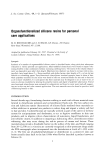
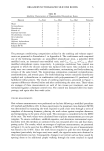
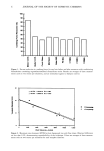
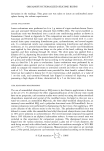
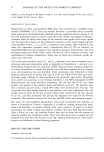
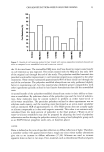
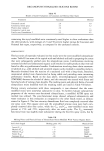
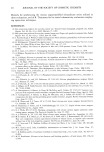
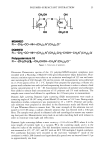
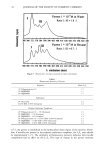
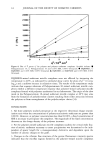
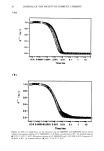
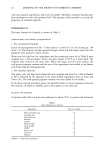
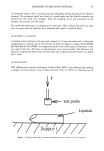
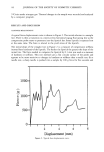
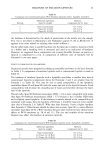
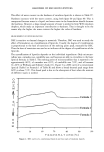
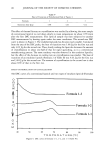
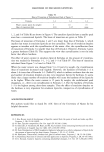
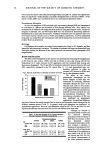
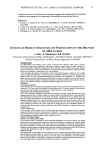
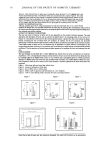
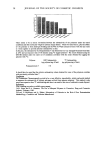
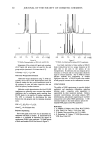
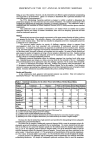
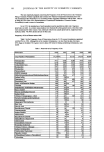
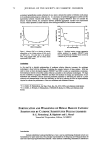
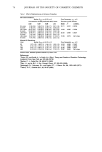
32 JOURNAL OF THE SOCIETY OF COSMETIC CHEMISTS 360 366 372 378 384 390 396 402 408 414 420 426 432 438 •.•.• 450 /III Pyrene 1 * 10 -7 M in Hexane ß : = .7:1 _ • [ [ • ' [ I I I I I I I I 360 366 372 378 384 390 396 402 408 414 420 426 432 438 •.•.• 450 emission (nm) Figure 7. Fluorescence intensity ooe pyrene in water and hexane. Table I Fluorescence Intensity of Pyrene Polymers Ratio Ix/I 3 1% Polyquaternium 10 1.7 1% MQNNED 1.7 1% DQNNED 1.7 Surfactants 1% Octoxynol 1.2 0.10% SDS, 0.90% Octoxynol 1.2 Polymer-Suroeactant Complexes 1% Polyquaternium 10 + 1% Octoxynol 1% MQNNED + 1% Octoxynol 1% DQNNED + 1% Octoxynol 1% Polyquaternium 10 + 0.10% SDS, 0.90% Octoxynol 1% MQNNED + 0.10% SDS, 0.90% Octoxynol 1% DQNNED + 0.10% SDS, 0.90% Octoxynol 1.3 1.3 1.3 1.3 1.3 1.3 0.7:1, the pyrene is solubilized in the hydrocarbon chain region of the micelies. There- fore, if micelies are present in the polymer-surfactant complexes, the I•/I 3 ratio should be approximately 1.2:1. The similarity in fluorescence intensity indicates that micelie composition has no effect on the I•/I 3. This type of change in the pyrene emission

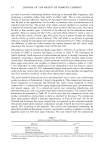
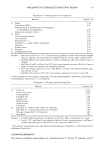
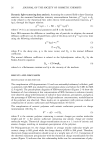
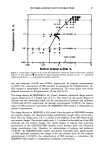
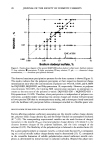
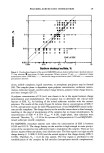
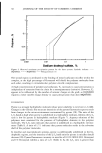
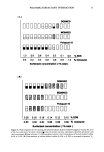
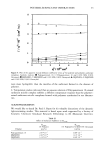
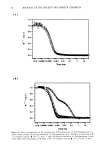
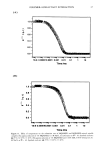
POLYMER-SURFACTANT INTERACTION 33 spectrum has been well documented (28-30) and has been connected to the formation of micelie clusters in both the absence (28,30) and presence of polymer (31-33). Changes in pyrene fluorescence indicate that micelies are present in the polymer sur- factant complexes (Table I). The I•/I 3 ratio of 1.3:1 is approximately the same as that of pyrene solubilized in free micelies. The similar values of I•/I 3 for both surfactant and polymer-surfactant complex solutions indicate that the polymer-bound surfactant clus- ters and normal micelies have almost equal polarity (29,34). However, pyrene solubi- lized in the polymer-surfactant complexes experiences a slightly more hydrophilic en- vironment than in micelies alone, which is consistent with the concept of smaller micelies being bound along the polymer strand (31). For smaller micelies, one would expect the water penetration to be greater so that the pyrene would encounter more of the polar palisade layer of the micelie and the water associated with this layer (31). DYNAMIC LIGHT SCATTERING Cumulant analysis. For experiments at 25 øC, the correlation functions were nearly mono- exponential at all angles for the Polyquaternium 10 polymer the MQNNED and DQNNED polymers showing appreciable nonexponential character at low angles. The polymer-mixed surfactant micelie complexes exhibited more complex correlation func- tions with "tails" and "plateaus." In all cases, a fourth-order polynomial fit to the correlation functions was applied to extract I •, the decay rate, which for the purposes of this paper corresponds to the main diffusive mode. The average decay rate increases linearly with q2 for purely translational diffusion. Deviations from linearity usually signal the presence of polydispersity and/or rotational motion. Figure 8 shows the dependence of I • on q2 for each polymer and polymer-mixed surfactant micelie complex. At a polymer concentration of 1 g/dL, I • scaled linearly with q2 at all angles for the Polyquaternium 10 polymer, but an upward curvature was evident at high q for the MQNNED and DQNNED polymers. This effect was probably due to polydispersity. At high angles, the scattering form factor drops off for large molecules, leaving the small molecules to dominate the scattering intensity and thus produce a positive sloping effect in the plot. After addition of 0.10% SDS/0.90% Octoxynol, the Polyquaternium 10- mixed surfactant micelie complex formed was uniform, as judged from the linearity of the plot. The data were replotted in Figure 9 to show the dependence of I•/q 2 on q2. Table II displays values of Dm,app, the apparent mutual diffusion coefficient, obtained from the intercepts of plots in Figure 9. The value of Dm,ap p increased after addition of the surfactant for both the Polyquaternium 10 and DQNNED polymers, the effect being more evident for the Polyquaternium 10-mixed surfactant micelie complex. The be- havior of the MQNNED-mixed surfactant micelie complex was perplexing, as the value of Dm,ap p decreased by a factor of 2 after addition of surfactant, implying an increase in the overall dimensions of the polymer-mixed surfactant micelie complex. Temperature dependence, The effect of temperature on the relaxation time of the polymers and the polymer-mixed surfactant micelie complexes was studied in the temperature range 25•40øC (Figures 10-12). The relaxation time of aqueous solutions of the poly- mers was not affected by temperature. However, the relaxation time of aqueous solutions of Polyquaternium 10-mixed surfactant micelie complexes was affected when the tem- perature was increased to 40øC. This phenomenon was indicated by both a bimodal decay curve in plots of normalized g(•) (t) versus 1og•o t and change in the solution from clear to turbid. The relaxation times of aqueous solutions of both MQNNED and
Purchased for the exclusive use of nofirst nolast (unknown)
From: SCC Media Library & Resource Center (library.scconline.org)