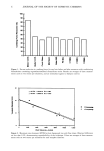
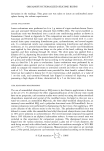
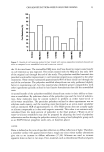
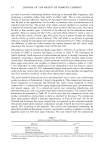
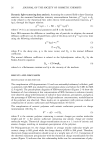
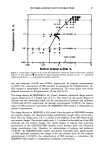
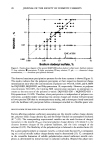
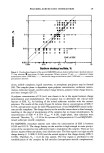
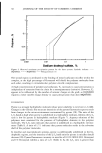
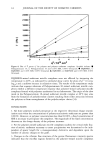
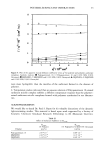
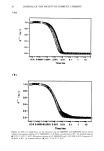
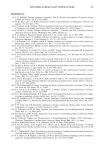
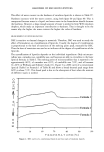
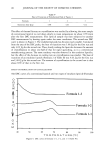
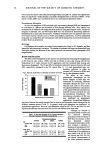
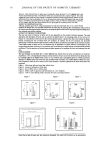
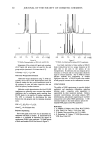
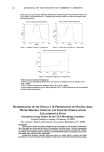
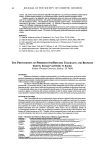
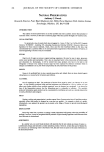
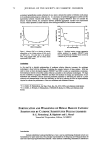
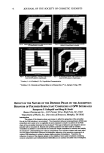
62 JOURNAL OF THE SOCIETY OF COSMETIC CHEMISTS Measurements made under different deformation conditions probe the structural nature of each region of material behavior. Changing the thermal profile can affect theological and thermal properties. 50% by wt. Aqueous Alcohol Ethoxylate Solution1 104 I '• lO.7 10 .2 15.0 --• .... __. , . 25.0 350 450 55 0 Temp ['CI Figure 1 - Complex Viscosity vs. Temperature 50% by wt Aqu•s Alcohol Ethoxylate Sot•fio• 10 s A lo • • 150 250 :•50 450 55.0 Temp [øC[ Figure 2 - Storage and Loss Moduli vs. Temperature 50% by w[ AqueOus Alcohol Ethoxylate Solution 002 o Ol }Go.0 -o 01 •_•• -o.o2 15.o 25.0 35 o 45 o 55.0 Temp ['C] Figure 3 - Temperature Differential vs. Temperature References and Acknowledgments 1. Dennis Laba, Rheological Properties of Comnetics a•d Toiletries, Marcel Dekker, New York, c 1993. 2. Th. F. Tadros, Surfactants, Academic Press, New York, c 1984. A specifil acknowledgment goes to Rhyta Rounds, Ph.D., of Fluid Dynamics, for the material and invaluable discussions. DETERMINATION OF THE EFFICACY OF PRESERVATION OF NON-EYE AREA WATER MISCIBLE COSMETIC AND TOILETRY FORMULATIONS: COLLABORATIVE STUDY Presented by George Fischler I for the CTFA Microbiology Committee 2 •Colgate-Palmolive Company, Piscataway, NJ 08855 •The Cosmetic, Toiletry and Fragrance Association, Washington, D.C. 20036 Introduction Water miscible cosmetic and toiletry formulations may be susceptible to microbiological contamination due to their high water content and the nature of the ingredients which they contain. Microbial contamination of a formulation may result in off odor, separation of emulsions, and the production of undesirable metabolic by-products. fithe organisms which are growing in the contaminated formulation are pathogens, they may also pose a health risk to the u•oxs of these formulations. Antimierobial chemicals, commonly called preservatives, are usually added to cosmetic and toiletry formulations to prevent the growth of microorganisms which may be inadvertently introduced during making,

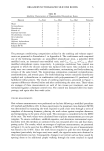
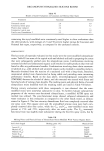
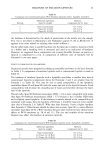
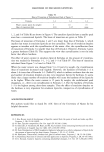
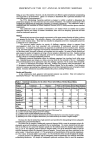
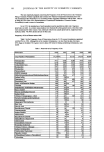
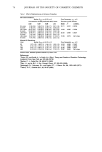
PREPRINTS OF THE 1997 ANNUAL SCIENTIFIC SEMINAR 63 filling or use of the material. However, not all preservatives are effective against all potential contaminating microorganisms in all formulations. Hence it is necessary to demonstrate that a particular formulation will control the growth of microorganisms.•a The CTFA Microbiology Committee undertook a program to validate a method to demonstrate the preservative adequacy of a water based non-eye area cosmetic formulation. The method is based on the CTFA Guideline for Determining the Preservative Adequacy in Cosmetic Formulations. 4 The eollaborative study is conducted under the Association of Official Analytical Chemists (AOAC), which prescribes rigorous statistical requirements. This eollaborative study is intended to demonstrate a new method which can reliably and accurately distinguish between two classes of cosmetic formulations, those which are adequately preserved and those which are inadequately preserved. Method Preserved and unpreserved test samples representative of the most common formulas of toiletry products were prepared for this study. They included a shampoo, a hair conditioner, a water in oil emulsion lotion and an oil in water emulsion lotion. These had been classified as adequately preserved or inadequately preserved, as defmed by U.S.P. XXII criteria. s The proposed method employs ten species of challenge organisms, chosen to represent those microorganisms which have been associated with contamination of inadequately preserved eosineric formulations. To simplify test performance, the organisms are combined into four inoeulum pools. Bacteria, yeasts, and molds typical of organisms recovered from contaminated cosmetic and toiletry products are grown on laboratory media, harvested, calibrated, and inoculated into test samples. By means of serial dilutions and plate counts, the number of organisms surviving in the test samples is determined over time. Samples meeting the specified criteria are considered adequately preserved for manufacture and consumer use. Samples not meeting criteria are considered inadequately preserved. Adequately preserved formulations reduce the challenge organisms from inoeulum levels within seven days. Microbial counts must remain at or below seven day levels for the remainder of the test. Inadequately preserved formulations fail to significantly reduce the challenge organisms over the course of the test period. A total of 19 laboratories participated in this study. Products were prepared, coded, and distributed. All 19 laboratories conducted the proposed Preservative Efficacy Method Test on the samples. Each laboratory received 24 samples representing three adequately preserved and three inadequately preserved samples of each preduct. Seventeen laboratories successfully completed the protocol, yielding 408 data points. Results and Discussion In the collaborative study, agreement with expected outcomes was excellent. Data were analyzed as described by McClure 6. The results are summarized in Table I. •able 1. Statistical Calculations for the AOAC Preservative Efficacy Method Round Robin Product Conditioner Shampoo Water in Oil Emulsion I Oil in Water Emulsion Preservation ½') Adequate Inadequate Adequate Inadequate Adequate Inadequate Adequate Inadequate Positive 48 0 49 0 51 I 51 C Samples cø) Negative 3 51 2 51 0 50 0 51 Samples • Sensitivity (a) 0.941 n/a 0.961 n/a I n/a 1] n/• Specfficit• ') n/a I n/a I n/a 0.98 n/a l Standard error 0.033 0 0.027 0 0.0196 0 0 C of mean 95% 0.882 I 0.912 I I 0.946 I l Confidence (a) As determined by the USP XX]II Antimicrobial Preservative Effectiveness Test. (b) A positive sample exhibits adequate preservative efficacy. (e) A negative sample exhibits inadequate preservative efficacy. (d) Sensitivity is the number ooeposifives determined by the method divided by the total number ofpositive samples. (e) Specificity is the number of negatives determined by the method divided by the number ooenegative samples. The data show that the method has a high sensitivity and specificity for distinguishing between adequately and inadequately preserved formulations. The results from all samples of inadequately preserved shampoo failed to meet the acceptance criteria for adequately preserved formulations as specified by the test methodology. The results obtained from forty-nine (49) of the fifty-one (51) preserved shampoo samples met the method criteria for adequacy of preservation. One (1) out of the triplicate preserved shampoo samples tested in two of the laboratories failed to meet the specified acceptance criteria for adequately preserved samples. Several factors may have contributed to the outlier results. Critical factors include: (1) The preparation and standardization of the inoeulum suspensions. (2) The volume ofinoeula added to each sample. (3) The distribution of the inoeula throughout the sample. Triplicate samples of an adequately and an inadequately preserved conditioner were tested by each of the collaborating laboratories. All samples of inadequately preserved conditioner failed to meet the acceptance
Purchased for the exclusive use of nofirst nolast (unknown)
From: SCC Media Library & Resource Center (library.scconline.org)