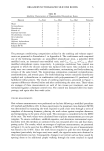
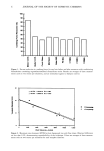
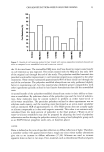
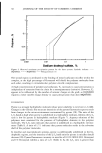
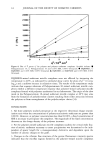
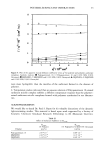
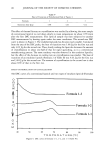
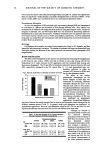
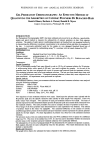
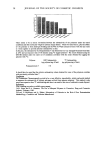
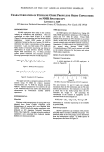
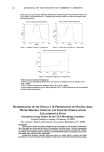
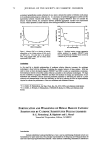
72 JOURNAL OF THE SOCIETY OF COSMETIC CHEMISTS n-tetradecyl poly(ethylene oxide) surfactants (C•4Ej, where j denotes the number of ethylene oxide groups in the surfactant polar group) as a function ofj. As j increases, the predicted aggregation numbers and the experimental solution viscosity both decrease. Although program PREDICT does not calculate the solution viscosity directly, the correlation between predicted aggregation numbers and experimental viscosity values represents a useful indicator of the rheological behavior of the miceliar solution. 10 Mixture Composition 2,000 200 ,. 1,000 õ 2oo •' 50 206 7 8 9 I I 12 No. of EO Groups (}) 100 50 • 20 • Figure l. Mixture CMC as a function of mixture composition, ct, for a binary mixture of CaEn (ct=0) and SDS (ct=l). The solid line is the predicted CMC using program MIX, and the circles denote experimental CMC values. Figure 2. Predicted number average aggregation number predicted by program PREDICT (solid line), and experimental viscosity values (circles) as a function ofj for C•nEj surfactants. Conclusions As the need for a detailed understanding of surfactant solution behavior increases, the surfactant technologist is faced with the challenge of modeling the complex behavior of these systems. With this need in mind, we have developed programs PREDICT and MIX to make our comprehensive molecular- thermodynamic theories of miceliar solution behavior accessible to the surfactant teclmologist. We hope that the availability of programs PREDICT and MIX will facilitate the design and optimization of new surfactants and surfactant mixtures possessing desirable properties by alleviating the need for a priori synthesis and characterization of the new chemicals, as well as by reducing the level of experimentation required to evaluate the performance of the new surfactants and surfactant mixtures. • N.J. Zoeller, D. Blankschtein, Ind Eng. Chem. Res., 34, 4150 (1995), and references cited therein. 2 N.J. Zoeller, A. Shiloach, D. Blankschtein, CHEMTECH, 26 (3), 24 (1996), and references cited FORTIFICATION AND WEAKENING OF HUMAN HAIR BY CATIONIC SUBSTITUTED BY CATIONIC SUBSTITUTED POLYSACCHARIDES D. E. Firstenberg •, R. Rigoletto • and L. MoraP •Amerchol Corporation, Edison, NJ 08818 Introduction Cationic substituted polysaccharides have been used as conditioning chemicals in hair care formulations for quite some time. The principal representatives of this group are Polyquaternium-10 and Guar Hydroxypropyltrimonium Chloride. These cationic conditioning chemicals are substantive

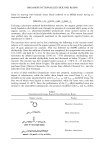
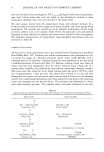
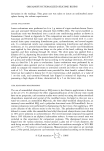
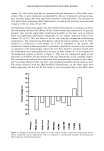
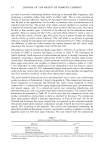
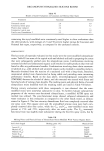
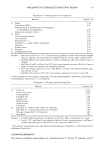
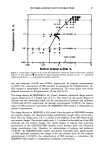
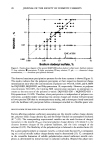
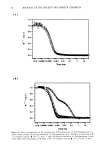
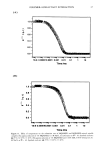
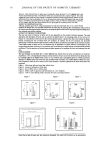
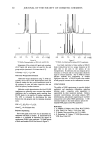
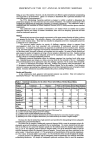
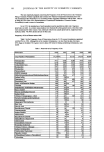
PREPRINTS OF THE 1997 ANNUAL SCIENTIFIC SEMINAR 73 to hair through electrostatic attraction. Previous studies with Polyquaternium-10 have shown that the rate and amount of polymer sorption are inversely related to the molecular weight of the polymer on anionic surfaces (Faucher and Goddardt). Hair fibers are cellular in structure. The structure is comprised of a central medulla, which may or may not be present, a cortex which is comprised of spindle shaped cells which are tightly packed together with an intraceilular matrix and the cuticle. The cuticle is comprised of curved flattened cells which surround the cortex and have an overlapping roofing shingle-like appearance (Robbins2). The tensile strength of the hair fiber has been attributed singularly to cortical proteins and their structure with no contribution of the cuticle (Robbins2). Methods and Materials Tresses of virgin brown human hair (DeMeo Brothers, Inc.) were used for all tests described in this paper. Tresses were washed with a nonionic surfactant (Pareth-15-9) prior to treatment with either aqueous solutions or simple shampoos containing polysaccharides. The tresses were subjected to treatment with either aqueous solutions of cationic polysaccharides or simple •hampoos containing cationic polysaccharides. The cationic polysaccharides tested included Polyquaternium-10 and Guar hydroxypropyitrimonium chloride. Control treatments consisted of deionized water, a simple anionic shampoo without polymer or a hydroxyethylceilulose solution. When using the aqueous solutions, all test tresses were shampooed with nonionic surfactant, rinsed thoroughly and immersed in the test solution. After rinsing, the tresses were combed and allowed to air dry. Individual hairs were selected randomly and subjected to lnstron tensile strength analysis. When using the simple shampoos, all test tresses were shampooed with nonionic surfactant, rinsed thoroughly and then shampooed with the test shampoo. After rinsing, the tresses were combed and allowed to air dry. Individual hairs were selected randomly and subjected to lnstron tensile strength analysis. Results and Discussion Treatment of virgin brown hair with cationic ceilulosic polymers had significant effects on the tensile strength (Fig. 1) and Young's modulus of the hair (Fig. 2). Statistical analyses utilizing ANOVA indicate a significant fortification of hair by Polyquaternium-10. The degree of fortification by Polyquaternium-10 ranged from 13.1% to greater than 55 % (Fig. 3) and was inversely proportional to the molecular weight of the molecule (Fig. 4). The effect varied linearly with respect to molecular weight over the range of molecular weights tested (100,000 to 900,000 Daltons). The level of cationic charge had no apparent effect on the degree of fortification over the range tested but cationic charge was necessary for fortification to occur. Treatment with Guar hydroxypropyitrimonium chloride under the same conditions caused a 33.$% reduction of the observed tensile strength. Hair tresses treated with low molecular weight Polyquaterniumo10 had twice the tensile strength of those treated with Guar hydroxypropyi- trimonium chloride. The proposed mechanisms for fortification and weakening are cortical protein interaction. The proposed mechanism of weakening is plasticizing of the cortical matrix. This plasticization would occur by the cationic nitrogen moieties of the guar binding to the cortical proteins through electrostatic bonds. The presence of this large molecule could cause additional spacing between cortical protein molecules which results in reduction of the intramolecular hydrogen bonding. The reduction of hydrogen bonds could be caused by increasing the distance between cortical protein molecules beyond the maximum distance necessary for effective hydrogen bonding. Alternatively, hydrogen bonding could be decreased by steric interference. Essentially, this mechanism of tensile strength reduction is a net reduction of hydrogen bonding. Fortification may be accomplished by creating additional intermolecular and intramolecular electrostatic bonds in the cortical proteins with additional strengthening created by the formation of intermolecular and intramolecular hydrogen bonds between the cortical proteins and the ethoxylate chain of the Polyquaternium-10 molecule. This increases tensile strength through a net gain in hydrogen bonding and cross-linking.
Purchased for the exclusive use of nofirst nolast (unknown)
From: SCC Media Library & Resource Center (library.scconline.org)