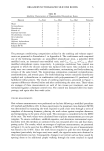
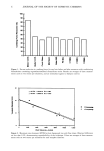
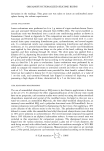
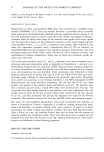
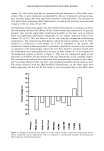
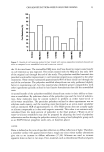
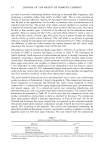
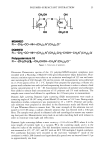
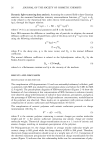
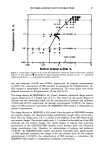
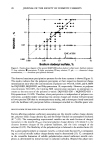
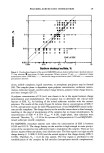
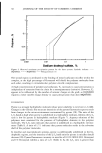
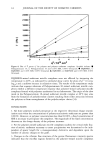
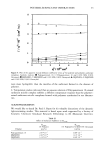
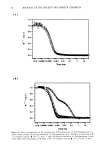
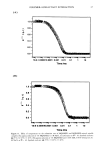
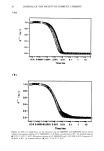
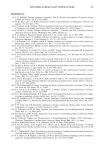
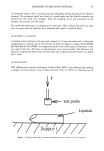
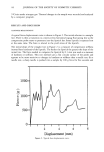
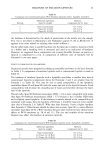
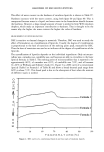
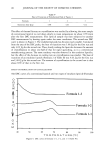
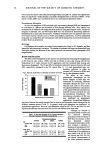
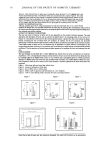
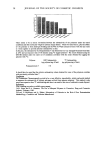
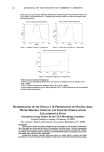
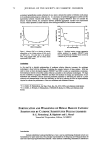
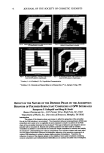
74 JOURNAL OF THE SOCIETY OF COSMETIC CHEMISTS Fiinlrel. Tensile strenlth of Ylriin brown heir treated with 0.5% polymer in n simple SilOBIped •1 treatment • 01%( 'h MOIH I I h •s I rt • I Mt % I ß DEi - IREAIMI%I F•gure2. ¾ounl'a modulns of viriin brown hair treated with O.S% polymer in o altopie shampoo •- treatment IS,( RF •S1%( • MOI !('l I •R•L'I( 111 FiBure 3. The :-dative ,trenk, thefiin I or weakening of virsin brown hair Figure 4. The :-elationship of molecular weight to tensile strenL, th in hair treated with 0,5% polymer in I Iblal•e shampoo. treated with 0,5% pol•lner in a simple shampoo. i Faucher, J. A. & Goddard, E. D. Unpublished Communication 2 Robbins, C.IL Chemical and Physical Behavior of Human Hair, 3 ra ed., Springer-Verlag, 1994 EFFECT OF THE NATURE OF THE DISPERSE PHASE ON THE ADSORPTION BEHAVIOR OF POLYMER-SURFACTANT COMPLEXES AT O/W INTERFACES Rampurna P. Gullapalli' and Bhogi B. Sheth 2 •Banner Pharmacaps Inc., 4125 Premier Drive, High Point, NC 27265 2Department of Pharm. Sci., University of Tennessee, Memphis, TN 38163 Introduction The nature of the disperse phase was known to affect the properties of the emulsifier film at the O/W interface in an emulsion 1. The interactions between polyoxyethylene (POE) type emulsifiers and a polar oil or a vegetable oil were proposed to result in a portion of the POF = chain of the emulsifier immersed in the oil phase 2. This type of behavior was thought to be not possible with a non-polar oil. Natural and synthetic polymers are often used as auxiliary emulsifiers in addition to conventional low molecular weight emulsifiers to enhance the stability of emulsions a. Understanding how various components in an emulsion interact with each other and how these interactions influence the adsorption behavior of the emulsion components at various Ofi/V interfaces is critical to design stable emulsion formulations. Therefore, the influence of nature of the disperse phase on the stability of oil-in-water emulsions containing nonionic emulsifiers and methylcellulose 4000 (MC) as an auxiliary emulsifier was investigated.

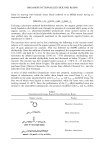
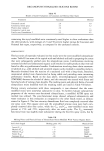
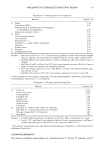
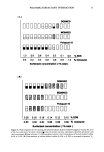
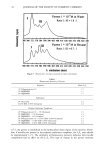
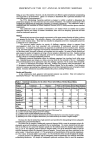
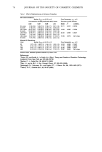
PREPRINTS OF THE 1997 ANNUAL SCIENTIFIC SEMINAR 75 Methods One stable and three unstable base emulsions each of olive oil and of mineral oil were formulated with an emulsifier blend of polysorbate and sorbitan fatty acid ester. The stable emulsion (SE) contained 2% emulsifier blend optimized for maximum stability. Three unstable emulsions were formulated from the SE formulation: one with 0.5% emulsifier blend as of the SE formulation (UE1), one with excessive polysorbate (UE2) and one with excessive sorbitan ester (UE3). A series of emulsions was prepared containing increasing amounts of MC for each base emulsion. Stability of emulsions was evaluated on the basis of creaming and change in particle size distribution of the disperse phase with time for six months. Flow properties were evaluated by measuring rheograms using a Ferranti-Shirley cone and plate viscometer at 25 øC. Results and Discussion Flow curves of emulsions and MC solutions were pseudoplastic at MC concentrations more than 0.29%. Olive oil emulsions were more viscous overall than the corresponding mineral oil emulsions. The slopes of the linear relationship between the Structure Equation 4 viscosity parameter, qoo of emulsions and of the external phase were determined and compared among the four types of emulsions for each disperse phase using the regression analysis. The increase in qoo value of emulsions with increase in MC concentration was significantly larger with a higher polysorbate concentration in the emulsions, suggesting an interaction between MC and polysorbate. Olive oil UE2 emulsions showed higher qoo values than the corresponding mineral oil emulsions though both the formulations had a similar polysorbate concentration. The analysis of particle size and flow data suggests that factors other than the viscosity and the partic!e size of the disperse phase, and the interaction between MC and polysorbate, appear to be responsible for the higher qoo values of olive oil UE2 emulsions. The higher viscosity of olive oil UE2 emulsions than that of mineral oil UE2 emulsions is thought to be due to the formation of a thicker and stronger film by MC-polysorbate interaction complex at the olive oil-water interface. Substantial increase in emulsion viscosity due to the presence of a stronger and thicker interfacial film was also proposed by others 5. The addition of MC caused a proportional reduction in the particle size of mineral oil UE3 emulsions containing no polysorbate. However, the addition of MC did not have a similar size reduction effect on mineral oil SE, UE1 and UE2 emulsions. The SE formulation was destabilized on addition of MC, eventually leading to oil separation in emulsions with 1.18% or more of MC. The destabilization effect occurred in a shorter pedod of time and at a lower MC concentration of 0.88% in UE1 emulsions containing the same emulsifier system at a lower concentration. However, the addition of MC improved the stability of UE2 and UE3 emulsions. Thus, in mineral oil UE3 emulsions with no polysorbate, MC could act like a protective colloid and the multilayer interfacial barrier formed with MC and sorbitan ester was firm enough to prevent coalescence of oil droplets and improve the stability of these emulsions. In SE and UE1 emulsions with a lower polysorbate concentration, most of polysorbate might be in the form of MC-polysorbate complex. The complex might concentrate at the mineral oil-water interface in these systems dudng emulsification process. In such a case, the particle size of these emulsions with MC remained essentially the same as of the emulsions with no MC. However, due to the hydrophilic nature of the complex and the less interaction between the POE chain of polysorbate and the nonpolar mineral oil, the complex might be dislodged from the mineral oil-water interface with time. This results in rupture of interfacial film and subsequent destabilization of emulsions. In UE2 emulsion with a higher polysorbate concentration, some of excessive polysorbate might complex with MC leaving most of polysorbate in free form. The more interfacially active free polysorbate could compete with less active MC-polysorbate complex at the O/W interface. Polysorbate would be retained at the interface, without affecting the stability of these emulsions. The addition of MC caused a significant reduction and narrowing of the particle size distributions of all base olive oil emulsions. The extent of particle size reduction with MC was higher in emulsions with a higher polysorbate concentration (UE2SEUE3). The concentration of polysorbate in UE2 formulation (1.52%) was higher than that of the SE formulation (0.8%) and the UE3 formulation (0.3%) and also could be the extent of association of MC with polysorbate in these emulsions. This suggests that MC-polysorbate complex could also act as an emulsifier at the olive oil-water interface in addition to the free emulsifiers. The stability of all four base olive oil emulsions improved with increasing MC concentration in the external phase. No oil separation was found in any emulsion stored at room temperature for more than six months. Thus, the MC-polysorbate complex when present at the olive oil-water interface would stabilize emulsions. This effect was thought to be due to higher interaction between the olive oil and the POE chain of polysorbate.
Purchased for the exclusive use of nofirst nolast (unknown)
From: SCC Media Library & Resource Center (library.scconline.org)