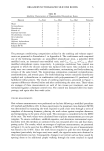
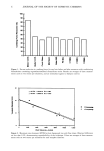
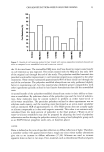
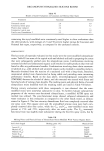
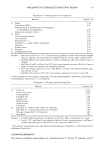
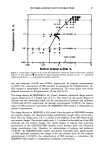
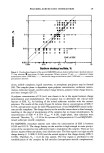
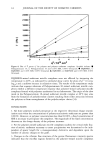
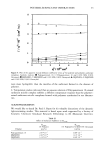
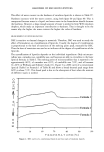
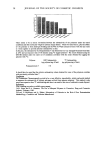
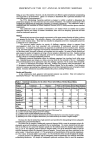
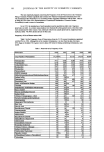
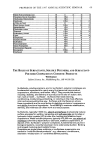
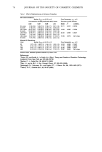
POLYMER-SURFACTANT INTERACTION 35 , • I ,•1 0 I o 1 2 I I I , 4 5 6 q2 1 10 •ø cni 2 Figure 9. Plot of the apparent mutual diffusion coefficient versus q2 for polymer and polymer-surfactant complexes. Symbols indicate: ß Polyquaternium 10 [] Polyquaternium 10 and 0.10% SDS, 0.90% Octoxynol ß MQNNED ¸ MQNNED and 0.10% SDS, 0.90% Octoxynol ß DQNNED /• DQNNED and 0.10% SDS, 0.90% Octoxynol. were more hydrophilic than the micelies of the surfactant formed in the absence of polymer. 4. Temperature studies indicated that an aqueous solution of Polyquaternium 1 O-mixed surfactant micelie complex exhibits a different temperature response than the polymer- mixed surfactant micelie complexes formed with polymers synthesized in our laborato- ries. ACKNOWLEDGMENTS We would like to thank Dr. Paul S. Russo for his valuable discussions of the dynamic light-scattering studies. This material is based upon work supported by a Society of Cosmetic Chemists' Graduate Research Fellowship to M. Manuszak Guerrini. Table II Effect of Surfactant Addition on Dm,ap p Polymer Dm,app 1% Polymer (cm2/s) Dm ,app 1% Polymer/0.1% SDS/0.9% Octoxynol (cm'/s) Polyquaternium 10 MQNNED DQNNED 2.97* 10 -7 2.61' 10 -8 3.13' 10 -8 3.98* 10 -7 1.13' 10 -8 3.94* 10 -8

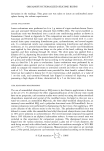
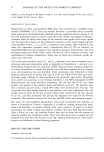
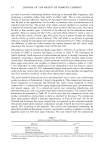
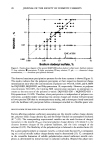
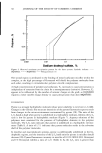
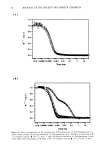
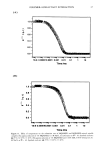
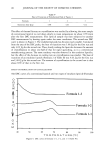
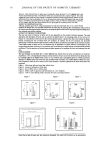
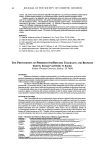
36 JOURNAL OF THE SOCIETY OF COSMETIC CHEMISTS (A) 1.2 1.0 • 0.8 0.6 0.4 0.2 0.0 1E-6 0.(}0001 0.0001 0.(}01 0.01 0.1 Time/ms I lO (B) 1.0 0.8 0.8 0.4 0.2 0.0 1E-6 0.00001 0.0001 0.001 0.01 0.1 I 10 Time/ms Figure 10. Effect of temperature on the relaxation rate of Polyquaternium 10 and Polyquaternium 10- mixed micelie complex: (A) aqueous solution of 1% Polyquaternium 10, 0.1 M NaC1, no surfactants at •) = 30. Symbols indicate: ß 25øC [] 30øC O 40øC. (B) aqueous solution of 1% Polyquaternium 10 and 0.10% SDS, 0.90% Octoxynol, 0.1 M NaC1, at •) = 30. Symbols indicate: ß 25øC [] 30øC O 40øC.
Purchased for the exclusive use of nofirst nolast (unknown)
From: SCC Media Library & Resource Center (library.scconline.org)