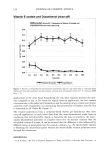
148 JOURNAL OF COSMETIC SCIENCE of the skin, e.g., use in skin hydration or on the barrier properties of the stratum corneum. Most of these ingredients will work only if they penetrate into the stratum corneum or the deeper layers of the epidermis. The extent and rate of penetration of an active ingredient from a topical formulation depends on its passive diffusion into the skin, which in principle obeys Fick's law of diffusion. This takes account of the con- centration of the active ingredient in the galenic vehicle, the mobility (diffusion con- stant) of the active ingredient molecule, and--in the form of the distribution coeffi- cient-the interaction of the active ingredient with the vehicle and the skin (overview in references 1 and 2). In practice, the application of this simple law is frequently difficult, because the composition of a topical formulation only rarely remains constant during the course of application volatile components vaporize, water evaporates (3-5), and the mobility and the distribution coefficient of the active ingredient change as a function of its concentration and of the viscosity and phase behavior of the galenic vehicle. Moreover, the penetration properties of a formulation are also dependent on the inter- action of the vehicle with the skin (2,6). The application of the emulsion can cause an occlusive effect, under which the hydration of the horny layer increases, resulting in increased penetration. Certain components of the formulation may accumulate in the outermost skin layer, the actual diffusion barrier, thus accelerating penetration (2,7). Simple penetration models cannot take these different, mutually interacting effects into account, so that an optimal galenical can only be developed on the basis of experimental penetration studies. On ethical grounds, in vivo studies on humans and animals are only carried out on a limited scale, mainly in connection with dermatics (8). The isolated perfused bovine udder skin (BUS) model is a good substitute for in vivo tests on humans (9). As a living skin model it takes also into account metabolic processes in the skin, so that it can be used to study both skin penetration and skin irritation by cosmetic formulations (10,11). Due to the different rheology of the emulsions under living conditions (physiological surface temperature, physiological TEWL) and the expected identical substantivity (same components as far as possible), it was intended to compare the emulsions under the conditions of infinite dose, i.e., more than 10 or 20 mg/cm 2. The high dosage prevents any depletion of vitamin concentration in the vehicle during the penetration experiment. Furthermore, the study design allows a comparison with the results of the testing of certain types of ointments and dermatics using this in vitro model (9). Based on an extensive investigation of the influence of emulsion type and structure on vitamin penetration into the skin (10), the objective of this work was to study the kinetics of the penetration of oil- and water-soluble vitamins such as vitamin E, vitamin E acetate, and D-panthenol. An emulsion of the water-in-oil (w/o) type and a lamellar oil-in-water (o/w) emulsion were chosen as leave-on products since they showed big differences in phase behavior and penetration properties (10). At an extreme, the short- term penetration from a surfactant-based shower gel is investigated under rinse-off conditions. MATERIALS AND METHODS CHEMICALS The galenic formulations selected for the penetration studies (Table I) exhibit basic

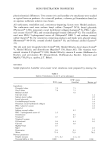
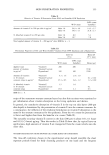
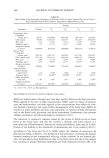
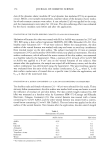
SKIN PENETRATION PROPERTIES 149 physicochemical differences. Two creams (w/o and lameliar o/w emulsions) were studied as typical leave-on products. As a rinse-off product, a shower gel formulation based on an aqueous surfactant solution was chosen. All surfactants, emulsifiers and, consistency-imparting factors were Henkel products. The surfactants used were sodium lauryl sulfate (Texapon © N70), lauryl glucoside (Plantacare © 1200), potassium cocoyl hydrolyzed collagen (Lamepon © S), PEG-7 glyc- eryl cocoate (Cetiol © HE), and cocoamidopropyl betaine (Dehyton © K). The emulsifiers used were PEG-7 hydrogenated castor oil (Dehymuls © HRE 7) and sodium cetearyl sulfate (Lanette © E) the consistency-imparting products and iipids were glyceryl oleate (Monomuls © 90-O-18), cetearyl alcohol (Lanette © O), and behenyl alcohol (Lanette © 22). The oils used were dicaprylyl ether (Cetiol © OE, Henkel KGaA), decyl oleate (Cetiol © V, Henkel KGaA), and dimethicone (Bayslion © 350, Bayer AG). The vitamins were natural vitamin E (Copherol © F1300, Henkel KGaA), vitamin E acetate (Hoffmann-La Roche), and provitamin B5 (D-panthenol, Hoffmann-La Roche). Glycerol and MgSO4*7H20 (p.a. quality, J.T. Baker). METHODS Sample preparation. Lameliar oil-in-water (o/w) emulsions were prepared by mixing the Table I Galenic Formulations (in wt.% active substance) O/W cream W/O cream (lameliar) Shower gel Ingredients Dicaprylyl ether 7.0 7.5 Decyl oleate 7.0 7.5 Behenyl alcohol 7.0 Glyceryl oleate 1.2 Sodium lauryl sulfate 9.5 Lauryl glucoside 5.4 Cocoamidopropyl betaine 1.0 Potassium cocoyl hydrolyzed collagen 1.0 PEG-7 glyceryl cocoate 1.0 Laureth-2 0.5 Sodium cetearyl sulfate 0.2 PEG-7 hydrogenated castor oil 3.5 Dimethicone 0.5 Vitamin E 0.7 0.7 Vitamin E acetate 0.1 D-Panthenol 0.4 0.4 0.2 Glycerol 5.0 5.0 MgSO4*H20 0.7 NaC1 0.5 Preservative 0.3 0.3 1.4 Water 75.4 71.9 78.2 Physical parameters Droplet size/pm 0.7 _+ 0.2 2.4 _+ 2.2 Viscosity/mPas at 30/s 1000 1000 1160
Purchased for the exclusive use of nofirst nolast (unknown)
From: SCC Media Library & Resource Center (library.scconline.org)