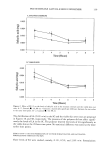
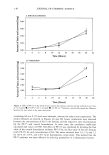
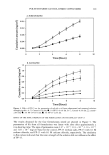
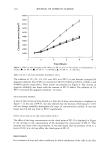
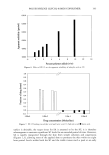
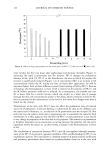
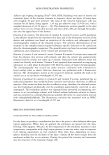
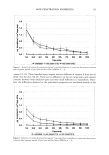
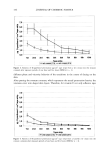
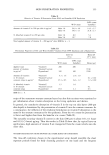
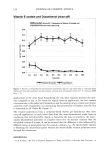
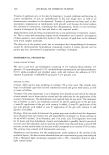
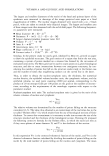
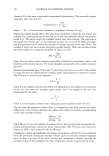
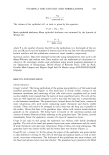
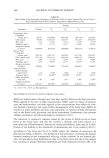
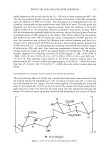
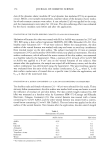
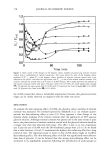
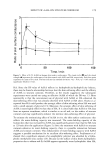
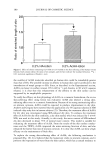
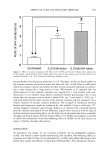
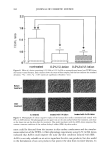
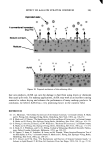
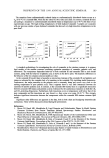
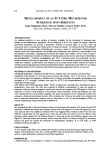
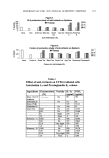
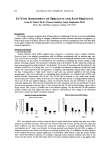
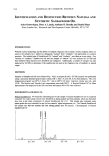
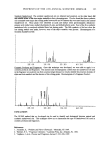
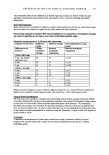
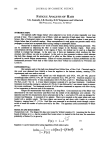
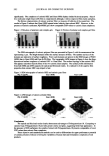
152 JOURNAL OF COSMETIC SCIENCE Directly after application, the lameliar cream contains 70% water and has a moderate viscosity of about 1000 mPas (Table I). When water evaporates, the lameliar layers are packed together more densely, leading to an appreciable viscosity increase (about 7,000 mPas). When the water content becomes less than about 15%, the amount of water is insufficient to allow o/w-emulsions to be formed any longer, and w/o-emulsions are formed (10). The situation is different with the w/o-cream. Here the oil is the outer phase and the viscosity rises exponentially by increasing the proportion of the inner water phase (10). During drying, therefore, the viscosity of the w/o-cream decreases below 10 mPas, in contrast to the o/w-emulsion. For the shower gel, the phase behavior will not change during the short application period. The surfactant product is washed away with a surplus of water after only two minutes. Therefore, phase changes caused by water loss will not take place under rinse-off conditions. KINETICS OF VITAMIN PENETRATION INTO THE SKIN UNDER LEAVE-ON CONDITIONS After application on the skin, an active ingredient begins to diffuse out of the galenic vehicle into the top layers of the skin. If, for purposes of simplification, it is assumed that the horny layer is a homogeneous diffusion barrier, then, according to Fick's law (Equa- tion 1), the penetration rate after a steady state has been reached depends only on the mobility of the active-ingredient molecule, given by the diffusion constant D, the coefficient of distribution K of the active ingredient between the vehicle and the stratum corneum layer, and the concentration c of the active ingredient (1,2). Penetration rate J = K/d ß D * c (Eq. 1) where d is the thickness of the horny layer, D is the diffusion constant, c is the concentration, and K is the distribution coefficient. Figures 1 to 4 show the penetration profiles of vitamin E and D-panthenol into the stratum corneum from w/o and o/w creams. The amount of naturally occurring vitamin E in the skin is several orders of magnitude smaller than the amount absorbed after topical application of the creams. For the oil-soluble vitamin E, a steep concentration gradient over the stratum corneum is observed (Figures 1 and 2), which indicates that the stratum corneum is the main penetration barrier. In contrast to the lameliar o/w emulsion, for the w/o emulsion there is no difference in penetration between 1 hour and 5 hours. This means that a steady state is already reached for the vitamin E penetration from the w/o emulsion after 1 hour. In general, the penetration is faster and much higher from the w/o cream than from the lameliar o/w cream. The water soluble D-panthenol penetrates faster and in a higher amount into the stratum corneum compared to the oil-soluble vitamin E (Figure 3, 4). The concentration gradient is smaller than with vitamin E, indicating a low skin barrier capability against pen- etration. Again, absorbed amounts are much higher for the w/o than for the o/w emul- sion. The reason for the poor vitamin penetration from the o/w emulsion relative to the w/o cream is the lameliar gel network that is responsible for the viscosity buildup in this o/w

SKIN PENETRATION PROPERTIES ! 5 3 1,6 1,2 0,4 0,0 1st 2rid 3rd 4th 5th 6th 7th 8th 9th loth Tape strip -•- untreated --•-w/o cream (1 h) --•-w/o cream ($ h) Figure I. Kinetics of vitamin E penetration (pg/cm 2 tape strip) from a w/o cream into the stratum corneum after exposure periods of one hour and five hours (SEM for n = 4). cream (12--14). These lameliar layers impede the free diffusion of vitamin E from the oil phase into the skin (10,15). There are no differences in the oil components and vitamin contents between both emulsion types and only small differences in emulsifiers. There- fore, the differences observed in the penetration properties are attributed mainly to the 1,2 0,8 0,4 0,0 1st 2nd 3rd 4th 5th 6th 7th 8th 9th loth Tape strip -e-untreated -x- o/w cream (1 h) -•- o/w cream ($ h)l Figure 2. Kinetics of vitamin E penetration (pg/cm 2 tape strip) from a lameilar o/w cream into the stratum corneum after exposure periods of one hour and five hours (SEM for n = 4).
Purchased for the exclusive use of nofirst nolast (unknown)
From: SCC Media Library & Resource Center (library.scconline.org)