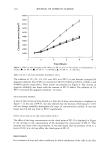
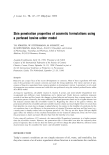
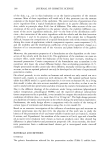
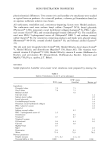
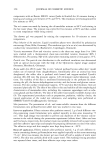
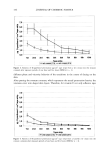
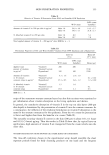
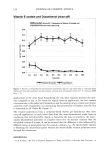
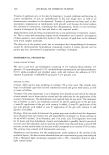
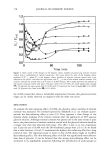
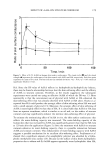
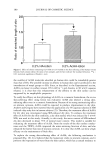
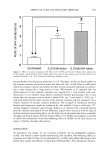
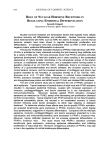
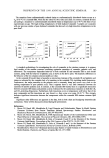
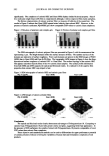
156 JOURNAL OF COSMETIC SCIENCE Vitamin E acetate and D-panthenol (rinse-off) BUS-model (rinse off): Penetration of Vitamin E Acetate and D-panthenol into the horny layer (n=4) 0,16 0,14 0,10 0,08 0,06 ........................................................................................ 0,04 I ...................... 0,02 0,001 , 1st 2rid 3rd 4th 5th 6th 7th 8th 9th 10th tape strip •Vitamin E acetate •D-panthenol 1 Figure 5. Kinetics of D-panthenol and vitamin E penetration (tlg/cm 2 tape strip) from a surfactant-based shower gel (rinse-off condition) into the stratum corneum after an exposure period of 3 * 2 minutes (SEM for n = 4). applications on the other hand. Considering the very short exposure periods (two min- utes compared to one or five hours for topical leave-on application), the low vitamin concentrations in the surfactant formulation, and the missing of any vitamin enrichment caused by water evaporation, it is astonishing that penetration of vitamins into the skin is achievable at all (Table III, Figure 5). The vitamin penetration from a surfactant-based shower gel formulation after three rinse-off applications is much lower than from the cream formulations under leave-on conditions, but still detectable. Again, as found for the leave-on products, the water- soluble D-panthenol penetrates to a higher extent into the stratum corneum than the oil-soluble vitamin E acetate. It can be assumed that the difference is also influenced by different routes of penetration into the stratum corneum, e.g., the lipid-soluble vitamin is following the intercellular spaces whereas the water-soluble vitamin penetrates more through the corneocytes. REFERENCES (1) K. B. Sloan, "The Use of Solubility Parameters of Drug and Vehicle to Describe Skin Transport," in

SKIN PENETRATION PROPERTIES 157 Topical Drug Delivery Formulations, D. W. Osborne and A. H. Areann, Eds. (Marcel Dekker, New York, 1990), pp. 245-270. (2) H. Schaefer and Th. E. Redelmeier, Skin Barrier: Principles of Percutaneous Absorption (Karger, Basel, 1996), pp. 87-117, 153-212. (3) S. E. Friberg and B. Langlois, Evaporation from emulsions. J. Di•2•. Sci. Tech., 13, 223-243 (1992). (4) B. Langlois and S. E. Friberg, Evaporation from a complex emulsion system,J. Soc. Cosmet. Chem., 44, 23-34 (1993). (5) S. E. Friberg, Amphiphilic associations structure and skin lotions, J. Disp. Sci. Tech., 15, 359-373 (1994). (6) W.J. Addicks, N. D. Weiner, R. L. Curl, and G. L. Flynn, "Drug Delivery From Topical Formula- tions: Theoretical Prediction and Experimental Assessment," in Topical Drug Delivery Formulations, D. W. Osborne and A. H. Areann, Eds. (Marcel Dekker, New York, 1990), pp. 221-244. (7) E.R. Cooper and D.C. Patel, "Practical Considerations for Topical Drug Formulations With and Without Enhancers," in Topical Drug Delivery Formulations, D. W. Osborne and A. H. Areann, Eds. (Marcel Dekker, New York, 1990), pp. 1-12. (8) L. K. Pershing and G. G. Krueger, "New Animal Models for Bioavailability Studies," in Pharmacology and the Skin, B. Shroot and H. Sch•tfer, Eds. (Karger, Basel, 1987), Vol. 1, pp. 57-69. (9) M. Kietzmann, W. L•Sscher, D. Arens, P. Maa•3, and D. Lubach, The isolated perfused bovine udder as an in vitro model of percutaneous drug absorption: Skin viability and percutaneous absorption of dexamethasone, benzoyl peroxide, and etofenamate, J. Pharmacol. Toxicol. Meth., 30, 75-84 (1993). (10) Th. F/3rster, B. Jackwerth, W. Pittermann, W. von Rybinski, and M. Schmitt, Properties of emul- sions-structure and skin penetration. Cosmet. Toiletr., 112, 73-82 (1998). (11) W. Pittermann V. H/3rner, Th. F/3rster, and M. Kietzmann, Use of natural and artificial skin models in cosmetic research, S•JFWJ., 123,666-670 (1997). (12) H. Junginger, C. Ftihrer, J. Ziegenmeyer, and S. Friberg, Strukturuntersuchungen yon Salben, J. Soc. Cosmet. Chem., 30, 9-23 (1979). (13) G. M. Eccleston, Multiple-phase oil-in-water emulsions, J. Soc. Cosmet. Chem., 41, 1-22 (1990). (14) Th. F•Srster, F. Schambil, and H. Testaann, Emulsification by the phase inversion temperature method: The role of self-bodying agents and the influence of oil polarity, Int. J. Cosmet. Sci., 12, 217-227 (1990). (15) H. E. Bodde, T. De Vringer, and H. E. Junginger, Colloidal systems for controlled drug delivery: Structure activity relationships, Progr. Colloid Polymer Sci., 72, 37-42 (1986).
Purchased for the exclusive use of nofirst nolast (unknown)
From: SCC Media Library & Resource Center (library.scconline.org)