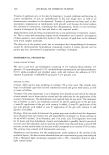
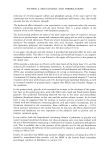
VITAMIN A AND GLYCOLIC ACID FORMULATIONS 161 The largest and smallest diameters of the nuclei of the basal and spinous layers of the epidermis were measured in drawings of the image projected onto paper at a final magnification of 1000x. The nuclear images obtained were traced with a no. 2 black pencil, with care taken to consider only elliptical images. The largest and smallest axes of these images were then measured with the aid of draft paper. The following karyomet- ric parameters were estimated: ß Mean diameter: M -- (D ß d) •/2 ß Perimeter: P -- (q'r/2) ß [1.5 ß (D + d) - M] ß Largest diameter/smallest diameter ratio: D/d ß Volume:V = 6 -• ß •'M 3 ß Area: A = q-r'M 2/4 ß Area/volume ratio: 3/2 ß M ß Shape coefficient: F = 4 ß q-r 'A/p2 ß Contour index: I = P/(A) •/• ß (D - d)•/•/D Stereo/ogy. In the present study we used a grid, idealized by Merz (2), printed on paper to draw the epithelial structures. The grid consists of a square that limits the test area, containing a system of points marked on a sinuous line formed by the succession of enchained semicircles. The Merz grid can be used to count points on a given histological structure, and also to count intersections between two contiguous structures, by con- sidering the number of points that fall on the structure under study in the former case and the number of times that neighboring surfaces cut the curved line in the latter. Thus, in order to obtain the nucleus-cytoplasm ratio, the thickness, the numerical nuclear density, the epithelial volume/interface ratio, the cytoplasmic volume, and the epithelial volume, we used point counting (2000 per animal, corresponding to the product of 20 microscope fields per 100 points on the grid) or the number of intersec- tions, according to the requirements of the stereologic equation with respect to the parameter studied. Nucleus/cytoplasm (n/c) ratio. The nucleus/cytoplasm ratio is given by the ratio of the relative volumes of nucleus and cytoplasm: Vvn n/c- Vvcyt The relative volumes are determined by the number of points falling on the structure considered (3-5). The value thus obtained is an overestimate of the real value due to the so-called "Holmes effect" (5), which results from the use of histological sections of finite thickness. To correct this overestimate it is necessary to take into account the size of the structure involved and the thickness of the histological section. Henning (6) proposed the following corrective formula for the Holmes effect, in which the nuclei are seen as if they were spheres of mean diameter D, and T is the thickness of the section: Vvn Vvc -- 1 + 3T/2D In this expression Vvc is the corrected volumetric fraction of the nuclei, and Vvn is the observed volumetric fraction calculated by dividing the number of points falling on the nuclei by the total number of points falling on the nucleus and cytoplasm. The mean

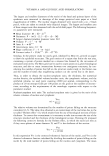
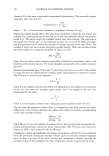
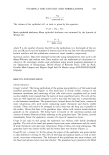
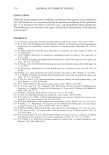
162 JOURNAL OF COSMETIC SCIENCE diameter (D) is the same as previously determined by karyometry. The corrected nucleus/ cytoplasm ratio will then be: Vvc Corrected n/c - -- 1 - Vvc where 1 - Vvc is the corrected volumetric cytoplasmic fraction (Vvcyt). Numerical nuclear density (Nvn). The area of the epithelium within the test system was evaluated by counting the points that fall on it, and the epithelial volume was propor- tional to it. The nuclei inside the standard square were then counted. The total area of the square was 50.625 pm 2 in two fields per section, for a total of 20 fields per block, and this permitted us to obtain the number of nuclear sections of the area (Nav). The number of nuclei per unit volume (numerical nuclear density, Nvn) was calculated using the Abercrombie (7) correlation modified by Elias eta/. (8): Sav Svn - D+T where D is the mean nuclear diameter previously estimated by karyometry, and t is the thickness of the section (6 pm). The result obtained corresponds to the number of nuclei per mm 3. External surface/basal layer (V/S) ratio. To determine this ratio we counted the number of times the test line intersected the interface under study (keratin or connective tissue). The V/S ratio is given by the equation: P'I V/S - 4I where P is the number of points that fall on the epithelium, I the number of intersections of the test line with the interface under study, and I the length of the test line, determined by the ratio: d'l I- 2 where d is the distance between two contiguous points marked on the test line. The fact that the epithelial volume (Vep) is constant for each field permits the estab- lishment of a direct relation between the surface areas of the two interfaces corresponding to the same standard volume: IK/Vep IK -- Ict/Vep Ict where IK and Ict are the numbers of intersections of the test line with the epithelium- keratin and epithelium-connective tissue intersections. The V/S ratio was inverted to obtain the IK/Ict ratio instead of the Ict/IK ratio. Cytoplasmic volume and epithelial cell volume. Cytoplasmic volume (Vct) was estimated from the previously determined nuclear volume and the corrected nucleus/cytoplasm ratio. In turn, the sum of the mean nuclear and cytoplasmic volumes provides the estimated value of the epithelial cell. The cytoplasmic volume is given by the ratio:
Purchased for the exclusive use of nofirst nolast (unknown)
From: SCC Media Library & Resource Center (library.scconline.org)