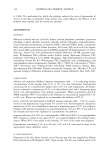
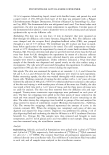
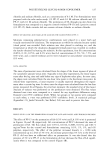
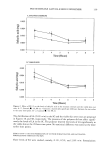
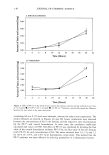
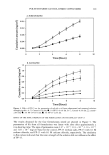
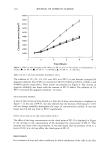
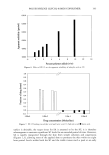
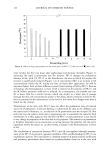
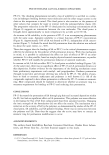
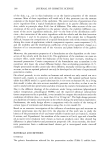
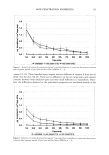
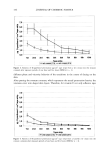
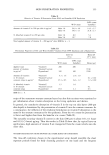
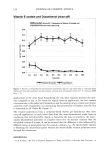
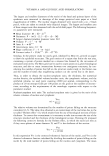
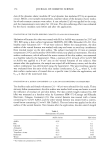
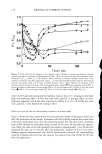
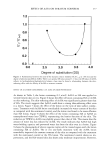
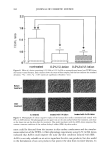
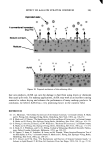
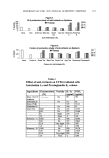
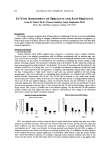
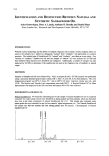
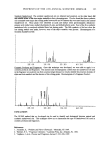
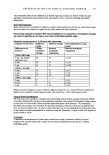
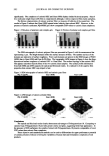
PREPRINTS OF THE 1999 ANNUAL SCIENTIFIC SEMINAR 199 A plot of In (x) Vs the led• hand side of equalion (2) gives a straight line with a slope b and an intercept - bin0, from which 0 can be calculated. Characteristic life can be evaluated from this plot by extrapolation of the number of cycles, which correspond to the failure of 63.2% of the specimens. This can be determined mathematically. Characteristic life has been used in this work as a measure of fiber damage and its alleviation. Effect of Chemical Treatments on Damage: Reduction: Characteristic life data on reduced fibers in Fig. 2 shows that TGA at high pH does the most damage to the fiber. Treatments involving GMTG and Cys are significantly less damaging. They are also less effective in curling. The cause seem to be the mixed disulfide which formed in the process and corresponds to the disulfide bonds that are not reformed. Bleaching (Oxidation): Nonlinear nature of fiber damage in oxidation can be seen from the dntn of Fig. 3. Although the difference between 1 and 2h treatments is not significantly different, 4h treatment leads to a drastic decrease in characteristic life. Conditioner Effects: Figure 4 shows that both low and high molecular weight conditioners reverse the damaging effect of the bleaching treatment. We propose that these effects are a result of cuticle reinforcement by the conditioner molecules in the intercuticular regio• Cross-linking by salt linkages and hydrophobic bonding seem to be possible. In the case of a low molecular weight conditioner this may occur both in the cuticle and the cortex because of penetration and diffusion. REFERENCES: 1. Prevorsek, D.C. and Lyons, J. W., Textile Res. J. 34, 1040 (1964) 2. Charles, L and Sheth, N.J., Statistical Design and Analysis of Engineering Experiments, McGmw-I-lill Book Company, New York, NY, 1973 ACKNOWLEDGEMENTS: Author is thankful to Ms. S. Homby and Ms. I. Bradford for their contribution to the experimental work and data trealmcnt. This work was supported by a group of TRI corporate participants.

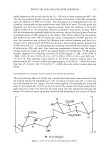
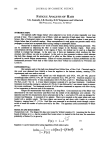
200 JOURNAL OF COSMETIC SCIENCE Fig. 1 Cyclic Tensile Fatigue Apparatus (Schematic) I Stretched Fibertl f/Relaxed Weight iiiiiiiiill' '"'"'"' Iiiiiiii'"ll•l "•Weiiht 40000 35000 30000 25000 20000 15000 10000 5000 0 Fiber Fig. 3 Effect of Oxidation (H202) Fig. 2 Effect of Reduction Characteristic Dr2• Untreated 10% TGA 10% GMTG 10% Cys ! Fig. 4 Effect of Conditioners on Oxidized Hair Characteristic Life (Cycles) 8000 7000 6000 5000 4000 3000 2000 1000 0
Purchased for the exclusive use of nofirst nolast (unknown)
From: SCC Media Library & Resource Center (library.scconline.org)