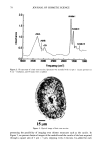
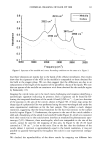
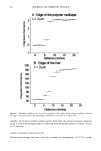
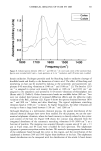
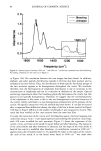
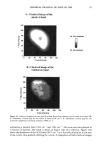
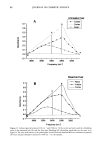
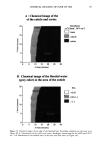
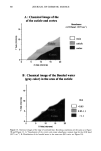
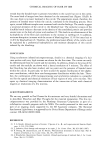
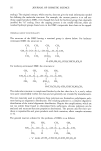
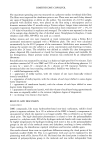
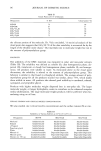
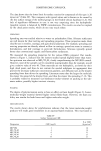
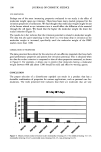
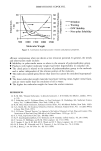
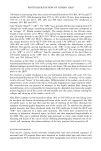
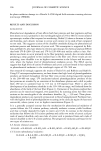
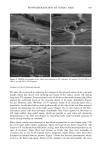
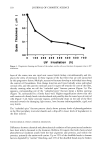
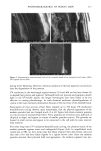
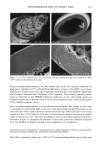
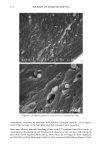
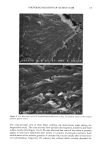
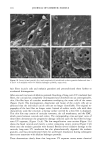
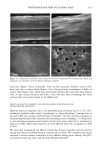
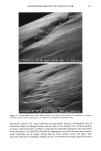
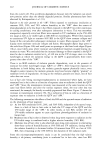
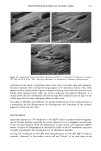
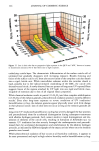
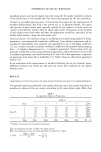
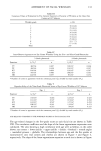
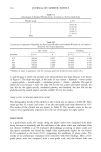
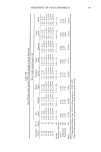
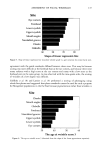
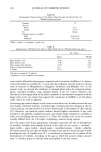
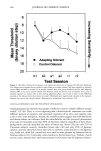
PHOTODEGRADATION OF HUMAN HAIR 107 2.0 J• f. o 1.2 0.8 0.4 Untreated Hair .o 230. o 264. o 298. o 332. o 366. o 400. COLLAPSE AND FUSION OF THE SURFACE CUTICLE CELL The conditions we have chosen in this study may seem somewhat extreme however, we felt they were necessary to be able to learn about the behavior of the hair fiber and the changes of its physical nature brought about by severe UV irradiation. Observations in the FESEM had shown that nearly all hair fibers exposed to long-term alternating cycles of UV irradiation (290-400 nm kma x = 340 nm) and humidification (95% RH 42øC) displayed an unusual topography. The hair fibers have a smooth topography similar to that of a man-made fiber, with little of the characteristic differentiation of the cuticle cell of undamaged hair. Figure 3a shows the typical appearance and thickness of a normal cuticle cell of unaltered, untreated hair fibers. However, after only 100 hours of UV irradiation and humidification in the QUV, a slight thinning of the surface cuticle cell and fusion at the scale edges are apparent (Figure 3b). After 300 hours of UV exposure, a more pronounced collapse of the surface cuticles and fusion of the scale edges to the underlying cuticle cells is seen (Figure 3c). 700 hours of UV exposure has produced hair fibers with a smooth topography, lacking clear differentiation of the cuticle cells (Figure 3d) because of extreme cuticular thinning and fusion to the underlying cuticle cells. The overall decrease in thickness of the surface cuticle cell as a function of exposure time to UV irradiation was obtained in the FESEM using built-in software for measuring distances on a nanometer scale in the axial, radial, and diagonal direction of fibers. Decreases in scale thickness were measured at the same high magnification and con- verted to the appropriate scale. The results are shown in Figure 4. Our hypothesis explaining this photochemical damage phenomenon is as follows: this progressive thinning and fusion of the surface cuticle cell, under the conditions we used, is most likely due to photochemical degradation of the proteins in the surface cuticle cell

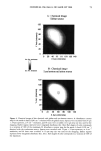
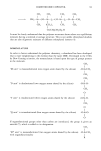
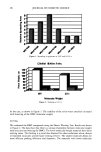
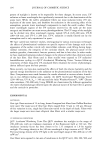
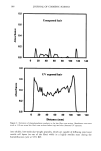
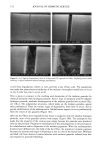
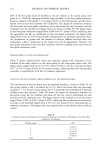
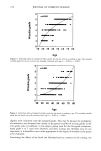
108 JOURNAL OF COSMETIC SCIENCE 0.8 o.4 0.2 0.0 0 20 40 60 80 1 O0 120 140 0.8 0.6 0.4 O.2 0.0 UV exposed hair 0 20 40 60 80 100 120 140 Distance (mm) Figure 2. Formation of photodegradation products in the hair fiber cross section. Absorbance scans were made at 330 nm across hair fiber cross sections before (top) and after (bottom) UV exposure. into soluble, low-molecular-weight peptides, which are capable of diffusing into lower cuticle cell layers (or out of the fiber) while in a highly swollen state during the humidification cycle at 95% RH.
Purchased for the exclusive use of nofirst nolast (unknown)
From: SCC Media Library & Resource Center (library.scconline.org)