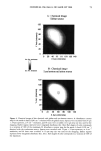
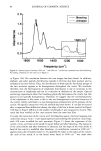
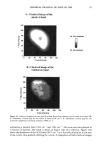
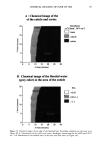
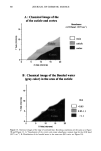
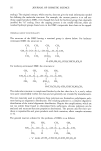
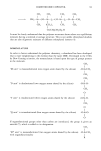
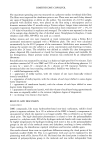
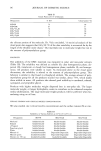
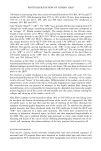
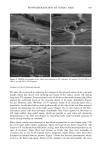
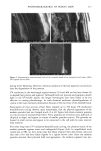
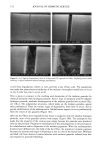
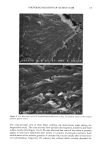
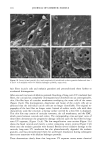
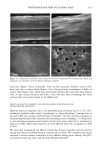
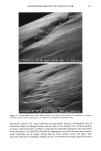
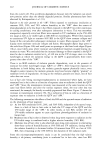
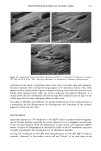
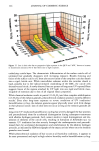
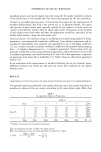
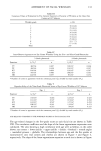
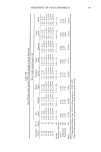
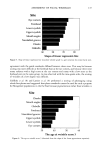
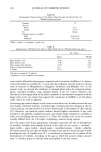
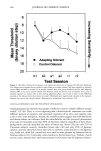
PHOTODEGRADATION OF HUMAN HAIR 123 Figure 16. Longitudinal views of hair fibers exposed to (a) 300 h of continuous UV radiation at constant 20% RH and 50øC in the "AW," and (b,c) subsequent 1-h immersion in lukewarm deionized water. conditions do not result in significant loss in hair color, even after long-term exposure. Increased exposure time and spectral range appear to be secondary factors. Also, there appears to be an initial period of great resistance to fading, since color loss does not occur during short exposure times under any of the conditions investigated. However, it is clearly shown that the combination of both the high RH conditions and the light in the visible range has the most damaging effects on hair color. According to Wolfram and Albrecht (2), partial solubilization of the melanoproteins is a prerequisite for the decolorization by disintegration and dispersion of the melanin pigments within the hair fiber. CONCLUSIONS Long-term exposure to UV irradiation in the QUV results in photo-oxidative degrada- tion of the hair proteins, especially of cystine, which occurs at its highest concentration in the cuticular domains where the degradation is most severe. UV irradiation (QUV) results in amino acid degradation as indicated by shifts in the UV absorbance spectrum to higher wavelengths and development of an absorbance shoulder. Cycling UV irradiation at 10% RH with humidification at 95% RH (QUV) leads to extensive "thinning" of the surface cuticle cell and "fusion" of its scale edge to the

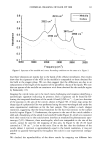
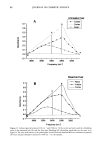
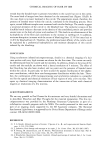
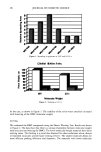
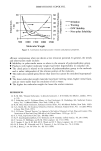
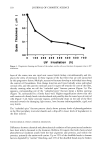
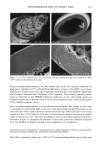
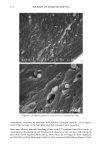
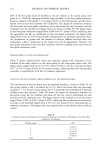
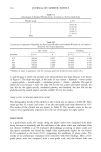
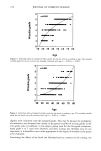
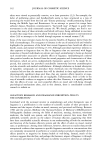
124 JOURNAL OF COSMETIC SCIENCE 20 • • • 20 t6 16 • 12 Figure 17. Loss •n hair color due to progressive light exposure in the QUV and "AW," shown as increase in transmission intensity (%) of hair fibers due to light exposure. underlying cuticle layer. The characteristic differentiation of the surface cuticle cell of untreated hair gradually disappears with increasing exposure. Besides thinning and fusion of the surface cuticle cell, there also occurs fusion of the complete cuticular sheath into a rigid, brittle unit. While intercellular cohesion within the cuticular sheath is high, possibly due to free radical-initiated crosslinking of the CMC, the cuticle cells themselves are brittle. A newly observed fracture pattern of long-term UV-exposed fibers suggests fusion of the regions attacked by UV light into one rigid and brittle mass, incapable of extension due to loss of all original elastic properties. While chemical oxidation results in partial (1 h H202) and then complete solubilization (4 h H102) of the melanin granules, photochemical oxidation produces entirely different results. Even after long-term exposure to severe conditions of UV irradiation/ humidification cycling, the melanin granules appear physically intact with little change in their physical nature. Loss of color does not occur as long as the melanin granules are intact. Long-term UV irradiation/humidification cycling has severely damaged the hair proteins and preconditioned them for accelerated disintegration during subsequent treatments with alkaline hydrogen peroxide. Such contact restfits in rapid disintegration and dis- solution of elements of the cuticle cells, restilting in formation of Allw/Srden sacs via osmosis. UV irradiation has also severely damaged the melanoproteins and precondi- tioned them for accelerated disintegration and solubilization by the alkaline hydrogen peroxide, as indicated by SEM micrographs of the empty cavities where once the melanin granules were housed. While photochemical oxidation of hair occurs at all humidity conditions, it appears to be more pronounced and rapid at high relative humidity and/or humidification cycling.
Purchased for the exclusive use of nofirst nolast (unknown)
From: SCC Media Library & Resource Center (library.scconline.org)