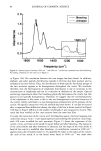
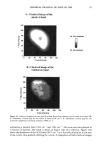
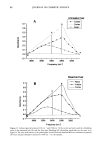
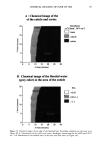
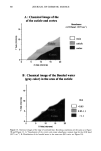
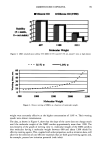
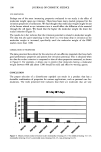
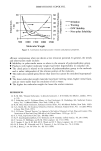
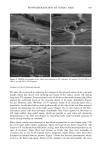
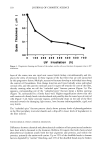
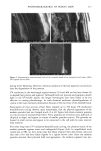
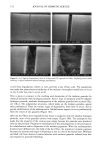
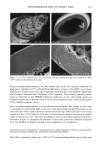
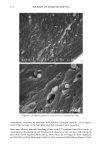
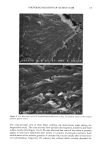
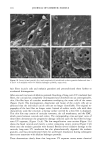
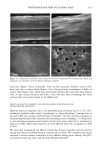
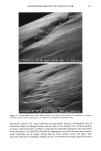
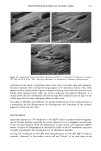
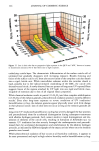
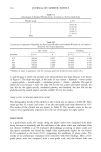
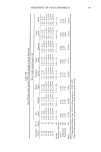
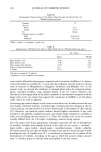
PHOTODEGRADATION OF HUMAN HAIR 125 Continuous UV irradiation at constant 10% RH (QUV), without alternating cycles of humidification, does not show the thinning and fusion of the surface cuticle cells. However, photochemical degradation has occurred, as subsequent immersion in water causes cuticle thinning and fusion of a magnitude similar to that experienced by fibers exposed to UV irradiation/humidification cycling (QUV). Low and moderate RH conditions during exposure to unfiltered solar light in the "AW" also fail to produce cuticle thinning and fusion, and hair fibers still display the char- acteristic cuticle cell differentiation. Subsequent immersion in water shows only mod- erate cuticle thinning and fusion. This suggests that the solar spectrum of the "AW" causes less severe levels of photo-oxidative degradation of the proteins than the UV irradiation in the QUV. High relative humidity is the primary contributing factor to accelerated loss in hair color. The combination of both the high RH conditions and the unfiltered solar light have the most damaging effects on hair color. REFERENCES (1) E. Hoting, M. Zimmermann, and S. Hilterhaus-Bong, Photochemical alterations in human hair. I. Artificial irradiation and investigations of hair proteins,J. Soc. Cosmet. Chem., 46, 85-99 (1995). (2) L.J. Wolfram and L. Albrecht, Chemical- and photobleaching of brown and red hair, J. Soc. Cosmet. Chem., 82, 179-191 (1987). (3) C. Dubief, Experiments with hair photodegradation, Cosmet. Toilerr., 107, 95 (1992). (4) J. B. Speakman and P. R. McMahon, The action of light on wool and related fibers, N. Z.J. Sci. Tech., 20 (1939). (5) C. Robbins and M. Bahl, J. Soc. Cosmet. Chem., 35, 379-390 (1984). (6) S. B. Ruetsch, Y. Kamath, and H.-D. Weigmann, unpublished observations. (7) C. R. Robbins,J. Soc. Cosmet. Chem., 22, 339 (1971). (8) W. E. Savige and J. A. Maclaren, in The Chemistry of Organic Salfar Compoands, N. Kharash, C.Y. Meyers, Eds. (Pergamon Press, New York, 1966), Vol. 2, pp. 367-402. (9) C. R. Robbins, Chemical and Physical Behavior of Haman Hair, 2nd ed. (Springer-Verlag, New York, 1994), pp. 103-104, 108. (10) L.J. Wolfram and K. Hall,J. Soc. Costa. Chem., 26, 247 (1975). (11) S. Ratnapandian, S. B. Warner, and K. Kamath, Photodegradation of human hair,J. Soc. Cosmet. Chem., 49, 309-320 (1998). (12) F. Leroy, A. Deftandre, and J. C. Garson, Photoaging of human hair, 7th International Hair Science Symposiam (Bad-Neuenahr, 1990). (13) C. R. Robbins, Chemical and Physical Behavior of Haman Hair, 3rd ed. (Springer-Verlag, New York, 1994), p. 78.

j. Cosmet. sci., 51, 127-139 (March/April 2000) A photographic scale for the assessment of human facial wrinkles KAZUE TSUKAHARA, YOSHINORI TAKEMA, HARUHITO KAZAMA, YUKIKO YORIMOTO, TSUTOMU FUJIMURA, SHIGERU MORIWAKI, TAKASHI KITAHARA, MICHIO KAWAI, and GENJI IMOKAWA, Biological Science Laboratories, Kao Corporation, 2606 Akabane, Ichikai, Haga, Tochigi, 321-3497 (K.T., Y.T., T.F., S.M., T.K., G.I.), and Cosmetic Science Laboratories, 2-1-3 Bunka, Sumida-ku, Tokyo, 131-8501 (H.K., Y.Y., M.K.),Japan. Accepted for publication February 15, 2000. Synopsis We report the utility of photographic scales to assess the degree of human facial wrinkles. A five-grade photo scale of wrinkles at eye corners was developed using photos obtained from 411 female participants aged 17 to 83 years. Based on this photo scale, scorings (five grades and nine grades) of all photos were performed by two specialists, and a standard photo for each wrinkle grade was obtained. In addition, in order to evaluate the influence of inter-observer differences in grading criteria, another scoring was performed by five general observers. The agreement between the grade standard and the score given by the general observers was evaluated by calculating the chance-corrected coefficient, i.e., the kappa value. The degree of agreement for the five-grade scale was more consistent than that for the nine-grade scale system, in which the kappa values were 0.499 and 0.396, respectively. When scoring was performed using the five-grade photo scale for the eye corners after 15 participants used a wrinkle-improving agent, a significant reduction of the wrinkle scores was confirmed. Taken together, the present findings indicate that the five-grade wrinkle photo scale is valid and useful to assess the degree of facial wrinkles. INTRODUCTION In recent years, cosmetic agents for the improvement of wrinkles have been actively developed. Photographs have been used for the clinical panel assessment of photodam- aged skin treated with several reagents (1,2). Clinical tests of retinoic acid as a treatment for wrinkles are representative, and the evaluation of its effects is often performed by scoring based on descriptive definitions (3-7). Scoring of photodamage, namely wrin- kling, using a photo scale has been performed, and its statistical validity has been Address correspondence and reprint requests to Genji Imokawa. Tel: 285-68-7467, Fax: 285-68-7305, E-mail: 073733 @kastanet.kao.co.jp 127
Purchased for the exclusive use of nofirst nolast (unknown)
From: SCC Media Library & Resource Center (library.scconline.org)