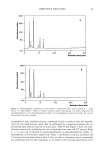
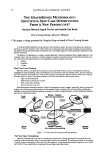
14 JOURNAL OF COSMETIC SCIENCE 50000 E 40000 30000 20000 10000 • BMDBM -0- OC • BEMT -•- Oxybenzone i i i 300 320 340 360 380 400 Wavelength / nm Figure 2. UV spectra of UV absorbers with different spectral characteristics, all measured with ethanol as solvent. SPF DETERMINATION The i, vivo SPF of the sunscreen formulations used in this study were determined according to the European protocol (12). In some cases instead of ten volunteers the studies were carried out with only five volunteers (as indicated in Table I). The formu- lations used in the present study were all of the o/w-type (see Appendix II). In order to increase the significance of this study, data from references 13 and 14 were also taken into consideration. In all cases the amount of sunscreen formulation applied is 2 mg/cm 2, which equals in terms of volume approximately 2 pl/cm 2. This in turn corresponds to an average film thickness of 20 pm. The i, vivo data of reference 13 were measured according to the COLIPA protocol, which implies the use of ten subjects and a confi- dence interval smaller than +20%. The i, vivo data of reference 14 were obtained according to the FDA protocol with a reduced number of volunteers (eight subjects instead of 20). With eight subjects the confidence interval in most cases is smaller than _+25%. SPF STANDARDS As mentioned in the introduction, the step film model was calibrated with the COLIPA standard sunscreen formulations P1 and P3 and a third standard, P4, of higher SPF. The UV absorber contents and i. vivo SPFs of these formulations are:

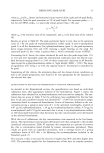
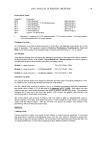
STEP FILM MODEL FOR SPFs 15 2.0 1.5 1.0 0.5 ß TiO 2 (•.max = 291 nm) O MBBT (•.max= 360 nm) Linear regressions .0 ! ! 0 I 2 3 % (w/v) Partiulate UV-Absorber Figure 3. Lambert-Beer law functionality of particulate UV absorbers dispersed in distilled water at realistic concentrations. © PI: 2.7% OMC, in vivo SPF = 4.2 (+0.2) © P3: 3.0% OMC, 0.5% BMDBM, 2.78% PBSA, in vivo SPF = 15.5 (+1.5) © P4: 5.0% OMC, 10% MBBT (active ingredient), in vivo SPF = 35.7 (+3.2) The formulations of P1 and P3 are given in the literature (12). The in vivo SPF study of P4 was carried out twice according to the COLIPA protocol (12) so that total number of volunteers in this case was 20, resulting in a rather small confidence interval (+9%), similar to that of the P3 standard. The formulation of standard P4 is given in Appendix I. All confidence intervals given with the in vivo SPF values are based on a significance level of 95%. THEORETICAL ASPECTS AND CALCULATIONS TRANSMISSION OF A STEP FILM The derivation of the step film model presented by O'Neill (9) starts with a homoge- neous film of absorbing material of a certain thickness d and a horizontal extension of 1. The derivation of the model is visualized in Figure 5 as a two-dimensional sketch. A portion of the homogeneous film given by the horizontal extension g and the thickness
Purchased for the exclusive use of nofirst nolast (unknown)
From: SCC Media Library & Resource Center (library.scconline.org)