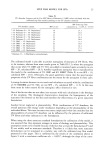
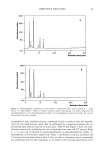
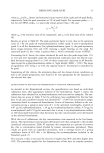
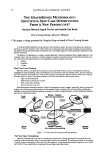
20 JOURNAL OF COSMETIC SCIENCE 80 60 I.t. 40 20 0 0.0 0.2 0.0 0.4 1.0 1.0 Figure 7. SPF calculated on the basis of the UV spectrum and UV absorber contents of standard P3 as a function of the step film parameters g and f The task is now to find the set of parameters g and f for which Ag,f has a minimum. At this point the deviation of the calculated values compared to the in vivo values is minimal and the agreement is best. The function hg,f is visualized in Figure 8. The minimum is located at g = 0.269 and f = 0.935, which therefore can be regarded as the step film parameters calibrated from standaMs P1, P3, and P4. The calculation was carried out with a 200-times-200 matrix of g- and f-values in the range between 0 and 1 using the MathCad 6.0 software running under Microsoft Windows © NT 4.0 on a personal computer (IBM 300PL). For standard P1 the calculated SPF value is 5.0 (in vivo SPF 4.2), for P3 it is 10.9 (in vivo SPF 15.5), and for P4 it is 38.5 (in vivo SPF 35.7). In order to cover a broad range of SPF values with this step film model calibration, low, medium and high SPF standards had been chosen. RESULTS AND DISCUSSION CORRELATION OF IN VIVO SPF VALUES AND SPF VALUES OBTAINED WITH THE CALIBRATED STEP FILM MODEL In order to correlate in vivo SPF values of sunscreen products with values calculated using

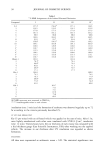
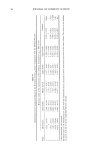
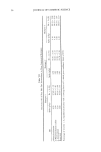
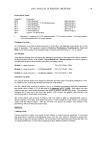
STEP FILM MODEL FOR SPFs 21 20 0.00 0.20 10 •__ 0.40 • : • • 0.60 0 -•- "--- -- "- 0.80 O• 1.00 f Figure 8. Section of the solution surface of the function A s f, the minimum of which occurs at the point g ß = 0.269, f = 0.935. the step film model, sunscreen formulations of different filter contents were manufac- tured and in vivo SPF values were determined according to the European protocol. From the concentrations of the UV absorbers used in these formulations, corresponding SPF values were calculated applying the calibrated step film model as described before. In addition, in vivo SPF values and UV filter contents of formulations published in refer- ences 13 and 14 were also used to test the model. In reference 13, formulations with a broad range of different filter combinations, including physical filters, had been manu- factured and assessed according to the COLIPA protocol. The assessment of formulations from reference 14 had been carried out according to the FDA method. Since both the COLIPA and the FDA protocols use 2 mg/cm 2 of sunscreen formulation, there should be no difference in the results. Tables II, III, and IV show the filter contents, the corresponding in vivo SPF values, and the SPF values calculated with the calibrated step film model of the formulations of this work, of references 13 and 14, respectively. In Figure 9 the correlation of in vivo and calculated values is shown. The slope of the correlation is 0.83 with an intercept on the abscissa at 0.55, and the correlation coef- ficient is r = 0.8957. DISCUSSION There have already been attempts to use a step film model in order to simulate invitro
Purchased for the exclusive use of nofirst nolast (unknown)
From: SCC Media Library & Resource Center (library.scconline.org)