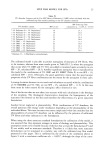
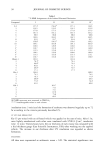
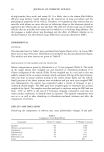
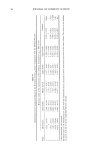
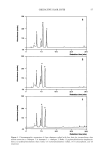
18 JOURNAL OF COSMETIC SCIENCE In the case of mixtures of several UV absorbers, in equation 4, e(}t) has to be replaced by e(}t) and c by ?. Figure 6 shows e(}t) for the case of standard P3. CALCULATION OF SUN PROTECTION FACTORS FROM TRANSMISSION VALUES Using the step film model, the transmissions TOO of sunscreens can be calculated, and for certain values of the parameters g andf the result may be close to the situation in vivo. The inverse of the transmission at a certain wavelength }t equals the factor of attenuation of the corresponding radiation. Therefore, l/T00 has the meaning of a monochromatic protection factor, MPF(k): 1/T(M = MPF(?t) (6) The spectral range of solar radiation that is regarded as potentially dangerous for the skin comprises the wavelengths between 290 nm and 400 nm. In order to calculate the sun protection factor, the monochromatic protection factors in this spectral range must be averaged. This average has to be weighted by the intensities of solar radiation S(}t) and by the skin sensitivity towards UV light and the erythemal action spectrum EA(?t), which both are functions of wavelength. The resulting formula for the calculation of the weighted average of monochromatic protection factors was first given by Sayre et al. (10): 4OO s(x). X=290 SPF= 400 (7) s(x). EA(X). X=290 S0•) and of EA(h.) are available from the literature. Values for S0•) used in this work are taken from Diffey and Robson (5) and values for EA(h.) from CIE (11). The T0•) data are calculated using the step film model as indicated above. CALIBRATION OF THE STEP FILM PARAMETERS Figure 6 shows the UV spectrum of the SPF standard P3 in terms of the average extinction coefficients in the range between 290 and 400 nm as calculated from the contributions of the individual filters according to equation 5c. Taking into account these extinction coefficients e(}t), the optical pathlength (d -- 20 pm), and the molar concentration ? based on the average molecular weight (? = 0.221 mol/1 for P3), the transmission TOO of a step film can be calculated according to equation 4 for different values of the step film parameters g and f, which both can vary between 0 and 1. For each pair of step film parameters, a spectrum of transmissions TOO in the range between 290 and 400 nm is calculated, which is transformed via equation 7 into an SPF value. In that way the SPF of a formulation with a certain set of UV absorbers can be obtained for every pair of step film parameters. This is shown in Figure 7 as a three-dimensional plot of the SPF as function ofg andf for the P3 standard. From the plot it is obvious that there are different sets of parameters g and f that reproduce exactly the in vivo SPF value of standard P3 of 15.5. Corresponding calculations for the other two standards, P1 and P4, were performed in

STEP FILM MODEL FOR SPFs 19 25000 20000 15000 10000 5OOO 300 320 340 360 380 400 Wavelength / nm Figure 6. UV spectrum of sunscreen standard P3 in terms of molar decadic extinction coefficients. the same way. There exists no unique set of parameters g andf which is able to reproduce exactly the i, vivo SPF results of all three standards at the same time. However, it is possible to search for the set of step film parameters that results in the closest possible simulation of the i, vivo SPF values of the three standards P1, P3, and P4. For that purpose a function Ag,f was defined that describes the overall quadratic deviation of the calculated SPF values from the i, vivo values of the sunscreen standards P1, P3, and P4, which are 4.2, 15.5, and 35.7, respectively. 4-5 + + ([SPF(P1)g•-4.2] -35 • + 4.2 + 15.5
[SPF(P3)•-15.5] + 35.7
[SPF(P4)•, (8) where SPF(P 1)•,f are the SPF values calculated according to the spectrum of standard P 1 as a function of parameters g and f and SPF(P3)g,fand SPF(P4)•,f are the correspondingly calculated SPF values for standards P3 and P4. The first three terms of equation 8 represent the squared deviations of each individual standard between the calculated values and the in vivo SPF, normalized to the corresponding in vivo SPF. The fourth term considers the square of the sum of the deviations of all three standards between calcu- lated and in vivo SPF, taking account of the fact that before their squares are computed, deviations of different terms may partly cancel.
Purchased for the exclusive use of nofirst nolast (unknown)
From: SCC Media Library & Resource Center (library.scconline.org)