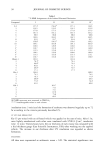
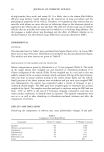
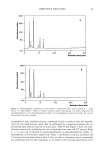
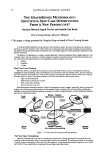
54 JOURNAL OF COSMETIC SCIENCE p-phenylenediamine (235 nm) Linear regression, confidence limits and error bars ... 250 ] Slope = 223.65 •' 200 .• 150 1 , 0.0 0,2 0.4 0.6 0,8 .0 Concentration of p-phenylenediamine (g/I) Resorcinol (270 nm) Linear regression, confidence limits and error bars 16 • 14 12 lO 8 '= 6 0 0.0 0.1 0.2 0.3 0.4 0.5 Concentration of resorcinol (g/I) Figure 3. Calibration line of the corrected peak area vs concentration for p-phenylenediamine (a) and resorcinol (b). formulations mimicking real commercial formulations is then proven to be very appro- priate in terms of identification and accuracy and precision of quantitation. DETERMINATION OF THE FOUR HAIR DYE INTERMEDIATES IN THREE COMMERCIAL SHAMPOOS To further validate the entire procedure, three commercial shampoos, known to contain

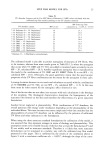
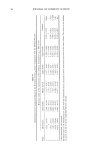
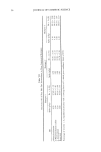
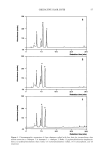
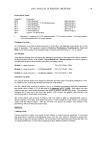
OXIDATIVE HAIR DYES 5 5 Table V Figures of Merit for the Calibration Lines Obtained for the Four Hair Dyes Dye Slope (AU/g.I-•) R 2 Detection limit (g/l) Range (g/I) n p-Phenylenediamine 223.650 + 2.065 0.9976 0.044 0-0.9 30 rn-Phenylenediamine sulfate 28.274 + 0.945 0.9874 0.055 0-0.4 14 rn-Aminophenol 145.520 _+ 1.507 0.9976 0.035 0-0.7 24 Resorcinol 32.580 _+ 0.509 0.9969 0.026 0-0.4 15 Table VI Recoveries (%) of Four Hair Dye Intermediates in Five Synthetic Formulations Hair dye recovery Re + 2s (%) Dye Dark brown Middle brown Light brown Dark blonde Light blonde p-Phenylenediamine 95.05 + 3.05 93.15 + 2.95 91.32 + 5.20 95.08 + 4.58 96.45 + 3.66 m-Phenylened iamine sulfate 99.56 -+ 4.17 96.93 + 8.31 96.06 + 9.29 93.50 + 9.65 90.58 + 9.95 m-Aminophenol 95.99 + 3.63 99.37 + 0.85 97.27 + 3.29 98.89 + 2.17 96.48 + 5.21 Resorcinol 93.76 -+ 2.66 92.14 + 2.76 98.24 _+ 1.77 98.58 + 1.36 97.51 + 2.49 Percentage of recovery + 2s, expanded uncertainty with a coverage factor of 2, which gives confidence limits of 95%. no hair dye intermediates (this was checked by confirming the absence of any peaks at the hair dye intermediates retention times reported in Table II), were spiked with weighed amounts ofp-phenylenediamine, m-phenylenediamine sulfate, m-aminophenol, and resorcinol. Figure 4 shows the chromatograms obtained for the three shampoos after appropriate dilution in a mixture of methanol and mobile phase (40%) followed by the extraction procedure. The matrix compounds are 100% extracted and the chromato- grams show five peaks, with a satisfactory resolution, calculated according to formula (a) and comprised between R3, 4 = 1.03 and R2, 3 -- 4.12 (shampoo 1), R3, 4 -- 0.85 and R2, 3 = 3.01 (shampoo 2), and R3, 4 = 1.03 and R•, 3 = 3.79 (shampoo 3) (see peak labeling in Figure 4). The identification of the hair dye intermediates could also be easily performed using individual retention times and UV spectra. Both peaks 1 and 2 had to be attributed to p-phenylenediamine because of the presence of both amphoteric and basic forms of this compound [experimental acidity constants of 2.46 and 6.04 (9)] at the working pH of 5.9. Both forms have thus to be taken into account for the quantitation. The concentration of each hair dye intermediate was calculated with the same procedure previously reported and compared to the spiked values. As shown in Table VII, the recoveries obtained, as well as the expanded uncertainties, were very good. Therefore, this whole procedure appears to be suitable for a complete identification and quantifi- cation of these hair dye intermediates. CONCLUSIONS The validation of the analytical procedure for the determination of oxidative hair dyes by RP-HPLC, coupled with DAD detection after a liquid-liquid extraction, has been
Purchased for the exclusive use of nofirst nolast (unknown)
From: SCC Media Library & Resource Center (library.scconline.org)