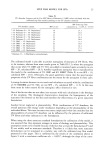
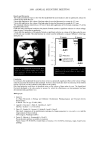
66 JOURNAL OF COSMETIC SCIENCE Pl•SSUl• SENSITIVE ADHESIVE SYSTEMS FOR TOPICAL AND TRANSDERMAL COSMETIC APPLICATIONS Scott D. Barnhart Adhesives Research, Inc., Glen Rock, PA Frequently utilized in the medical and pharmaceutical industry, skin-friendly pressure sensitive adhesives (PSA's) provide a clean, efficient vehicle for transdermal and topical delivery systems. This coating technology platform can be leveraged to deliver active or inactive cosmetic ingredients, many ingredients of which have been applied to the skin from traditional creams, ointments, and lotions. PSA's and specialty coatings are available in many forms, including substrate/adhesive laminate, unsupported adhesive transfer films, and tackless dissolvable films to name a few. Figure 1 provides examples of various adhesive tape constructions. Pressure sensitive adhesive chemistry draws upon a range of polymers including rubber/resin systems, acrylic copolymers, silicones, and advanced polymer blends. The substrate/adhesive constructions are unique combinations that, through the proper selection of components, lend themselves well to cosmetic applications. Figure 1 "P:&& T&pl ConttructlGnt Transfer •A dkesives ll Single.Faced Tapes D ouble-Faced Tapes Continuing research and development in the application of pressure sensitive adhesives and specialty coatings have produced unique, innovative topical delivery options. Coating chemistries now exist that may allow for the incorporation of an ingredient into a polymer system that was not previously possible. Or, these new chemistries may enhance specific applications whereby rapid transmission of a selected ingredient is facilitated to the skin surface •, moisture management is improved, or "smart" coatings may display activatable/deactivatable adhesion properties? Through the use of graft copolymer technology, it is possible to impart hydrophilic or hydrophobic properties onto a polymer molecule. Grafting the specific property to the polymer creates a unique material that does not phase separate into discreet groups of molecules in bulk, which would be the case if each individual component were simply mixed together, but rather forms small phase domains that are rich in either the graff or the main chain polymer. Due to covalent bonding during copolymerization, the graff is bound to the main polymer chain. Examples of unique properties include hydrophilic character imparted onto a relatively hydrophobic polymer, inhibition of crystal formation in a polymer system that otherwise would exhibit limited solubility of a solute, and improvements to the cohesive strength of an adhesive that is susceptible to dissolution by an excipient.

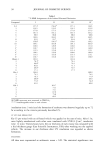
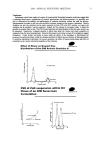
2001 ANNUAL SCIENTIFIC MEETING 67 Cross-linking an adhesive polymer can also build cohesive strength in cases where the adhesive will be exposed to ingredients or environments that are capable of dissolving or softening the layer. Many options are available for chemically cross-linking an adhesive. Heat may be used to lower the energy barrier for initiating the cross-linking reaction. For temperature-sensitive ingredients, cross-linkers employing a metal complex rely upon the removal of a volatile stabilizer during low temperature drying, at which point the system will react. Figure 2 presents the viscoelastic property, Tan b, at various frequencies for a number of cross- linked acrylic adhesive formulations. Tan •5 is defined as the ratio of G", or the loss modulus, to G', or the storage modulus. Since the storage modulus (G') reflects the elastic component of a pressure sensitive adhesive and the loss modulus (G") reflects the viscous component, it can be seen from Figure 2 that cross-linker concentration reduces G" whereby Tan •5 decreases as mole percent of cross-linker increases. Figure 2 1.2 1 08 0.4 0.2 Tan Delta vs Frequency [Acrylic Adhesive with Varying Degrees of Softness o_o o 1.o lO.O lOO.O Frequency (rad/•c) - - x. . - Increasing cross-linker concentration, thereby decreasing G", will affect the tackiness and adhesion of the system to the skin. Careful selection of the mole percent of cross-linker will allow one to tailor a pressure sensitive adhesive in order to balance the viscoelastic properties. The correct amount of cross- linking agent will provide for a balance between the adhesive and cohesive strength of the formulation. This balance should be optimized so that the adhesive will adhere to the surface of the skin for a predetermined length of time, while providing sufficient cohesive strength so as to prohibit the system from moving or sliding in parallel with the skin surface. Many aspects need to be considered when developing adhesives and it should be evident that various chemistries can be controlled when tailoring a coated product. • Therriault, Donald J., et al, Transdermal Pressure Sensitive Adhesive Drug Delivery System, US Patent 5,951,999, (1999). 2 Therriault, Donald J., et al, Water-lnactivatable Pressure Sensitive Adhesive, US Patent 5,352,516, (1994).
Purchased for the exclusive use of nofirst nolast (unknown)
From: SCC Media Library & Resource Center (library.scconline.org)