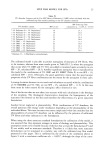
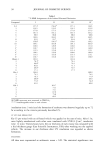
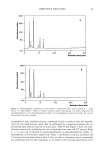
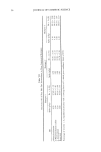
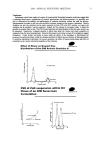
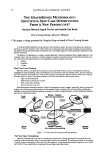
16 JOURNAL OF COSMETIC SCIENCE 40000 30000 20000 10000 --•-- MBBT --0-- Ti02 300 320 340 360 380 400 Wavelength / nm Figure 4. UV spectra of particulate UV absorbers dispersed in distilled water. Table I Characteristic UV Spectroscopic Parameters of the UV Absorbers Used in This Study Molecular weight k ...... e(k ...... ) UV Absorber (tool/g) (nm) (1' tool -• ß cm -•) E•.•(X ...... ) OMC 290.00 310 23980_+ 480 827_+ 17 PBSA 274.00 299 25390 _+ 500 926 _+ 19 MBC 254.00 299 22780+ 460 897 + 18 Padimate O 277.00 310 26880 + 540 970 +_ 19 OT 823.06 314 124700 _+ 2500 1515 _+ 30 BMDBM 310.00 357 34130_+ 680 1101 _+22 OC 361.00 303 12190_+ 240 338_+ 7 BEMT 627.80 342 48970 _+ 980 780 _+ 16 Oxybenzone 228.25 287 13970 _+ 280 612 _+ 12 MBBT (dispersion) 658.86 360 38500 _+ 2700 584 _+ 41 TiO2 79.9 291 6170_+ 430 772_+ 54 The error ranges are indicated for e(X .... ) and E•,•(X .... ) as confidence limits with 95% level of significance. f' d is removed from its original position and added to the remaining thicker part of the film. This results in two film fractions of different thicknesses d' and (l-f)' d, with horizontal extensions (l-g) and g, respectively. The transformation of the film geometry is carried out under the condition that the amount of absorbing material stays constant. The expression for d' is then:

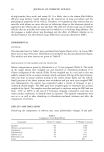
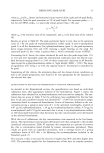
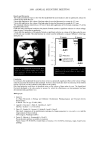
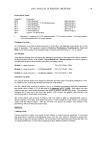
STEP FILM MODEL FOR SPFs 17 (1-f)-d ,:_:_:.:.:.:.:.:.:.:.:.:.:.:.:.:.:.:.:.:.:.:.:.1.:.:.:.:.:.:.1. ............................... ,:.:.:.:.:.:.:.:.:.:.:.:.:.:.:.:.:.:.:.:.:.:.:.:.:.:.:.:.:.:.:., •.:.:.:.:.:.:.:.:.:.:-:.:.:.:-:.:.:.:.:.:.:.:.:.:.:.:.•.:.:. .:. ::::::::::::::::::::::::::::::::::::::::::::::::::::::::::::::: ::::::::::::::::::::::::::::::::::::::::::::::::::::::::::::::: ::::::::::::::::::::::::::::::::::::::::::::::::::::::::::::::: •.:.1.:.:.:.:.:.:.:.:.:.:.:.:.:.:.:.:.:.:.:.:.:.:.:.:.:.:.:.:. . ::::::: :::::::::::::::::::::::::::::::::::::::::::::::::::: •••:•:•:•:•:•:•:•:•••:•••••:.:•:••:•:•:.•••••••••••••••••••.••:•••••••••••••:•••••••••••:•••:.• ••.:.:.:.:.:.:.:.:.:.•.:.:.:.:.:..:.:.:.:.•.:.:.•.:.•.:.•.•.•.•.•.•.•.:.:••.:.:.•.•.:.:.:.:.:.•. ::::::::::::::::::::::::::::::::::::::::::::::::::::::::::::::: -K g (l-g) Figure 5. Illustration of O'Neill's step film model explanations in the text. = ' +1 (1) 1-g From the Lambert-Beer law the transmission T(X) of light with wavelength X is given as T(X) = 10 -•(x) (2) where E(X) is the extinction that is a function of the molar decadic extinction coefficient e(X), the molar concentration is c, and the optical pathlength is d: E(X) = e(X).c ß d (3) The transmission of a step film TOO can then be written as the sum of the transmissions through the two fractions of the film: T(X) = g' 10 -•(x'•"/'{•-/} + (1 - g)' 10 -•(x)'c'd'ts'f/(1-g)+l} (4) where d is the average thickness of the step film. Since the in vivo methods for SPF measurements define an amount of sunscreen of 2 mg/cm 2 = 2 pl/cm 2 that is applied on the skin, the average thickness of the film is d = 20 pm. Again, e(X) is the molar extinction coefficient and c is the molar concentration of the UV absorber. With cosmetic sunscreens, in most cases several UV absorbers are combined. Consid- ering a mixture of n different UV absorbers, the concentrations of the individual ab- sorbers are most conveniently given as percentages •i (weight per volume). The corre- sponding molar extinction coefficients are the e00i, and the molecular weights ]Vl i. The -- average molecular weight M, the molar concentration based on the average molecular weight ?, and the average molar absorption coefficient e(X) of the mixture can be calculated using the following formulae:
Purchased for the exclusive use of nofirst nolast (unknown)
From: SCC Media Library & Resource Center (library.scconline.org)