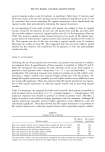
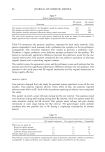
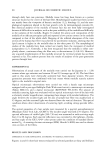
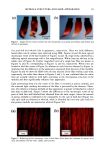
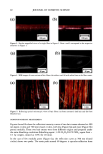
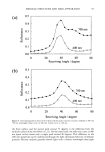
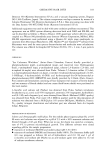
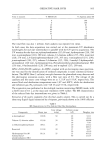
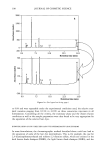
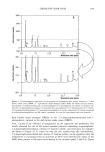
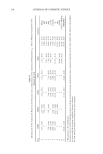
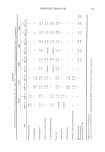
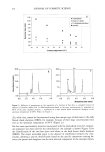
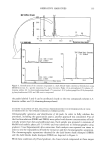
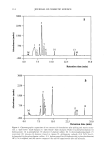
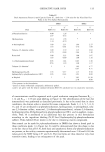
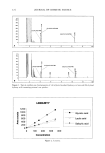
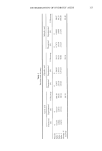
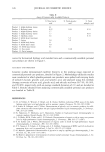
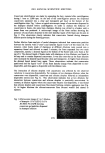
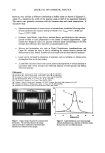
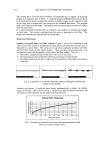
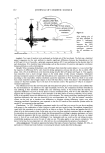
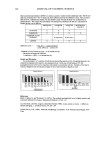
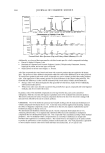
OXIDATIVE HAIR DYES 107 chromatographic separation. As an example, the chromatographic separations obtained for the dark brown shade cream (DBRC) and the light blonde shade shampoo (LBLS) are depicted in Figure 1. Similar types of chromatograms were obtained for the three other formulations. Obviously, most of the matrix compounds are 100% extracted, and the chromatograms show only seven (brown shade cream, DBRC) to nine (blonde shade shampoo, LBLS) peaks. The resolution, calculated according to reference 7, was excellent for all two consecutive peaks except for res and oap (peaks 7 and 8 in Figure la), which were coeluted in these conditions in the dark brown shade cream (DBRC). All the calculated resolutions were greater than R6, 7 = 2.30 (see peak labeling in Figure 1). The identification of the hair dye intermediates could be easily performed using indi- vidual retention times and UV spectra. Indeed, these two characteristics having been previously recorded in a database containing 68 hair dyes and matrix compounds in pure standard solutions commonly found in oxidative hair dye formulations (9), the identi- fication could then be performed by comparison between the experimental data obtained and the recorded data. Table II shows the identification obtained using the retention time. Peaks 3, 4, 5, 7, 11, and 12 in Figure lb are attributed to p-aminophenol, m-aminophenol, toluene-2,5-diamine sulfate, resorcinol, 6-hydroxyindole, and 2-meth- yl-5-hydroxyethylaminophenol in the light blonde shade shampoo (LBLS), while peaks 1, 4, 6, 7, and 8 in Figure la are attributed to p-phenylenediamine, m-aminophenol, 2,4-diaminophenoxyethanol, resorcinol, and 0-aminophenol in the dark brown shade cream (DBRC). Peaks 15 or 16 in this cream may be attributed to hydroxybenzomor- pholine, a hair dye intermediate that appears in the ingredient labeling but that we did not consider for this validation study. Peaks 0 (attributed to sodium ascorbate) and M are due to remaining matrix compounds not interfering with the dye separation in accordance with previous observations (6,7). The repeatability of the analysis was also investigated, in terms of retention times and peak areas for the ten hair dyes in the five formulations. On the whole, the repeatability of the separation is high for both the retention times (0.12%RSD 1.91%) in the five formulations and the peak response intensity (0.90 % RSD 3.35 %) (data not reported). The quality of the column was also evaluated by calculating the peak asymmetry factor s and the factor capacity k' of the peaks attributed to the hair dyes according to the formulas described in reference 7. Results are given in Table III. The peak asymmetry factor is very close to the optimum value of 1 (10) for the peaks ofp-aminophenol (peak 3 in the light blonde shade shampoo, LBLS), 2-methyl-5-hydroxyethylaminophenol (peak 12 in the light blonde shade shampoo, LBLS), m-aminophenol (peak 4 in all five formulations), and 6-hydroxyindole (peak ! ! in the light blonde shade shampoo, LBLS). For p-phenylenediamine (peak ! in the dark brown shade cream, DBRC), the peak asymmetry factor is 0.8, showing a light fronting of the peak. For resorcinol (peak 7 in the light blonde shade shampoo, LBLS) and toluene-2,5-diamine sulfate (peak 5 in the light blonde shade shampoo, LBLS), the s value is greater than 1, what commonly occurs in HPLC. Moreover, it was noticed that the peak asymmetry factor is very close to the optimum value of 1 for hydroxypropyl-bis-(N-hydroxyethyl-p-phenylenediamine) HCI in all three formulations where present [dark brown shampoo (DBRS), light brown shampoo (LBRS), and dark blonde shampoo (DBLS)] and for resorcinol in the dark brown shampoo (DBRS) and in the light brown shampoo (LBRS). Concerning the k' factor, the values calculated for each hair dye peak range from 1. ! !

108 JOURNAL OF COSMETIC SCIENCE 2000 1500 - 1000 - 6 500 -I ....................................... l[ ............................. i' .......................................................................................................... -200 I 0.0 7.5 15.0 22.5 35.0 500 1 6 Retention time (rain) •' / 16}• '•• 7-8 ø / -200 1 I I I 0.0 7.5 15.0 22.5 35.0 Retention time (min) Figure la. (See legend on facing page.) to 9.84 and were repeatable under the experimental conditions used, the relative stan- dard variation ranging from 0.13% to 4.01% on three consecutive injections in all formulations. Considering all the criteria, the stationary phase and the chosen elution conditions as well as the sample preparation were thus found to be very appropriate for the separation of the selected hair dyes. IDENTIFICATION OF THE COELUTED HAIR DYE INTERMEDIATES USING ESI/MS/MS In some formulations, the chromatographic method described above could not lead to the separation of some of the hair dye intermediates. This is, for example, the case for 2,4-diaminophenoxyethanol and toluene-2,5-diamine sulfate, which are coeluted in the dark brown shade shampoo (DBRS), the light brown shade shampoo (LBRS), and the
Purchased for the exclusive use of nofirst nolast (unknown)
From: SCC Media Library & Resource Center (library.scconline.org)