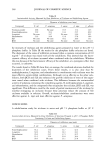
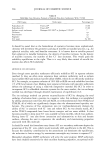
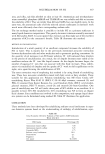
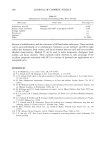
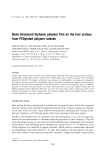
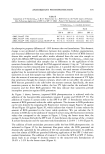
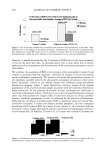
SOLUBILIZATION OF SCI 567 ness, and silky, talc-like afterfeel on skin or hair (6). Ammonium and triethanolamo- nium monoalkyl phosphate (AMAP and TEAMAP) are very soluble and able to increase the solubility of SCI. They are milder than ALS and ALES, but cost slightly more. In the same way, the ammonium salts of all the selected anionic surfactants in method I work much more efficiently than their corresponding sodium salts. The ion exchange method makes it possible to include SCI as a primary surfactant in many liquid detersive compositions. This greatly decreases irritation normally associated with ALS and/or ALES. It is anticipated that chemists can thus make use of the excellent properties of SCI to the consumer's benefit. Table III illustrates this method. METHOD III: EMULSIFICATION Introduction of a small quantity of an emollient compound increases the solubility of SCI in water. This is mainly due to the previously mentioned attractive interaction between hydrocarbon tails and other molecules and to geometric packing constraints. As the quantity of oil increases in an SCI/water solution, CI- will surround these droplets in the process of emulsification. As a result, the oil droplet becomes more stable as the emollient anchors the CI- ions like liquid cement. As the droplet becomes larger, the number of aqueous CI- ions that can associate with this body increases. Thus, stabili- zation via emulsified oil droplets and the uptake of CI- work to shift equilibrium to the right, once again favoring the solubilization of SCI. The most convenient way of employing this method is by using blends of emulsifying wax. These have non-ionic emulsifiers mixed with fatty esters or fatty alcohols. Those suitable for this application are: Polawax (emulsifying wax NF) from Croda self- emulsifying Kester Wax K-82 H (INCI: C-20-40 alkyl stearates, ceteareth 20, and PEG-14 stearate) from Koster Keunen, Inc. and Emulium Delta (INCI: cetyl alcohol, glyceryl stearates, PEG-75 stearate, ceteth-20, and steareth-20) from Gattefosse. One part of emulsifying wax NF will make three parts of SCI soluble in an emulsion. It is possible to have 30% SCI emulsified by 10% emulsifying wax NF to form an elegant facial cleanser. Since emollients are involved in this composition, only opaque liquid deter- sive systems can be formulated using method III. Table IV illustrates this application. CONCLUSION Three methods have been developed for solubilizing sodium cocoyl isethionate in aque- ous detersive systems based on the understanding of enthalpy of solubilization, equi- Table III Clear Economic Detersive Formula of ALS and/or ALES Surfactants With 10% SCI INCI name Percentage (%) Ammonium lauryl sulfate 7.00 Ammonium laureth sulfate 5.2 5 Cocamide MEA 1.75 Sodium cocoyl isethionate 10.0 Preservatives q.s. Fragrance q.s. D.I. water To 100%

568 JOURNAL OF COSMETIC SCIENCE Table IV Mild Detersive Formula of Emulsifying Wax With 30% SCI INCI name Trade name Percentage (%) Emulsifying wax NF Polawax © 10.00 Sodium cocoyl isethionate Hostapon SCI 85G © or Jordapon CI Prill © 30.00 Reology modifier q.s. Preservative q.s. Fragrance q.s. Water To 100% librium of solubilization, and the structures of SCI and other surfactants. These methods can be used individually or in combination. Chemists can use method I and III to make sulfate-free shampoos, body washes, and facial cleansers that are mild and have excellent afterfeel characteristics. Method II can be used to make inexpensive shampoos, body washes, and facial cleansers. These methods enable chemists to take advantage of the excellent properties associated with SCI in a variety of personal care applications at a reasonable price. REFERENCES (1) J. D. Middleton, J. Soc. Cosmet. Chem., 20, 339 (1969). (2) P.J. Frosch and A.M. Kligman, J. Am. Acad. Dermatol., 1, 35 (1979). (3) A. N. Liebert, Final report on the safety assessment of sodium cocoyl isethionate,J. Am. College Toxico/., 12, 459 (1993). (4) H. Plate, Magnesium surfactants--Cleansing at its best and mildest, Parrum. Kosmet., 76, 28-32 (1995). (5) D. W. Williams and W. H. Schmitt, Chemistry and Technology of the Cosmetics and Toiletties Industry, 2nd ed. (Blackie Academic & Professional, 1996), pp. 7-8. (6) M. M. Rieger and D. R. Linda, Surfactants in Cosmetics, 2rid ed. (Marcel Dekker, New York, 1997), pp. 29-81,427-487. (7) R. S. Lee and T. M. F. Salmon, Detergent composition, US Patent 5,415,810 (Lever Brothers Company, 1995). (8) G. S. Gabriel, R. B. Bell, and M. Einziger, Stable liquid delivery system for acyl isethionates, US Patent 5,925,603 (Rhodia Inc., 1999). (9) T.J. Cassady and R. R. Schoettker, Process for making skin cleansing combination soap bars and cleansing liquids, US Patent 6,046,147 (Henkel Corp., 2000). (10) M. Born, Verband/. Deut. Physik. Ges., 21, (1919) F. Haber, Verband/. Deut. Physik. Ges., 21, 750 (1919). (11) P. W. Arkins, Physical Chemistry, 3rd ed. (Oxford University Press, 1986), p. 823. (12) J. Z. Sun and J. W. Parr, Liquid detersire composition containing sodium cocoyl isethionate, US patent pending.
Purchased for the exclusive use of nofirst nolast (unknown)
From: SCC Media Library & Resource Center (library.scconline.org)