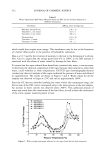
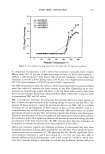
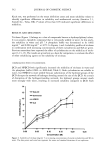
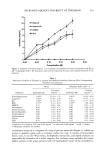
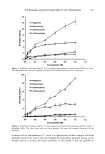
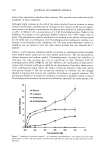
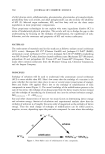
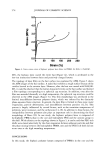
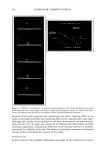
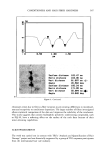
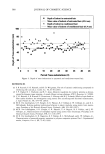
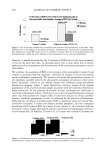
588 JOURNAL OF COSMETIC SCIENCE 100 Depth of indent in untreated hair Mean value of indents of untreated hair (49.4 nm) Depth of indent in conditioned hair Mean value of indents of conditioned hair (61.9 nm) •= 8o ,• 60 i i i i i i i i 0 5 10 15 20 25 30 35 40 45 Paired Nano-indentations (#) Figure 5. Depth of nano-indentation in untreated and conditioner-treated hair. REFERENCES (1) S. B. Ruetsch, Y. K. Kamath, and H.-D. Weigmann, The role of cationic conditioning compounds in reinforcing the cuticula, J. Cosmet. Sci., 54, 63-83 (2003). (2) S. p. Chahal, N. I. Challoner, and R. T. Jones, Moisture regulation by cosmetic proteins as demon- strated by dynamic vapor sorption-•A novel efficacy testing technique, IFSCC Magazine, 3, 2 (2000). (3) Y. K. Kamath, S. B. Ruetsch, E. Petrovicova, L. Kintrup, and H.-J. Schwark, Effects of spin finish on fiber surface hardness: An investigation using atomic force microscopy and frictional measurements, J. Appl. Polymer Sci., 85, 394-441 (2002). (4) M. R. Van Landingham, S. H. Knight, G. R. Palmese, R. F. Eduljee, J. w. Gillespie, Jr., and R. L. McCullough, Relating polymer indentation behavior to elastic modulus using atomic force micros- copy, Proceedings of the Materials Research Society, Pittsburgh, 440, 195-200 (1997). (5) M.R. Van Landingham, S.H. Knight, G.R. Palmese, T.A. Bogetti, R.F. Eduljee, and J. W. Gillespie, Jr., Characterization of interphase regions using atomic force microscopy, Proceedings of the Materials Research Society, Pittsburgh, 458, 313-318 (1997). (6) M. R. Van Landingham, R. R. Dagastine, R. F. Eduljee, R. L. McCullough, and J. W. Gillespie, Jr., Characterization of nanoscale property variations in polymer composite systems: Part 1: Experimental results, Compatites, Part A, 30, 75-83 (1999).

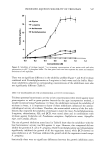
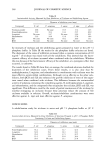
j. Cosmet. Sci., 54, 589-598 (November/December 2003) Bioconvertible vitamin antioxidants improve sunscreen photoprotection against UV-induced reactive oxygen species KERRY M. HANSON and ROBERT M. CLEGG, Laboratory for Fluorescence Dynamics, Department of Physics, University of Illinois, Urbana-Champaign, Illinois. Accepted for publication May 20, 2003. Synopsis The ability of sunscreens and antioxidants to deactivate highly destructive reactive oxygen species in human skin has remained inconclusive. Two-photon fluorescence imaging microscopy was used to determine the effect of sunscreen/antioxidant combinations upon UV-induced ROS generation in ex vivo human skin. A sunscreen combination containing octylmethoxycinnamate (Parsol © MCX) and avobenzone (Parsol © 1789) at SPF 8 and SPF 15 was tested for its ability to prevent UV radiation from generating ROS in the viable epidermal strata ofex vivo human skin. A UV dose equivalent to two hours of North American solar UV was used to irradiate the skin. Each sunscreen reduced the amount of ROS induced in the viable strata by a value consistent with the SPF level. UV photons that were not absorbed/scattered by the sunscreen formulations generated ROS within the viable epidermal layers. The addition of the bioconvertible antioxidants vitamin E acetate and sodium ascorbyl phosphate (STAY-C © 50) improves photoprotection by converting to vitamins E and C, respectively, within the skin. The bioconversion forms an antioxidant reservoir that deactivates the ROS generated (within the strata granu- losum, spinosum, and basale) by the UV photons that the sunscreens do not block in the stratum corneum. INTRODUCTION Ultraviolet (UV) irradiation of human skin induces the generation of reactive oxygen species (ROS), including singlet oxygen (102) , hydrogen peroxide (H202) , and/or per- oxynitrite (ONOO-) (1). These highly reactive derivatives of molecular oxygen react with cellular components including lipid membranes and are considered a source of photoaging and skin cancers that appear later in life (2-9). The ability of sunscreens to protect against the generation of ROS within the skin has not been identified. Although sunscreens do prevent erythema, and are recommended to be used as part of safe-sun practices (10), current research suggests that photoprotection is also needed to reduce ROS levels within the skin (11,12). Address all correspondence to Kerry M. Hanson. 589
Purchased for the exclusive use of nofirst nolast (unknown)
From: SCC Media Library & Resource Center (library.scconline.org)