JOURNAL OF COSMETIC SCIENCE 246 Inc., Glenside, PA). Inside the environmental room, temperature and humidity are also controlled using two fl oor heaters (Model HZ-519 Honeywell, Morristown, NJ) and a cool mist humidifi er (Model HM3655 Holmes, Boca Raton, FL). During testing, temperature, humidity, and dewpoint were monitored every minute in the sauna, in the environmental room, outside the environmental room in the building, and outside of the building in a shaded area. These data were recorded using data loggers (Model DVTH 421-338-0023 purchased from Supco, Allenwood, NJ), and were transferred to computer by USB cable where they could be analyzed using software provided by Supco. The barometric pressure was also recorded at the beginning of all experimental sessions using an aneroid (mechani- cal) barometer (Model Proteus Maximum Inc., New Bedford, MA). Unless otherwise indicated, subjects are allowed to acclimate for 30 min in the environ- mental room prior to entry into the sauna. During this time, they are discouraged from engaging in stressful conversation or work-related reading. The temperature and humid- ity of the room are (normally) maintained constant at approximately 28°C (84°F) and 40% RH, corresponding to a dew-point temperature of roughly 14°C (57°F) and satura- tion vapor pressure of 3.98 kPa. All subjects were dressed in a uniform consisting of cot- ton slacks (Model RN85080 La Difference, Mexico) and cotton T-shirts (I2701 Fruit of the Loom, Inc., Bowling Green, KY). For safety reasons, the blood pressure and pulse rate of each subject were recorded before entry into the sauna using a blood pressure monitor kit (Model HEM-780 Omron, Kyoto, Japan). If blood pressure readings indicated any degree of hypertension, the subject was immediately dismissed from participating in the test. The following guidelines were used to determine the level of severity of hyperten- sion: mild hypertension (systolic blood pressure = 140–160 mm Hg diastolic blood pressure = 90–100 mm Hg), moderate hypertension (systolic blood pressure = 160–200 mm Hg, diastolic blood pressure = 100–120 mm Hg), and severe hypertension (systolic blood pressure = above 200 mm Hg, diastolic blood pressure = above 120 mm Hg). We measured resting heart rate (no physical exertion) and eliminated any subjects from the study whose monitored values were greater than 90 bpm. Once the subject reached equilibrium in the environmental room, they entered the sauna for a total of either 30 (Test 1) or 45 min (Test 2). In Test 1, the fi rst 10 min is an equi- librium period followed by a 20 min sweat production period. At t = 10 min, the subject was given two pre-weighed feminine hygiene pads (Stayfree, Ultrathin Overnight Pads with Wings McNeil-PPC, Inc., Skillman, NJ), which they place (folded) in the left and right axillae. At t = 30 min, the weight of the absorbent pad is measured using an elec- tronic balance (Scout Pro Balance, Ohaus, Pine Brook, NJ). After the pad is weighed, replica measurements are conducted. In Test 2, the subject enters the chamber and is im- mediately given the pads to place in the axillae. The pads are weighed every 5 min until the conclusion of the test. In Test 1, we recruited more than 25 subjects, both male and female, from diverse racial backgrounds and ranging in age from 30 to 45 years. In Test 2, two male subjects participated in a battery of range-fi nding experiments. Subject 1—38 years old, 62 in. height, 135 lb. weight, and of Chinese origin. Subject 2—43 years old, 70 in. height, 175 lb. weight, and American of Northern European ancestry. These two subjects had no history within the last 5 years of antiperspirant usage. In several experiments, subjects were preconditioned using an exercise bike (Schwinn Ac- tive 10 Series Nautilus Inc., Vancouver, WA). In other experiments, subjects were placed in a cool room (2°C and 80% RH) for the fi rst 30 min of the test, then directly entered the sauna. Also, the infl uence of hot (76°C) and room temperature (22°C) water ingestion

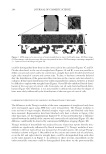
ENVIRONMENTAL PARAMETERS ON SWEAT GLAND ACTIVITY 247 on sweating was investigated by giving the subjects 250 ml of water at t = 20 min in the sauna (water was consumed within 5 min). RHEOLOGICAL ANALYSIS AND PREPARATION OF REPLICAS To obtain replicas of the skin-surface structure, including sweat bead topography, we used Silfl o impression resin in combination with supplied thinner and catalyst (CuDerm, Dallas, TX). The preparation consisted of (i) Adding 10 drops of thinner to 4.0 g of resin, mixing thoroughly, and allowing 20 min for equilibration. (ii) Five drops of catalyst were subsequently added to the resin/thinner mixture, followed by 10 s of meticulous mixing, and ensuing application to the skin or DMA geometry. Because the resin hardens via a time-dependent, condensation curing process, where the hydroxyl-terminated silicone chains are catalyzed into a crosslinked, elastomeric network, the kinetics and rheology of the curing process were studied prior to in vivo testing. A DMTA Mark IV Dynamic Me- chanical Analyzer (TA Instruments, New Castle, DE) was used to approximate the gel point (i.e., E′ = E″) of the curing resin (14). Aliquots of the catalyzed resin were loaded into a compression fi xture (17-mm-diameter stainless steel plates) and dynamic time sweep experiments (ω = 1 Hz, γ = 0.5%, gap = 1 mm, 25.7°C, n = 6) were executed to follow the changes in viscoelasticity as a function of time. To simulate the presence of a bead of sweat in contact with the curing resin, a 20 μl droplet of ρ = 18.2 MΩ·cm puri- fi ed water (Millipore, Burlington, MA) was added to the surface of the loaded resin prior to adjusting the DMA geometry to the 1-mm testing gap and starting the test. During the in vivo perspiration tests, silicone impressions were only taken during Test 1. In this particular test, we used Procedure 1 (described in the section above) in which case approximately 10 drops of thinner is added to the impression material at t = 10 min in the sauna. This mixture is allowed to sit until t = 30 min, when 5 drops of catalyst were added. The resulting mixture is thoroughly, but gently, mixed prior to application avoiding the formation of air bubbles (note that mixing was carried out in the environmentally con- trolled room, not the sauna). Four skin replica rings were placed on the upper part of the inner forearms of the subjects for the last 5 min they spent in the sauna. Also, the day prior to experiments, all subjects were thoroughly shaved in the inner former area so that hair fi bers would not interfere with the replica measurements of sweat protrusions. Subjects did not use any type of cosmetic or pharmaceutical products on their inner forearm region for at least 1 day prior to the examination (In fact, in almost all cases, subjects reported never treating their skin with products.). Prior to the tests, the forearm of each subject was gen- tly washed with Dove soap (Dove beauty bar Unilever, Trumbull, CT). Image analysis methods were used in combination with skin replica analysis to quantify the number of active sweat glands per given area. This technique is largely based on a published report by Keyhani et al. (13). Image processing and analysis were carried out using Adobe Photoshop CS5 (Adobe Systems Inc., San Jose, CA) and ImageJ (http://rsbweb.nih.gov/ij/). IR THERMAL IMAGING We conducted thermal imaging measurements with a FLIR Systems camera (Model P620 FLIR Systems Inc., Wilsonville, OR). The thermal imaging camera was mounted on a tripod
Purchased for the exclusive use of nofirst nolast (unknown)
From: SCC Media Library & Resource Center (library.scconline.org)