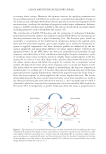
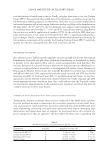
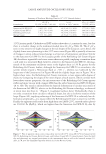
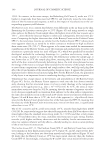
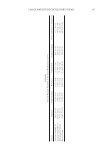
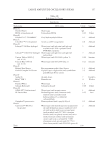
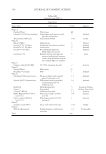
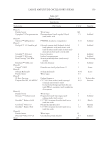
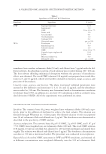
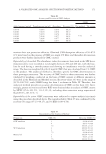
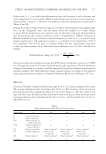
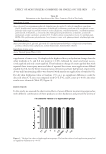
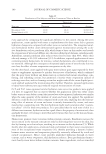
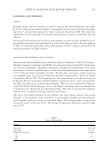
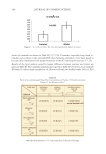
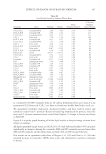
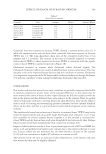
LARGE AMPLITUDE OSCILLATORY SHEAR 135 rival the rheological trends seen in the jar. Finally, at higher shear rates in situ, the Cushion Cream SPF-15 does peel from the parallel discs of the rheometer—evidently concurring that the formulation exhibits properties of cohesiveness. Note that, in vivo, interfacial phenomena and natural asperities aid in overcoming deleterious peeling or pilling of the formulation on the skin surface. At 25° and 32°C, the I2/I1 harmonic ratio suggests some asymmetric fl ow at oscillatory shear rates less than 1 s-1 (0.02 and 0.05, respectively) however, plug fl ow or slip was not seen with the application of a marker (25°C). At the end of the LVR, there were large and steady rises in I3/I1 and I5/I1 (0.08 and 0.02 at 100 s-1), signifying nonlinear rheo- logical changes. Finally, correlation of technology with the sensorial panel may be tricky for this sample as components of the initially thick-feeling Cushion Cream SPF-15 sorb fairly quickly into the skin, leaving behind a fi lm with a nontacky, dry feel. BROOKFIELD VISCOMETRY As a reference point, Table I provides apparent viscosity and pH data for the four textural formulations. Generally, the pH values of skincare formulations are formulated as closely as possible to the skin surface pH in order to avoid incompatibility with skin fl ora. The viscosity data provide a general reference point for the formulations since Brookfi eld vis- cometry is employed almost universally in development and quality control laboratories. Removing the Buttery Cream result, the T-spindle Brookfi eld viscometry data correlated well (R2 = 0.988 and 0.999, respectively) with the steady torsional and ZSV data for the Sunscreen Gel SPF-50, Cushion Cream SPF-15, and Refreshing Gel Cream. As the rheo- logical data for the Buttery Cream were observed below the steady torsional and ZSV versus apparent viscosity correlation lines, this could indicate that the T-spindle results are less sensitive than rheometry to the generation of a signifi cant interfacial slip layer for a sample structured with a waxy matrix. SUMMARY OF NON-LINEAR RHEOLOGY DATA (LISSAJOUS REPRESENTATIONS) Traditionally, dynamic oscillatory shear tests are conducted in the SAOS mode, and have been the preferred method to characterize the viscoelastic properties of soft solids. In re- cent years, however, much interest has focused on collecting data in the LAOS mode since many engineering, processing, and application operations often require impinging large deformation and higher shear rates on samples. As mentioned above, this certainly ap- plies to preparations that are applied to the skin where the shear rates in spreading and Table I Brookfi eld Viscometry and pH Results (T Spindle, 25°C) Formulation T-spindle Apparent viscosity (cP) pH Sunscreen Gel SPF-50 C 27,500 ± 2,500 NA Cushion Cream SPF-15 D 95,000 ± 25,000 5.3 ± 0.2 Refreshing Gel Cream B 42,500 ± 7,500 5.6 ± 0.2 Buttery Cream D 185,000 ± 25,000 5.2 ± 0.2

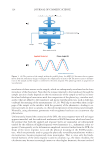
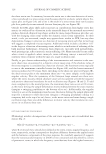
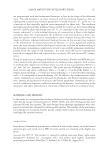
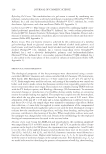
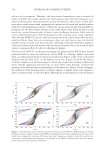
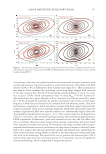
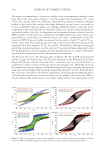
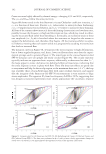
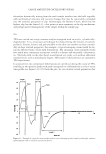
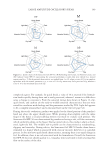
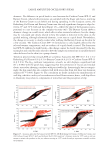
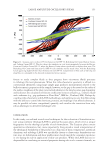
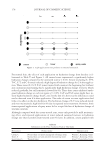
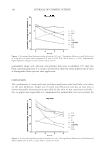
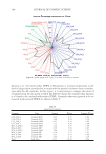
JOURNAL OF COSMETIC SCIENCE 136 rub-in can be enormous. Therefore, the four texture formulations were evaluated by means of LAOS. The reader should note that Lissajous plots from low frequency (i.e., lower oscillatory shear rate) experiments are also introduced in this section, as they illus- trate many useful points when comparing the interaction of rough and smooth surfaces with the tested formulations. Figure 4 shows the viscous Lissajous plots from LAOS ex- periments for the four texture systems in the study. Most of the Lissajous plots in this article are viscous Lissajous plots of stress versus oscillatory shear rate. Each series of curves is plotted full scale so that the dynamics of the contours can be easily examined. Note that the ARES-G2 data are collected in transient mode, which means that the mea- sured oscillatory shear rates are instantaneous shear rates and, hence, may not directly parallel trends in steady state shear rate data. Although traditional rheometry displays a collection of data points that may be taken as almost disjointed facts, the Lissajous plots convey a continuous fl ow of collective rheological changes. The Sunscreen Gel SPF-50. As illustrated in Figure 4A, Sunscreen Gel SPF-50 has a smooth transition from an elastic microstructure (in the LVR) to a fl owing, lightly structured fl uid—as demonstrated by the evolution of symmetrical ellipses at the center to distorted ellipses with line-like “tails” at the highest strain rate. Figure 5A shows the impact of surface roughness on the measurement—where the rough surface displays higher total stress, thereby suggesting that wall slip, or, more likely, shear banding, confound the meaning of the smooth surfaces measurement at low shear rate. Hence, for the sandpaper, the transition of the Lissajous plots to thinner ellipses at higher strain rates suggests a plastic transition from a yield stress fl uid. Although the yield transition in the prototypes Figure 4. Smooth surface viscous Lissajous plots for (A) Sunscreen Gel SPF-50, (B) Refreshing Gel Cream, (C) Buttery Cream, and (D) Cushion Cream SPF-15 formulations. For the same applied strain, the inset in 4C shows stress changes with iterations of the same shear rate. Changes are related to the brittle and waxy mi- crostructure, and the apparent thixotropy is accentuated at the highest oscillatory shear rates. σ0 approxi- mates the location of the apparent yield stress.
Purchased for the exclusive use of nofirst nolast (unknown)
From: SCC Media Library & Resource Center (library.scconline.org)