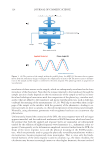
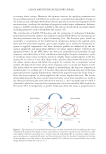
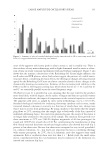
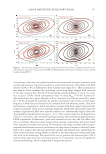
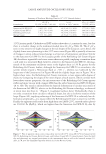
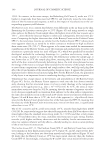
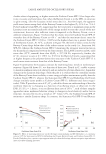
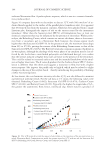
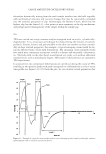
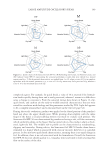
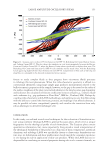
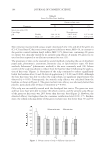
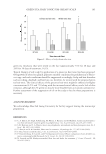
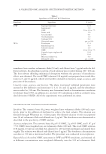
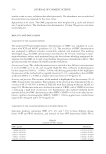
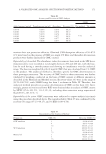
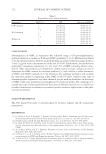
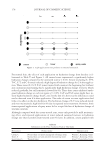
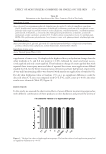
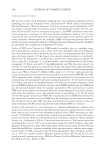
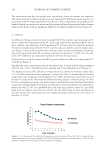
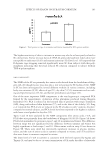
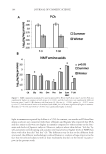
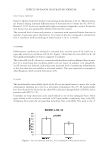
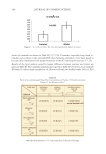
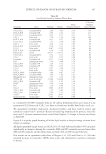
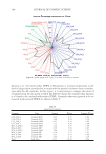
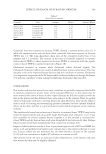
LARGE AMPLITUDE OSCILLATORY SHEAR 149 completely agrees. For example, for quick break, a value of 10 is assessed if the formula- tion breaks quickly during shear and is easily perceived, whereas 1 means it is diffi cult to sense a change in consistency. From the sensorial ratings data shown in Figure 12, slip, quick break, and cushion are the early-to-middle sensorial characteristics that are most suited for correlation with rheology and the parameters studied by TPA. Light feel appears to be a complex sensorial facet and is discussed later in the text (see page 32). During the tactile evaluation, product was applied to the dorsal portion of the panelist’s hand just above the upper thumb joint. While pressing down slightly with the index fi nger of the hand, a circular rubbing motion was made to evaluate each product. The Sunscreen Gel SPF-50 was characterized by panelists as having a soft, oil-like consistency, which uniformly glides on the fi nger. During initial rub-in, this product adapts a thick- ened, light-oily feel. The middle rub-in profi le can be characterized as nonabsorbing, slippery, and nontacky. During rub-in, the Sunscreen Gel SPF-50 breaks down from a semisolid to a liquid, which is associated with a loss in viscosity however, it is a gradual process. It does not have quick break characteristics, meaning there is no rapid change in feel. In addition, there is no tack associated with the formulation. Overall, the Sunscreen Gel SPF-50 does not absorb quickly (i.e., long play time) and tends to form a lasting thin fi lm on the surface of the skin. Figure 12. Spider charts of (A) Sunscreen Gel SPF-50, (B) Refreshing Gel Cream, (C) Buttery Cream, and (D) Cushion Cream SPF-15 representing the sensorial performance results that were tallied by a trained expert panel (n = 5). Each sensorial characteristic was ranked from 1 to 10, where a score of 10 is in complete agreement with the named parameter, e.g., a score of 1 for slip means very little perceived slip, whereas a score of 10 is the maximum perceived slip.

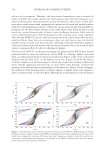
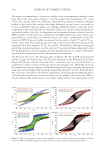
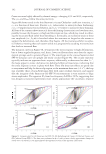
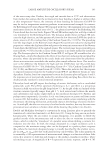
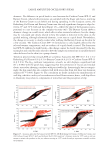
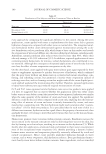
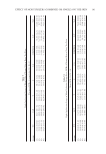
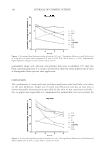
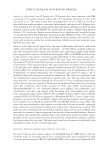
JOURNAL OF COSMETIC SCIENCE 150 The initial tactile perception of the Refreshing Gel Cream is a “cool to touch” sensation. Pressing down with the index fi nger, it was noted that the product is adaptable and easy to manipulate. There is a slight cushion that is similar to that of Sunscreen Gel SPF-50. During rub-in, there is a perceptible quick break. It should be noted that quick break processes are usually observed due to a dramatic change in feel that is associated with a discernible variation in the structure of the product, resulting in a cooling effect (rapid water evaporation), or change in physical state from a semisolid to a lower viscosity liq- uid. In the case of the Refreshing Gel Cream, a cream gel to liquid phase transition is the sensorial cue. It should be noted that shearing between two plates does not instigate the cream to liquid transition—factors from the skin surface appear critical to the perceived spreading rheology. The initial perception of the Buttery Cream is that it has discernible viscous resistance. It is very matte, indicating that it has a dry feel. It does, however, start to thin with contin- ued rubbing and thinning of the fi lm, which is a gradual process and not noted as an abrupt collapse of structure. As mentioned below, this is probably why the Buttery Cream is ranked fairly low on quick break. It has a viscous characteristic during rubbing, which is distinct from the Refreshing Gel Cream (lighter feel) and Sunscreen Gel SPF-50 (the lightest feel). The Buttery Cream is a wax-based structure, therefore, there is no sustained cushion. Usually waxy structures require greater preliminary forces to break down the structure, but then they transition quickly to a fl uid—especially if melting transitions are encountered. This phenomenon is clearly evident if one examines the Lissajous plot shown in Figure 4C, which undergoes a more drastic shape change than the other products ex- amined. As with the Refreshing Cream, the skin surface environment conspicuously im- pacts the rheological outcome. The Cushion Cream is best characterized as slightly elastic with some pickup when the index fi nger is forced downward on the product and then retracted. It maintains its shape when placed on the skin, thereby illustrating its robust microstructure. It is a thick treat- ment with more fl ow-resistance characteristics than the other samples. The initial feel characteristics reveal a large viscous component as the product thins, while during the secondary and fi nal rub-in, a powder-like texture is experienced. There is no quick break, and the product absorbs into the skin rather quickly. Also, there is no tack, and the rich formula remains very dry throughout the sensorial test. The texture of the Cushion Cream is based on a hybrid polymer and wax structure however, the polymer is the dominant structuring agent. In general, cushion is related to elasticity and fl exibility, properties common in polymers. Waxes, on the other hand, are crystalline, less tough, and require greater initial forces to manipulate form. Comparing the sensorial and rheology data, we can make several conclusions about the relationship between these two data sets. The mean quick break sensorial data ranks as follows: Refreshing Gel Cream (5.4 ± 0.6) Sunscreen Gel SPF-50 (2.4 ± 0.9) Buttery Cream (1.3 ± 0.5) = Cushion Cream SPF-15 (1.3 ± 0.5). As already mentioned, quick break is a parameter related to the early perception of a change in structure. As judged by τ0, ZSV, σ’max, and the trends in Figures 5 and 9, the Sunscreen Gel SPF-50 has the soft- est microstructure. The soft microstructure potentially masks dramatic changes as the sample is spread onto the skin. The Refreshing Cream, on the other hand, has a rather cohesive structure, even though it is softer than the Buttery Cream and Cushion Cream SPF-15 however, the Refreshing Gel Cream is sensitive to the chemistry of the skin sur- face and appears to melt when sheared. The transition from a cohesive soft solid to fl ow is
Purchased for the exclusive use of nofirst nolast (unknown)
From: SCC Media Library & Resource Center (library.scconline.org)