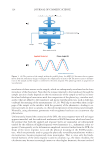
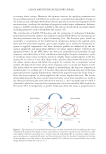
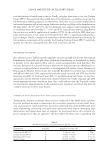
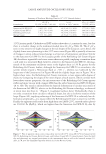
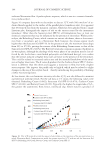
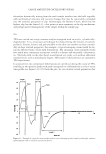
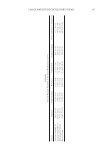
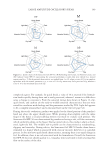
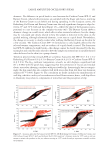
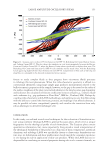
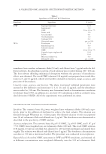
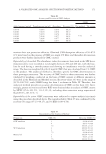
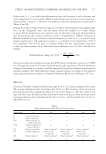
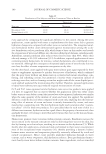
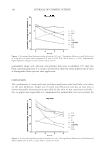
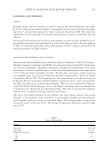
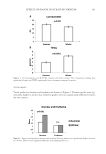
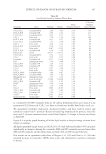
LARGE AMPLITUDE OSCILLATORY SHEAR 139 32°C Lissajous profi le. Chebyshev and DFT analyses show that e3/e1 remains the same, but that there is a modest change in the nonlinear moduli ratio (G’L/G’M Table II). The G’L/G’M ratio is very sensitive to slight changes in the tail shapes of the Lissajous curve hence, the slightly lower stress plateauing in the 32°C stress curve (Figure 6B) is partially a function of changes in strain-induced stored energy as a function of temperature and shear. Similar to the Sunscreen Gel SPF-50, the Lissajous profi le of the Refreshing Gel Cream (Figure 4B) describes a sigmoidal total stress versus shear rate profi le, implying a transition from a soft solid to a structured fl uid however, relative to the Sunscreen Gel SPF-50, the mag- nitude of the maximum oscillatory stress at the highest shear is 130 Pa greater for the Refreshing Gel Cream further, although the Sunscreen Gel SPF-50 is viscoelastic, the system trends toward a Newtonian fl uid at ~300 s-1, whereas (as evidenced by the larger area of the Lissajous tail in Figure 4B and the slightly larger area in Figure 7A) at higher shear rates, the Refreshing Gel Cream maintains a more appreciable degree of elasticity. Comparing the slopes of the inner ellipses of each system, which correlate with lower-shear texture properties, the microstructure of the Refreshing Gel Cream appears stiffer and more viscous with a longer LVR than the softer Sunscreen Gel SPF-50 (Figure 4A vs. 4B). The trend is inferred from the hurried deformation of circular trajectories of the Sunscreen Gel SPF-50, relative to the Refreshing Gel Cream technology, as observed at strain rates less than 4 s-1 (Figure 5, roughened surfaces data). Undoubtedly, there is not only a transition from circular to elliptical shape, but also a clockwise rotation of the loops (Figure 4A), implying softening of the Sunscreen Gel SPF-50 at relatively low de- formation amplitudes—in a region where the Refreshing Gel Cream is nearer to its LVR. Finally, the apparent yield results from high shear rate LAOS (25°C, smooth surface plates) are 230/160 Pa (σ0/σ’0), which are higher than the Sunscreen Gel SPF-50 σ0 data by Table II Summary of Nonlinear Rheology Data for 25°/32°C (Smooth Surface) Formulation G’L/G’M 25/32°C at 185 s-1 (±3.9%) (e3/e1) 25/32°C at 185 s-1 (±0.01) σ’max, γ = 600% 25/32°C (±2 Pa) Sunscreen Gel SPF-50™ 4.80/2.45 (−43%) +0.31/+0.23 (−26%) 177/126 (−29%) Cushion Cream SPF-15 2.87/2.70 (−5.9%) +0.24/+0.24 (0.0%) 400/336 (−16%) Refreshing Gel Cream 3.52/2.57 (−27%) +0.23/+0.23 (0.0%) 191/180 (−5.8%) Buttery Cream 2.17/1.30 (−40%) +0.26/+0.13 (−50%) 358/146 (−59%) Figure 7. Plot of apparent elastic stress versus shear rate for (A) 25°C versus (B) 32°C for Sunscreen Gel SPF-50, Refreshing Gel Cream, Buttery Cream, and Cushion Cream SPF-15 (smooth plates). Note that wall slip and thixotropy are integral participants in the instrumental data as well as the sensorial ratings (12). Also, in 7B, note the diminished apparent elasisticity for the Buttery Cream.

JOURNAL OF COSMETIC SCIENCE 140 150%. In contrast, in the stress sweeps, the Refreshing Gel Cream τ0 result was 371% higher in magnitude than Sunscreen Gel SPF-50, and implicitly notes the time depen- dence of the microstructural response, as well as the impact of viscoelasticity on the cor- responding apparent yield behavior. The Buttery Cream. It is a system that behaves very differently in the jar than on the skin. Examining the Lissajous contour plot at 25°C (Figure 4C) and using smooth or rough plate surfaces, the Buttery Cream sample shows the highest stress of the four textures up to 150 s-1, after which the structure begins to soften and, subsequently, the total stress pla- teaus. Comparing the higher shear rate data of the Buttery Cream to the Cushion Cream SPF-15, the total stress maxima are similar, but the Cushion Cream SPF-15 shows much more apparent elasticity, as noted by its wider contours at moderate-to-high oscillation shear strain rates (50–350 s-1). There appears to be some time needed for measurement equilibration of the Buttery Cream, as per the striations and gradual stress decay for each iteration at a particular strain (see inset of Figure 4C), which was paralleled by standard rheological methods for evaluating thixotropy (i.e., preshear and recovery, steady tor- sional). By using a marker to visually follow the deformation within the sample gap, it was shown that at 25°C the sample plug fl ows, meaning that the sample slips at both walls of the discs instead of laminarly deforming hence, the total stress plateaus because the energy of the motor is no longer fully translated to the entirety of the sample. Further, as noted from comparisons of smooth and rough surfaces data, wall slip and plug fl ow affect the tilt and maxima of the smooth-surface Lissajous loops. It appears that generated slip layers lead to lubricity and increased plug fl ow. For the Buttery Cream, the generation of slip layers is an important factor in correlating rheology with sensory perception. Temperature has a large impact on the fi rmness and spreadability of the Buttery Cream (Figure 6C). In fact, the Buttery Cream appears to melt onto the skin almost immedi- ately, showing that for structured waxes it is key to study rheology at the temperature pertinent to the application (e.g., skin = 32°–35°C) (18). At 32°C, the stress at maxi- mum shear strain rate drops by 302 Pa, meaning that the amount of apparent viscoelas- ticity decreases signifi cantly on transition from ambient to the skin surface temperature the same directionality is seen in the trends in σ’ (elastic stress) as a function of shear rate. Figures 7A and B show that at 32°C, the level of the apparent (i.e., slip affected) elastic stress for the Buttery Cream drops below that of the Sunscreen Gel SPF-50, meaning that the elasticity of the Buttery Cream microstructure, even at low shear rates, is signifi cantly softer than it is at 25°C. The G”/G’ crossover and σ’0 yield stress results (25°C, smooth) from high-shear LAOS (394/293 Pa, respectively) suggest that the yield magnitudes from LAOS are three to four times higher than the standard stress sweep result (τ0 = 92 Pa) and that at low strains (γ 3.7%) and short times, the waxy, crystalline microstructure is quite strong. Further, near the yield, higher oscillatory shear rates and the inability for the microstructure to relax may suppress inherent wall slip effects—thereby leading to a more accurate probing of the at-rest waxy microstructure. The Cushion Cream SPF-15. The Cushion Cream SPF-15 and Buttery Cream have similar stress maxima in their fi nal Lissajous loops (25°C, Figure 4C, and D, respectively) how- ever, looking at the low shear rate data from smooth and rough surfaces (Figure 5C and D) shows that the Buttery Cream at 25°C has more initial elasticity than the Cushion Cream SPF-15. Interestingly, evaluating the σ’ and σ” data versus strain for both systems
Purchased for the exclusive use of nofirst nolast (unknown)
From: SCC Media Library & Resource Center (library.scconline.org)