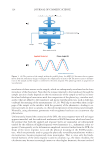
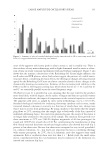
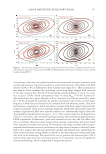
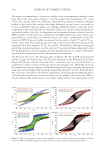
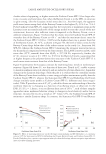
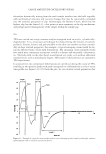
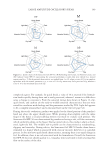
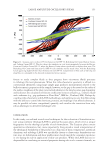
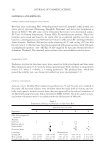
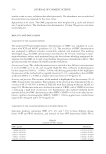
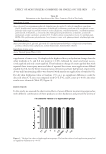
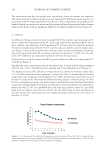
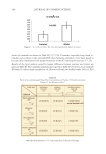
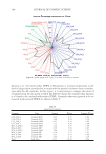
LARGE AMPLITUDE OSCILLATORY SHEAR 145 electrolyte dynamically mixing from the steel–sample interface into the bulk, arguably adds asymmetrical structure and viscosity changes that may be conceivably comingled into the sensorial perception of slip. Interestingly, the Buttery Cream, which has the highest slip, has the lowest I2/I1—this points to more symmetry in the slip mechanism, and perhaps greater homogeneity of the sample within the sample gap. TPA TPA was carried out using a texture analyzer equipped with an acrylic, cylindrically- shaped probe. It is a very practical technique for characterizing the textures of cosmetic products. Creams, lotions, and gels available in the skin-care market can vary consider- ably in their textural properties. For example, a typical antiaging cream would be dis- tinctly different from a body milk formulation. The antiaging cream normally would have much more consistency or structure as well as a distinct rub-out profi le, cohesiveness, etc. The body milk, on the other hand, would spread very easily, even without additional external forces, such as spreading by fi ngers. These types of characteristics are captured in TPA experiments. In a typical test, two compressive deformations are carried out during the course of TPA, resulting in two positive peaks (each peak corresponds to a deformation) in a force versus time profi le (see Figure 11) (22). From the plot, we can calculate several parameters that Figure 11. Example of a typical texture profi le analysis curve denoting specifi c length, peak height, and area measurements used to calculate textural attributes.

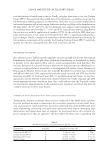
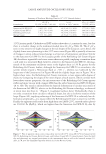
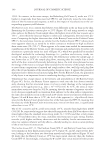
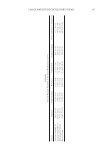
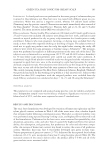
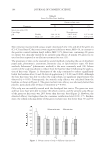
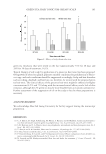
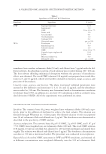
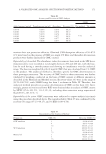
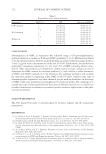
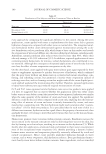
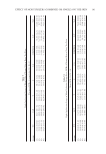
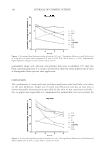
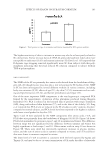
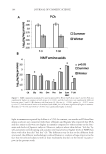
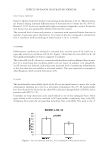
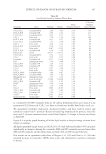
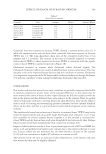
JOURNAL OF COSMETIC SCIENCE 146 can be related to textural properties of the formula. Areas 1 and 2 are the calculated areas under the fi rst and second peaks, corresponding to the fi rst and second deformations. These values are used to calculate the TPA cohesiveness (Area 2/Area 1) and compress- ibility [1 − (Area 2/Area 1)] of the emulsion. Peak 1 is the maximum value of the fi rst peak and corresponds to the fi rmness or penetration force required to deform the sample. The fi rst peak can further be analyzed by taking the ratio of Area 5 to 4, which provides a measure of resilience. During withdrawal of the probe, the force of attraction between the particles of a substance and the probe (adhesion) may be gleaned from Area 3 or 6 (negative peaks). Integrity of shape corresponds to the springiness of the sample and may be calculated by taking the ratio of Length 2 to 1. The elastic resistance to deformation for a semisolid corresponds to Peak 1 (Area 2/Area 1). Finally, stringiness corresponds to Length 3, which begins in the negative force region of Area 6 and ends when the force becomes asymptotic to zero force. In this work, we characterized the four prototype formulas according to the various TPA results, which are shown in Table III. Upon inspection of the data, it is immediately ap- parent that fi rmness is the highest for the Buttery Cream followed by the Cushion Cream SPF-15, Refreshing Gel Cream, and Sunscreen Gel SPF-50. For comparison, the maxi- mum stress values in Figure 4 from the LAOS experiments match very well with the fi rmness data for all of the formulas. The compressibility is a little more diffi cult to dis- cern upon initial inspection. The Buttery Cream is the most diffi cult to initially pene- trate, which may be attributed to the large quantity of esters and the rigid lamellar gel technology in the formula however, the Cushion Cream SPF-15 is the most diffi cult to condense in successive compressions, essentially illustrating the objective design of this product as a “bouncy cream.” Not surprisingly, resilience follows the same trend as com- pressibility, demonstrating that the Buttery Cream is thixotropic and that the Cushion Cream SPF-15 quickly adapts to changes caused by the initial force deformation. The TPA resilience data again resonate with the results of the thixotropy data from the steady torsional, preshear and recovery, and LAOS work as opposed to the other three textures, apparently there is rapid structure breakdown, and/or perhaps the generation of an interfacial slip layer, for the Buttery Cream after the initial probe penetration. The Refreshing Gel Cream and Sunscreen Gel SPF-50 both exhibit higher compressibility and resilience than the Buttery Cream, which also suggests minimal thixotropy and rapid microstructure recovery. Cohesiveness refers to the tendency of the molecules within the composite formulation to stick together and is given by Area 2/Area 1 in the TPA curve. Normally, formulas with signifi cant consistency tend to be more cohesive. For example, a product that spreads or fl ows easily would tend to be less cohesive. Similar to the comparison we provided above—skin-care cream versus body milk—a skin-care cream would be more cohesive than a body milk. For the tested formulas, the Buttery Cream provides the highest cohe- siveness followed by the Cushion Cream SPF-15, Refreshing Gel Cream, and Sunscreen Gel SPF-50. Interestingly, these data follow the same trend given by τ0, which is not surprising as the yield stress and cohesive forces describe similar physical behavior related to the breakdown or fl ow of a material. The cohesiveness data inversely trend (R2 = 0.914, semilog plot) with G’L/G’M at 185 s-1 (see Table II). As stated previously, G’L/G’M provides an indication of nonlinear Lissajous shape and is a measure of the ratio of the elasticity at large strains (G’L) to the residual elasticity (G’M) at 0% oscillatory strain. The resulting correlation suggests that lower TPA cohesiveness, which is derived from area of work
Purchased for the exclusive use of nofirst nolast (unknown)
From: SCC Media Library & Resource Center (library.scconline.org)