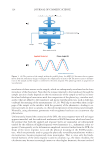
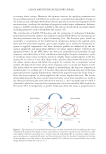
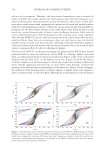
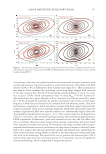
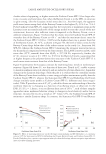
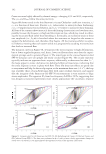
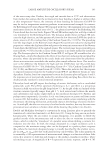
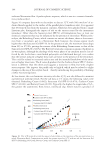
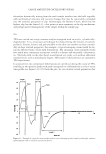
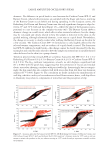
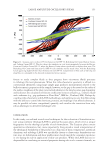
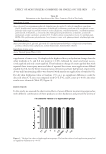
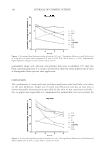
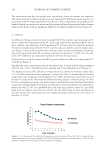
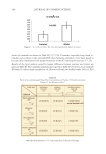
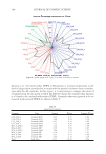
LARGE AMPLITUDE OSCILLATORY SHEAR 153 fi xture to study complex fl uids as they progress from viscometry (fl uid) processes to tribology (friction) phenomena. When this tribo-rheometric geometry is affi xed to a conventional rheometer, using large sample gaps produces measurements related to the bulk viscometric properties of the sample however, as the gap is decreased to the order of the surface roughness of the plate (or attached substrate), the data becomes gap dependent and facilitates the calculation of friction coeffi cients between a fl uid (e.g., cosmetic fl uid) and a substrate (e.g., pig epidermis or Vitro-Skin®, IMS Inc., Portland, MA). Perhaps by coupling tribo-rheometry with LAOS methodology, and applying to very thin fi lms along with the ability to control the chemistry, porosity, and topology of an affi xed substrate, it may be possible to better comprehend, quantify, and visualize the transition from early rub-in (rheology) to after-feel (tribology) (24). CONCLUSION In this study, we outlined several novel techniques for the evaluation of formulation tex- ture using nonlinear rheology (LAOS) to generate Lissajous plots, which serve as unique fi ngerprints for the rheological profi le of each formulation. The Lissajous plots contain quantitative information, but, more importantly, they provide a visual interpretation of the rheological breakdown of the products as a function of shear, temperature, interfacial chemistry, and tribology. LAOS was specifi cally chosen to characterize formulation tex- ture since its deformation and shear profi les most closely match the consumer experience in vivo during the rub-in application of skin-care products. While the LAOS data are in- dispensable for correlating to sensorial properties during rub-in of a cosmetic formula, we Figure 14. Lissajous curve overlay (25°C) for Sunscreen Gel SPF-50, Refreshing Gel Cream, Buttery Cream, and Cushion Cream SPF-15. The plot shows the similarity in total stress magnitude between the Buttery Cream and Cushion Cream SPF-15, where the Buttery Cream softens signifi cantly at higher shear rates. The Refreshing Gel Cream and Sunscreen Gel SPF-50 scale similarly and are much softer, with the Refreshing Cream appearing slightly fi rmer than the Sunscreen Gel SPF-50. Complexities in fl ow, such as wall slip and plug fl ow, are comingled in the depicted instrumental stress response.

JOURNAL OF COSMETIC SCIENCE 154 also generated a signifi cant amount of standard rheology data to better appreciate trends in Lissajous profi les, as well as to characterize the formulations with rheological parameters that more closely correspond to the initial tactile and at-rest properties of the formula- tion. Overall, our fi ndings demonstrate that temperature, electrolyte, oscillatory shear rate, and the tribology/surface chemistry of the rheometer probes all impact the meaning of the data. Rough parallel plate surfaces challenge the integrity of the microstructure, while smooth data tend to better correlate with characteristics like slip. In addition to the complex rheology assessment, we also conducted TPA measurements to provide an over- all characterization of key textural parameters of the formulation itself, such as fi rmness, cohesiveness, compressibility, resilience, etc. In several cases, comparison of these discrete attributes with results from linear and nonlinear rheology tests showed good correlation. Finally, sensorial analysis by an expert panel provided demonstrable discrimination between the distinct textural formulas and correlated well with several rheological parameters. ACKNOWLEDGMENTS We would like to thank the following individuals for their patience, cooperation, and important contributions to the article: Bharath Rajaram, Ph.D. (TA Instruments), Sarah Cotts, Ph.D. (TA Instruments), Professor Gareth H. McKinley, Ph.D. (MIT), William Thompson (Ashland, Inc.), Karine Deruddre (Ashland, Inc.), Nevine Issa (Ashland, Inc.), Diane Kennedy (Ashland, Inc.), Ritamarie Guerrero (Ashland, Inc.), James E. Brady, Ph.D. (Ashland, Inc.), Lexie Niemoeller, Ph.D. (TA Instruments), Alina Higham-Latshaw, Ph.D. (TA Instruments), Nathan Hesse, Ph.D. (TA Instruments), Aurelio Perez (TA Instruments), Tom Basalik (TA Instruments), David J. Moore, Ph.D. (GSK Consumer Healthcare), J.P. (writing partner and the world’s most awesome 19 year-old feline), and Donald Koelmel (TRI-Princeton). REFERENCES (1) F. J. Pilgrim and D. R. Peryam, Quartermaster Food and Container Institute for the Armed Forces (U.S.) Food Acceptance Branch, Sensory Testing Methods: A Manual. (ASTM International, 1958). (2) W. E. Craighead and C. B. Nemeroff, The Concise Corsini Encyclopedia of Psychology and Behavioral Science. (John Wiley & Sons, Hoboken, NJ, 2004), pp. 929–930. (3) S. Guest, F. McGlone, A. Hopkinson, Z. Schendel, K. Blot, and G. Essick, Perceptual and sensory- functional consequences of skin care products, J. Cosmet. Dermatol. Sci. App., 3, 66–78 (2013). (4) M. Bourne, “Food Texture,” in Encyclopedia of Agricultural, Food, and Biological Engineering, D. R. Heldman, Ed. (Marcel-Dekker, New York, 2003), pp. 352–357. (5) L. Gilbert, C. Picard, G. Savary, and M. Grisel, Impact of polymers on texture properties of cosmetic emulsions: A methodological approach, J. Sensor. Stud., 27, 392–402 (2012). (6) M. Karsheva, S. Georgieva, and S. Alexandrova, Rheological behavior of sun protection compositions during formulation, Kor. J. Chem. Eng., 29, 1806–1811 (2012). (7) T. Moravkova and P. Filip, The infl uence of thickeners on the rheological and sensory properties of cos- metic lotions, Acta Polytech. Hung., 11, 173–186 (2014). (8) M. C. Taelman, J. C. Dederen, H. Peeters, and T. F. Tadros, Skin feeling quantifi cation: An important formulators tool, 20th IFSCC Congress, Cannes, France, September 14–18 (1998). (9) E. K. Park and K. W. Song, Rheological evaluation of petroleum jelly as a base material in ointment and cream formulations: Steady shear fl ow behavior, Arch. Pharm. Res., 33, 141–50 (2010). (10) R. E. Greenaway, Psychorheology of Skin Cream, Ph.D. Thesis, University of Nottingham, Nottingham, England (2010).
Purchased for the exclusive use of nofirst nolast (unknown)
From: SCC Media Library & Resource Center (library.scconline.org)