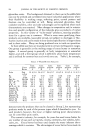
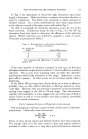
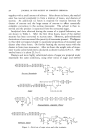
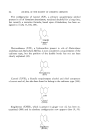
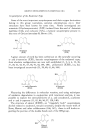
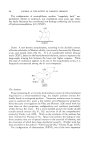
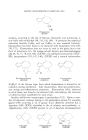
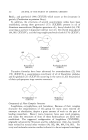
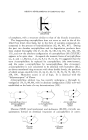
302 JOURNAL OF THE SOCIETY OF COSMETIC CHEMISTS phyllene alcohol, respectively, have also been reinvestigated (5, 7, 88, 89, 90) and new structures have been assigned to them at least tentatively. 'Cedrene and cedrol: These baffling compounds have been under in- vestigation (144) since their isolation from cedarwood oil (yuniperus virginiana L.) sixty years ago. It was only recently that structural formulas could be suggested for these tricyclic sesquiterpenes (129, 130, 165) they conform with the various compounds obtained by oxidative degradation of cedrene (XLIV) and cedrol (XLV) in the course of earlier investigations. Last year the structure of cedrol was confirmed by an unambiguous, stereospecific, total synthesis (165). Diterpenes CHo , __/,/ '•OH Cedrene Cedro] (XLIV) (CLV) Space does not permit a discussion of recent developments in the field of diterpenes which occur in essential oils. For a review the reader is re- ferred to an excellent article by Haagen-Smit (68), which also includes a discussion of the biogenesis of the sesquiterpenes and diterpenes, and an explanation of modern nomenclature. Moreover, the paper of Haagen- Smit goes into the stereochemistry of some of the more important ses- quiterpenes and direrpenes. RESEARCH ON AUSTRALIAN ESSENTIAL OIL-BEARING FLORA I. Physiological Forms About thirty years ago a group of chemists and botanists, including Penfold of the Museum of Applied Arts and Sciences in Sydney, Aus- tralia, made a striking discovery. On the occasion of an excursion to the interior of the coun.try they observed eucalyptus trees that were mor- phologically identical, but the leaves of which on distillation yielded es- sential oils of entirely different chemical composition. A closer study led to the introduction of the term "physiological forms," as the trees in question were of the same botanical variety. In the course of years many cases of physiological forms have been discovered among the species of Eucalyptus, Melaleuca and related Australian flora (64). This work has been pursued actively by Penfold and his collaborators, and in the last few years a number of new physiological forms have been observed and studied by the scientists of the above mentioned museum. The oils derived from these forms will be described briefly:

RECENT DEVELOPMENTS IN ESSENTIAL OILS 303 (1) Eucalyptus citriodora Hook. The Type or normal form of this species yields an essential oil consisting chiefly of (4-)-citronellal (65 to 85 per cent), but in 1951 (123) it was found that a variant form (var. "A") produces oils in which the major constituents are the alcohol citro- nellol and its esters (citronellate and acetate). The aldehyde content of these latter oils is low, being of the order of 10 per cent. Trees were also discovered that yielded oils with aldehyde contents intermediate be- tween these citronellol-containing oils and the Type oils. In addition, a form was found which contained terpene hydrocarbons as the principal constituents. The presence of guaiol was demonstrated in the oils con- taining 30 to 50 per cent of citronellal (69). Some idea of the frequency of occurrence of these various forms may be gained from data published in 1950 (120). Penfold and his collaborators (117, 127) found that the progeny (192 trees) from a single open-pollinated tree of the low-aldehyde form contained a great variety of oils: 40.1 per cent produced oils cor- responding to the Type (65 to 85 per cent of citronellal), 29.2 per cent be- longed to the intermediate aldehyde group (30 to 50 per cent of aldehydes), 20.8 per cent gave alcohol-ester oils similar to the parent, and 9.8 per cent produced considerable quantities of terpene hydrocarbons. This breeding behavior is similar to that of Leplospermum citratum var. "B" (119, 122) (see below). The observation that terpenic oils were obtained from some of the prog- eny of the variety "A" directed attention to the relationship of Eucalyp- tus citriodora to E. maculata, a very closely related species with a terpenic oil. Oils from E. maculata growing in both New South Wales and Queens- land were examined (95) the New South Wales oils were found to be uniform in nature, consisting of cineole, pinene, dipentene and limonene, sesquiterpenes and sesquiterpene alcohols of the cadinene-cadinol type. On the other hand, the Queensland oils contained no cineole, c•-pinene being the chief constituent. The minor components showed considerable variation. Current unpublished work indicates that E. maculata in New South Wales may be a species different from the Queensland E. maculata, which in turn cannot be differentiated from E. citriodora on morphological evidence alone. The work on the physiological forms of E. citriodora also revealed the surprising fact that no reliable data existed on the nature of the nonalde- hydic portion of the oil of the Type, which has been an article of com- merce for so long. McKern and Spies (93) demonstrated that besides 65 to 85 per cent of citronellal, the Type oil contains chiefly isopulegol, citronellol, the formic, acetic and citronellic acid esters of these alcohols, c•-pinene, •-pinene and isovaleric aidehyde. No evidence could be found for the presence of ge,raniol, cineole, propionic, burytic or valeric acids, re- ported years ago by Ets. A. Chiris (30).
Purchased for the exclusive use of nofirst nolast (unknown)
From: SCC Media Library & Resource Center (library.scconline.org)