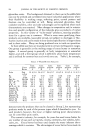
314 JOURNAL OF THE SOCIETY OF COSMETIC CHEMISTS lack of know-how in extraction techniques and of a poor grade solvent (petroleum ether). Recently, however, several manufacturers in Calabria and Sicily have ordered new extraction equipment from Grasse, and as soon as they learn to purify their solvent with the utmost care, a marked improvement in the Italian jasmine concrete can be expected. So far as orris root (Iris pallida Lam.) is concerned, the best grade origin- ates on the mountainsides near Florence in Tuscany. It is only after several years' storage (aging) of the peeled and dried root that on hydro- distillation a good quality of orkis concrete, with a high content of irone (about 15 per cent), can be obtained. Apparently the distillers' heavy demand for orris root in recent years has made it difficult to get properly aged roots hence oil quality has suffered. Mexico During the past fifteen years Mexico has emerged as a large producer of lime oil (distilled and expressed). Prior to World War II production of this oil in Mexico was almost negligible, and the small lots appearing on the market were often of poor quality, characterized by lack of uniformity. In the last fifteen years the writer has spent much time in various sections of Mexico, experimenting and attempting to improve the quality of this oil. In 1940 production of distilled lime oil in Mexico rose to about 47,000 pounds in 1954 it totaled 223,000 pounds. As a result of the application of new distillation techniques many of the lots now reaching the United States are of excellent quality, and the Mexican lime oil--both distilled and expressed--has largely replaced that from the West Indies. The oil of best qttality originates from the Pacific coast (Colima and Acapulco). For many years Mexico has been a substantial producer of linaloe oil, distilled from the wood of closely related species of the genus Bursera. To fill the demand for this oil the trees used to be cut down recklessly, without much thought given to replanting. To prevent extermination of the re- maining trees the Mexican Government a few years ago enacted laws by which oil derived from the wood can be exported only under a license (which, however, is seldom granted). Hence very little linaloe wood oil is produced today, and this exclusively for the domestic market. On the other hand, no restrictions have been imposed upon the export of linaloe seed oil, and a few tons per year are still produced. Morocco Of all the recent developments in the field the most important and inter- esting is probably that which has taken place in Morocco since the end of the Second World War. Within these ten years Morocco has emerged as a heavy producer of natural flower oils, in some of which (chiefly rose) Morocco already by far outranks the Grasse region.

RECENT DEVELOPMENTS IN ESSENTIAL OILS 315 As regards the rose, there are now two principal producing regions in Morocco .' (1) The deep south, in the Dad's Valley, south of the High Atlas. This famous valley, populated by Berbers. who were pacified less than twenty years ago, has for a long time supplied large quantities of dried roses which are used all over North Africa for the preparation of the fragrant rose water so popular among the Moslem population. Prior to the last war substan- tial quantities of dried roses were exported to Europe and America for use in sachets. Transport of the roses out of the valley has usually been by caravan. In the Dad,s, the roses are cultivated in the form of hedges that protect small fields of grain against ravages by sheep and goats. The growing of the roses is a purely native family industry in which the whole population of the valley participates. The plant is probably a form of Rosa damascena, closely related to that grown in Turkey and in Bulgaria. It was introduced from Persia more than 1000 years ago, during the period of the great Arabian invasion of North Africa, reaching the Dad,s by a long route, from oasis to oasis. In 1955 the valley produced roughly 1200 metric tons of roses, about 1000 tons of which were extracted or distilled in two modern plants constructed in 1945. One of these factories is the property of Aromag, a branch of l•.ts. A. Chiris the other belongs to the Soci•t• Florale de l'Atlas and to the Compagnie Fran9aise des Plantes •i Parrum (CAPP), two associated French enterprises. In 1955 these two plants pro- duced 600 to 660 kilograms of rose concrete and some distilled rose oil. Production cannot very well be increased in the coming years, because the supply of roses from the hedges around the native fields is limited. The French administration, which must protect the well-being of the Berbers, cannot permit the laying out of special rose fields because water in the Dad,s Valley is scarce, and the remaining fertile and uncultivated land must be reserved for food crops for the growing population. (2) The north, between Rabat and Mekn•s. Here Pierre Chauvet, a well-known French essential oil producer, and his associates have created thousands of acres of floral plantations (rose, jasmine, jonquil, geranium, etc.) on land where from time immemorial Arabian nomads pitched their black tents and grazed their flocks of sheep. To make these lands produc- tive it was necessary to develop an efficient irrigation system by digging artesian wells modern agricultural equipment (bulldozers, tractors, deep plows, trucks, etc.) had to be imported from the United States selected planting material had to be collected in Southern France and Algeria, brought to Morocco and propagated on a large scale distilleries, extraction plants, boiler houses, repair shops, offices and homes for the technical employees had to be built shelter for the hundreds of agricultural labor had to be provided--altogether a most difficult and complex task in the
Purchased for the exclusive use of nofirst nolast (unknown)
From: SCC Media Library & Resource Center (library.scconline.org)