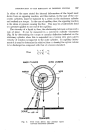
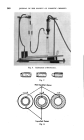
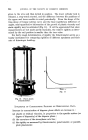
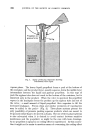
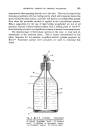
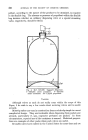
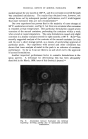
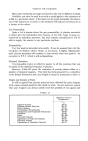
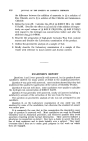
INTRODUCTION TO THE RHEOLOGY OF DISPERSE SYSTEMS 337 In either of the cases stated the internal deformation of the liquid must derive from an opposinõ reaction, and this motion, in the case of the con- centric cylinders, must be balanced by a stress on the stationary cylinder and realised as a torque. In the case of capillary flow, the opposinõ reaction is the stress or pressure causinõ the flow. This may be a hydrostatic head or a pressure applied to one end of the capillary. The viscosity of a liquid is, then, the relationship between a stress and a rate of shear. It can be measured in a concentric cylinder viscometer (Fiõ. 3) by determininõ the torque or annular deflection indicated on the stationary cylinder when this is suspended on a torsion wire and a õiven velocity of rotation is imparted to the outer cylinder. In capillary instru- ments it is usual to determine the relative (time x density) for a õiven volume to be discharõed as compared with that of a known standard. Thus t• X d• • INNER CYLINDER OUTER CYLINDER MIRROR WIRE SCALE TELESCOPE. Fig. 3. View from above into annular space between concentric cylinders.

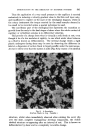
338 JOURNAL OF THE SOCIETY OF COSMETIC CHEMISTS Quite a number of other instruments for the determination of viscosities of fluids are available, among which may be cited the falling sphere, rolling ball, microviscometer, etc. The rolling ball instrument is useful when dealing with an opaque fluid or when observation on a volatile fluid over a period is needed, whilst the microviscometer needs but a millilitre or so of fluid. The falling sphere instrument allows measurement of a very wide range of viscosities merely by selecting steel spheres of suitable diameter. Viscosity is a constant for any given temperature and is independent of the rate of shear ruling during its determination. As a dynamic character- istic it only applies to true fluids in which there is no lower limit of applied stress below which no corresponding flow results (other than surface tension effects). Fluids do not, therefore, include any property of internal rigidity or elasticity. From a subjective standpoint the viscosity of a fluid determines the work necessary to stir it at a given rate and, in the case of very high viscosities, is probably closely related to stickiness and tack. In general, viscosity increases with molecular weight indeed, relative molecular weights are often determined by this means. True fluids are monophasic (true solutions included). When a system is made biphasic, as, for example, by dispersion of a powder or immiscible liquid in another liquid, or formation of froth by dispersion of air in liquid, it is no longer classifiable as a Newtonian fluid, but as a plastic body. Dis- persions of many high polymers in a solvent form non-Newtonian fluids, these being generally oi high viscosities and subjectively similar to Newtonian fluids. They differ, however, in rheological behaviour in that their apparent viscosities decrease with increasing rates of shear, but otherwise exhibit the properties of free-flow of true fluids unless highly concentrated, when they form gels. Plastic bodies, however, exhibit markedly different subjective and rheological characteristics. Thus, whilst sell-healing, they no longer freely flow, a limiting low value of applied stress being needed to effect internal flow. In other words, they exhibit an internal friction or rigidity. This rigidity may be sufficiently marked that the bodies exhibit jelly-like proper- ties, which indicates that sufficiently small applied stresses may result in recoverable elastic deformation without flow. Like non-Newtonian fluids, their apparent viscosities decrease with increasing rates oi shear. For the examination of such non-Newtonian materials rheologically, apparatus is needed wherewith different rates of shear may be measured. Whilst the falling sphere viscometer, operated with a range of steel spheres of different sizes, permits of recognition of such anomalous viscosity, for transparent, freely flowing non-Newtonian fluids, other apparatus is needed for opaque dispersions and pasty bodies. These fall roughly into the two classes of variable pressure capillary plastometers and rotary plastometers.
Purchased for the exclusive use of nofirst nolast (unknown)
From: SCC Media Library & Resource Center (library.scconline.org)