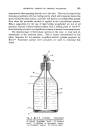
PLASTICS i•OR PACKAGING 377 COMPRESSION MOULDING A hard steel die consisting of an upper and lower member is mounted on the platens of an hydraulic press. The die is machined to the shape it is required to produce and may consist of only one or as many as forty-eight moulding cavities. The die is heated, usually by circulating steam through ports in the platens or the mould itself or electrically, to a temperature sufficiently high to soften the plastics material. Thermoserring material in powder or pellet form is charged into [he tool, the press closed and the softened material constrained to take the shape of the cavity. Pressures up to 2 tons per square inch of projected moulding area are normally used and this pressure is maintained until the applied heat has hardened the material in which final condition it can be ejected as a finished piece without cooling. Curing times between two and ten minutes. The materials most commonly fabricated by this method are the phenol formaldehyde, urea formaldehyde and melamine formaldehyde thermo- serring compounds. They are characterised by high rigidity, high water resistance, excellent heat stability, but, when compared with other plastics materials, poor impact stiength. however, by utilising fibrous fillers the impact strength can be considerably improved. The colour range is wide. INJECTION MOULDING Injection moulding is universally adopted for the thermoplastic materials. The powdered or granulated material is softened in a cylinder heated extern- ally, and is then, by the action of a pressure ram, squirted through a small orifice into the cavity of a closed multiple part cold steel die. The semi- liquid mass takes the shape of the cavity and gives up its heat to the die, the temperature of which is controlled by circulating water or other thermal liquid. Immediately the material is cold the die can be opened and the fi•ished article ejected. This process is extremely rapid, especially fm the production of articles having thin sections, since the time cycles do not usually exceed one or two minutes and for small parts may be as low as 10 seconds. Materials used for injection moulding are cellulose acetate, cellulose acetate butyrate, polythene, Terylene, ethyl cellulose, polysts•ene, nylon and P.V.C. They are materials whose maximum service temperature is limited by their softening points: for example, cellulose acetate, polystyrene, polythene and poly-vinyl chloride should not be used at temperatures in excess of 80 ø C., but nylon and Terylene have upper temperature limits of 100 ø C. and 180 ø C. The tensile and impact strengths are generally high, water resistance is excellent. Colour possibilities are wide, ranging from the completely transparent to the most vivid.

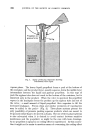
378 JOURNAL OF THE SOCIETY OF COSMETIC CHEMISTS EXTRUSION Extrusion by screw extruders is one of the long-established techniques of the plastics industry. In this process material is heated and softened during its passage along a screw contained in a heated barrel. It is then forced through appropriately heated dies attached to the barrel-end. By this process collapsible tubes from which lengths may be cut and afterwards sealed are easily produced, as also are semi-rigid tubes to which may be fitted end pieces either moulded or pressed from sheet. A development of the extrusion technique is that of extrusion blowing to produce thermoplastic tubes, bottles and containers. The method employed is, in many respects, similar to the long-established practice used to blow and mould hollow glassware and, in principle, comprises the extrusion of a hollow tube, the end of which is sealed. A mould is closed round the extru- sion while it is still soft and air is blown into it, expanding it to the walls of the mould. Both semi-rigid bottles and flexible bottles may be produced. Within limits imposed by orientation of the materials during extrusion, almost any material that will extrude may be used for this process. THERMOPLASTIC SHEET FORMING Thermo-plastic sheet materials are made into their sheet forms by a variety of methods, including slicing from cast or pressed blocks, extrusion, casting and calendering. Materials suitable for forming are celluloid, the acrylates (Perspex), P.V.C. co-polymers and now toughened polystyrene, which in the United States has started an almost entirely new branch of the moulding industry known as vacuum forming, which has passed from infancy to manhood without passing through the stage of juvenile delinquency. Special machines are available which will automatically heat the sheet to its working temperature, clamp it over the mouth of a simple cavity mould of shallow depth and apply a vacuum to the mould causing the soft sheet to snap into the mould and follow accurately its contour and reproduce whatever detail has been provided on the mould surface. The moulds are inexpensive and they may be made from plaster or wood, but aluminium or low-temperature melting alloys are preferred for long runs. Cavities may be single or multiple, and by planned spacing both containers and caps may be formed from the one sheet. A development of this process is to produce polystyrene sheet from an extruder situated immediately behind the vacuum-forming table. By this means only granulated or ground materials are purchased and sheet can be produced in any desired colour or width within the consumer's factory. There is also a saving in cost as it is not necessary to re-heat the sheet before
Purchased for the exclusive use of nofirst nolast (unknown)
From: SCC Media Library & Resource Center (library.scconline.org)