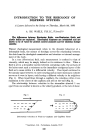
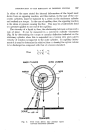
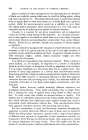
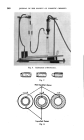
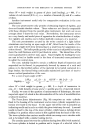
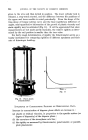
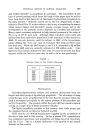
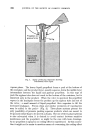
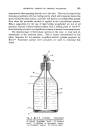
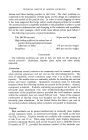
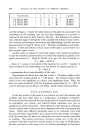
INTRODUCTION TO THE RHEOLOGY OF DISPERSE SYSTEMS 343 where W = total weight in grams of plate (and loading), g = 981, V = volume of each mound (0.2 c.c.), n = number of mounds (4), and R -- radius of discs. Another instrument useful only for comparative evaluation is the cone penetrometer. The cone penetrometer only permits of obtaining degrees of rigidity, and does not furnish absolute values. These values are not directly comparable with those obtained from the parallel-plate instrument, but work out on an average about 7 times the true value. Nevertheless, the instrument serves as a very handy and useful piece of apparatus for standardisation of subjec- tive rigidity and enables one to follow shelf-life constancy of a material. The cone penetrometer as used by the writer consists of a light hollow aluminium cone having an apex angie of 60% fitted from the inside of the apex with a light steel stem terminating in a small loop for suspension on a cotton thread. The bulk specific gravity of the cone is so adjusted by turning down the wall thickness until it just floats in water. The lateral face of the cone is graduated in circles 1 mm. apart. Small weights for loading the cone are cast in lead or fusible metal in the form of truncated cones perforated to admit the central stem. The cone, suitably loaded to attain a sufficient depth of immersion and suspended on its thread, is progressively lowered by means of a rack and pinion on to the levelled surface of the material to be tested contained in a large beaker, the thread being continually maintained just short of taut to ensure vertical penetration of the cone. For a cone of apex angle of 60 ø: 2. W.g g.L.(D -- d) 625 W- 163 L3(D - d) Rigidity-- •'L" 6 or L2 where W = total weight in grams, g: 981, L = depth of immersion in cms., D: bulk density of cone and d = specific gravity of material tested. Finally, we come to the question of measurement of thixotropy, the most important aspect of which is the determination of the rate of re-solidification of sheared materiM. The Pryce-Jones thixotrometer (Fig. 10) comprises an outer cylinder fixed to the housing of the instrument and an inner cylinder suspended on a torsion wire fixed to the head. To the upper end of the wire is attached an indicating needle and a scale on which the given twist may be read. A second needle is fixed to the top of the inner cylinder, which bears a locking device holding it in position when torsion is first applied from the head of the wire. The inner cylinder also carries a needle which can sweep over a circular scale and is furnished with a similar locking device. The annular space between the cylinders having been filled with material, the lower cylinder is locked in position and a torque of a selected value is

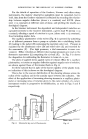
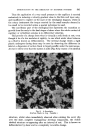
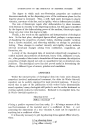
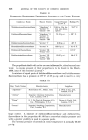
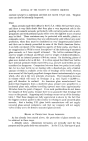
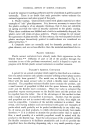
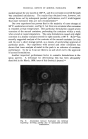
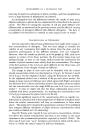
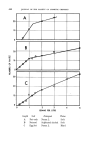
344 JOURNAL OF THE SOCIETY OF COSMETIC CHEMISTS given to the w/re and then locked in position. The lower cylinder lock is released, a stop-watch started, and the difference between the positions of the upper and lower needles is noted periodically. From the shape of the time-decay of torque (stress) curve and the final equilibrium difference of angles, semi-quantitative information of the growth of plastic viscosity and static rigidity may be estimated (Fig. 11). It will be appreciated that since measurements are not made purely statically, the relative rigidity as deter- mined by the end position is smaller than the true value. For fairly rough determination of rigidity the thixotrometer serves as a handy' instrument for comparing rigidities of different specimens and their rate of thixotropic build-up. Time -* Fig. 11 Fig. 10. Pryce-Jones •hixotrometer. INFLUENCE OF CONSTITUTIVE FACTORS ON RHEOLOGICAL DATA Increase in concentration of disperse phase effects an increase in: (a) plastic or residual viscosity, in proportion to the specific surface (or degree of dispersity) of the disperse phase (b) the curvature of the stress/shear rate line (c) the rigidity as measured by thixotrometer, penetrometer, or parallel- plate plastometer.
Purchased for the exclusive use of nofirst nolast (unknown)
From: SCC Media Library & Resource Center (library.scconline.org)