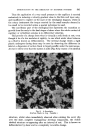
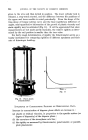
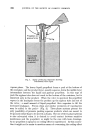
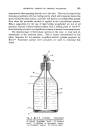
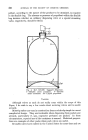
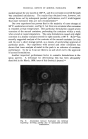
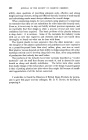
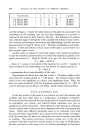
INTRODUCTION TO THE RHEOLOGY OF DISPERSE SYSTEMS 341 Thus the application of a very small pressure to the capillary is exerted exclusively in inducing a velocity gradient close to the thin wall layer only, and insufficient to register on the scale of the rheological diagram, whilst in the rotary instrument the torque exerted by the small annulus sheared is too small to be recorded unless a special technique be used. The curvilinear part of the rheological line represents the transition or growth from the early to the final stages of shear where the whole content of capillary or cylindrical annulus is in differential velocities. This process of a change from what is virtually a solid body at rest, even though it be of a low modulus o! rigidity, to one which under shear behaves as a fluid is known as deflocculation. The internal change which a rigid plastic undergoes during shear may be seen by observing the difference in field ot a dispersion of carbon black in liquid paraffin under the microscope. At rest it will be seen that the system is solid (Fig. 9) by reason of its skeletal ""':'•:' " ....... •"': :'..L: ..-.• .•'...• •- . • . ..-. '/..:j ? •.::: •: :-- •:. - • .... L.• .• .... ß .. '-i-'-:...:.. . :. •.• ..- ....... : ... . . .- .:, ::.• • :• '- ? :.. , . . • .... •. : •.' .:•. • -?•.: .. .... . , .- .-:. • , .'•: .. :,.:...., ...... ,.• •.- •?•:•. 4 ::::-,:: h:g •- •.:...::..•&• .•"'.• ... ,•?.• . ½ • :: .• ?5'" .?')'":"':-,•--.•'•:• "'•- :.'::,•. .. - ',•...': .•-. . ....... :"':'•' •' ' ':• ...... -. : . . • • '•:..' . ...::'• . . :.... • • .. .. • . • • •: 7'..". .: . ..". :. • .. ß ..• :• . .. ,- -.: .. -•: .. . :. .. .. •:•. • ....?.:'"..:.::... - . •. .. • . , :... ... ["ff t' ....•,¾:.'•. ':"-':•'-:• - .'.. '•'•' "-' :'" • : •".•' •. -: •.,.'•.•. ." , -:(.:?':, ' :--?..•. • ('..'L.• :'--.. .... ":--"L• •: .,'" :.• :.'•'"':"• .': --:: • ("'r• ":. --: ". •- ?i. :,,.•::! . i•,..': •' ................ •" •-_. . • .......• .• . .,• . •:•%.•:,.• • •-. .• •. ..• : • • • • • • - ,• •. -: ... • :•. •. • •'. . .• •,•. ".:..% ' •.•...• - .... ... - Q' ' . ß :.::•. '- •?..- .•:.- .... :...• •. ß .-.•-: •:•:. k •. .z. •..•. :- Fig. 9. A fiocculate. (Carbon black in Liq. Paraffin.) structure, whilst when immediately obeyed alter rubbing the cover slip over the slide, complete transparency devdops temporarily, the visible skeletal structure re-appear•g after an interval of rest. This is knom as defiocculation by shear and is a completely reversible change.

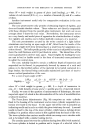
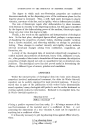
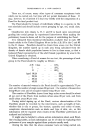
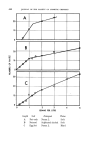
342 JOURNAL OF THE SOCIETY OF COSMETIC CHEMISTS Liquefication of plastic bodies under shear and regain of plastic nature on subsequent rest is known as thixotropic change and the process as thixo- tropy. Thixotropy is a very important factor in the behaviour of plastic bodies, as will be seen later. Returning to the rheological curve of a plastic body and confining our attention to the upper linear portion, we might designate this line as a differential viscosity, its differential nature being caused by a sort of memory of its previous shear history. Unlike the true fluid wherein: shearing stress Viscosity -• rate of shear = a constant the plastic body in the higher rheological regime of its linear part is •, (shearing stress) Plastic or residual viscosity = /k (rate of shear) constant The plastic body can therefore be considered to possess a residual vis- cosity, or a coefficient of resistance to shear after deflocculation by shear has been accomplished. However, as we know, it exhibits a rigidity in addition. Rigidity defeats attempts to measure it by any dynamic means, since its accompanying property of thixotropic change by shear would vitiate its constancy. It must therefore be determined by a static method of measurement. The best method is that employing the parallel plate plastometer, based on the technical instrument used in the rubber industry, but very greatly simplified to yield, paradoxically enough, more accurate measurement. This consists merely of two glass plates 6 in. X 6 in. X 0-25 in., fine- ground on their inner faces to eliminate slippage effects. The lower plate being carefully levelled, four 0.2 c.c. portions of the material under test are delivered from a hypodermic syringe in uniformly piled mounds at equidistant points on to the upper surface of the lower plate. The second plate is then carefully laid on to the mounds and left in an undisturbed state until the diameters of the pressed mounds cease to enlarge. In general, 15 minutes suffices for materials of butter-like consistency. The final diameters are measured by laying a transparent scale bearing concentric 1 mm. circles over each disc seen through the upper plate, the mean diameter being taken. Materials of higher rigidities may require the placing of additional weights on the top plate to obtain discs of sufficient diameter to ensure accuracy of measurement. W.g.V. Then, threshold rigidity-- 2.n.r•.R5 (dynes per cm. 2)
Purchased for the exclusive use of nofirst nolast (unknown)
From: SCC Media Library & Resource Center (library.scconline.org)