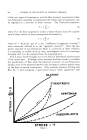
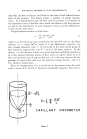
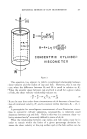
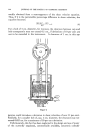
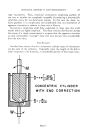
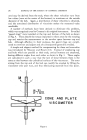
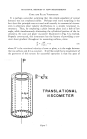
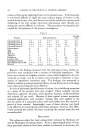
ROTATIONAL METHODS OF FLOW MEASUREMENTS 299 i mercial viscometers available. However, it suffers from the possible dis- • advantage of high price which will make it unavailable to many rheologists. Perhaps the simplest in construction of all the viscometers listed can be •a modification of the Bergen low shear translation device. This consists l essentially of an analytical balance (preferably chainomatic) from the I left arm of which a bob is suspended into a cylindrical vial containing the I test material. The right hand pan is loaded with various weights which j just barely allow the bob to either sink or rise in the test medium. By determining the rate of fall or rise of the bob with a given loading, a stress- strain diagram can be constructed which will be a reversed image of itself going through the origin of the coordinates as the bob direction changes from falling to rising. In the original instrument, the bob velocity was determined by means of a differential transformer sensing element. In the author's modification, a cathetometer or other suitable magnifying de- vice is used to visually monitor the velocity of the balance pointer. Also a hollow cylinder may be substituted for the original bob for the reasons previously described. TABLE I Approximate Shear Shear Range Gradient Thixotropy Name Type in Sec. -1 Constancy Measurabe Brookfield CCR* or cylindrical plate 10-•--102 MacMichael CCR 1-10 • Stormer Paddle Undefined Interchemical CCR 100--3 X 10² Hercules Hi-Shear CCR 10--5 X 10 a Ferranti-Shirley Cone and plate 20--2 X 10⁴ Merrill (17) CCR 3 X 10=-6 X 10 a Asbeck (18) CCR 10=2 X 10⁴ Band (15) Band, Tt 10--5 X 10⁴ Bergen (14) CCT:• 10 ø-10-2 Pochetino (13) CCT 10 6-10 2 Poor Yes Poor Yes Very poor No Fair Yes Fair Yes Very good Yes Very good Yes Very good Yes Very good No Fair No Fair No * CCR = Concentric Cylinder Rotational. t T = Translational. :• CCT = Concentric Cylinder Translational. The reader is referred to the literature cited, or to the pamphlets dis- tributed by the manufacturers for details of the other instruments. REFERENCES (1) Coulomb, C. A., Mere. inst. Natl., 3, 261 (1798). (2) Newton, I., Principia Lib. ii, Sect. IX. (3) Couette, M., Atnn. chim. phys., 21,433 (1890). (4) Stokes, G. G., Math. and Phys. Papers, 1, 75 (1880). (5) Reynolds, O., Philo. Trans., 177, 171 (1886). (6) Eyring, H., •7. Chem. Phys., 4, 283 (1936). (7) Ree, T., and Erring, H., •7- AtppliedPhys., 26, 793 (8) Rabinowitsch,'B., Z. physik. Chem., A-145, 1 (1929). (9) Mooney, M., y. RheoL, 2, 210 (1931).

300 JOURNAL OF THE SOCIETY OF COSMETIC CHEMISTS (10) Krieger, I. M., and Maron, S. H., y./Ipp/iedPhys., 23, 147 (1952). (11• Cram, K. H., and Whirwell, J. C., Ibid., 26,613 (1955). (12) Mooney, M., and Ewart, R. H., Physics, 5,350 (1934). (13) Pochetino, A., Nuovo Cimento, 8, 77 (1914). (14) Bergen, J. T., Patterson, W., Jr., y./IppliedPhys., 24, 712 (1953). (15) Wachholtz, F., Asbeck, W. K., Kol/oid-Z., 93, 280 (1940) ibid., 94, 66 (1941). (16) Asbeck, W. K., to be published. (17) Merrill. E., y. ColloidSc% 9, 7 (1954), (18) Asbeck, W. K., l,aiderman, D. D., and VanLoo, M., ibid., 7, 306 (1952). FUNDAMENTAL AND COMPARATIVE ACTIONS OF CLEANSING CREAMS* By ALBERT R. LATVEN Pharmacology Research, :Inc., Darby, Pa. ALTHOUGH CLEANSING creams are purported to produce a number of beneficial effects upon the skin, their primary effect and fundamental use is as cleansing agents. The nature of this cleansing action has not been clear particularly in view of the fact that plain soaps are said to be equally effective in removing dirt and other foreign matter from the surface of the skin. However, since it is unlikely that cleansing cosmetic preparations would have received continued use for centuries in the absence of superior cleansing action, the cosmetic chemist has justly accepted the presence of superior cleansing properties and has formulated his products more or less on an empirical basis. It is the purpose of this paper to present hith- erto unreported observations concerning the effects of cleansing creams and other products upon a specific type of natural skin soil, namely, upon sebum which has solidified in the form of "plaques" over the sebaceous or pilosebaceous orifices. The studies to be presented are preliminary in character and have been conducted as a matter of experimental orienta- tion it is hoped that the findings may serve as a guide to the refinement of less subjective techniques. While pursuing studies along unrelated lines, we confirmed the pub- ]ished observation that the sebum lying in the exit of the sebaceous duct fluoresces white to yellow or orange when illuminated by filtered ultra- violet light. However, we also observed that the majority of the yellow and orange fluorescent points consisted of sebum which had solidified in the form of a "cap" loosely covering, but nevertheless adhered to, the sur- face opening of the sebaceous gland. These caps, or plaques, could be pried loose with a sharp instrument such as a scalpel or razor blade and * Presented at the May 10, 1957, Meeting, New York City.
Purchased for the exclusive use of nofirst nolast (unknown)
From: SCC Media Library & Resource Center (library.scconline.org)