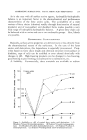
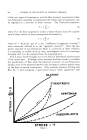
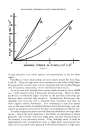
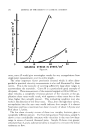
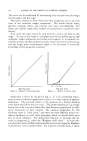
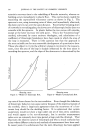
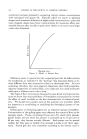
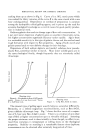
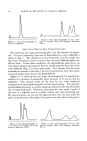
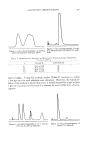
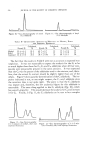
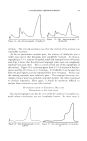
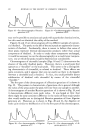
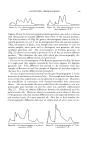
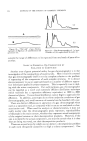
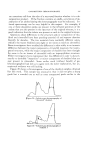
ROTATIONAL METHODS OF FLOW MEASUREMENTS 297 YIELD VALUE From these low shear curves, one is tempted to draw conclusions con- i cerning the "Yield Values" of these materials. By laying a tangent to the I steeply rising portion of the curves where it appears to become straight land extending this to intersect the stress axis, a threshold value of stress i is indicated above which the material substantially will flow, and below i which it will not. This concept of apparent "Yield Value" can often lead I to misconceptions of the viscous behavior of the materials tested if it is •not applied with the utmost caution, since very often it is a function de- I termined solely by the shear range employed during the measurement. Thus, from the curves of Fig. 10 it is obvious that a decided curvature toward the origin exists at the very low shear ranges, and that the material obviously flows, although very slowly, below the apparent yield value. If measurements at still lower shear velocity ranges could have been made, spreading the shear velocity axis out over a considerably greater range, a similar analysis may have resulted in a substantially different apparent yield value. This difficulty is particularly well illustrated by curve B of the high shear plot. An analysis similar to the low shear curve, by laying a tangent to the upcurve of this run and extrapolating down to the r axis, indicates an apparent yield value in this shear range about 180 times greater than the apparent yield value obtained for the same material in the low shear re- gion. Obviously, considerable ambiguity can consequently result if some regard to the shear range covered is not given in the interpretation of the commonly employed but often misapplied concept of apparent yield value. It is thus apparent that considerable caution must be applied to the interpretation of theological data obtained from measurements in a limited shear range. Fortunately, rotational type instruments, or related types when properly designed, are capable of covering an extreme range in shear velocities of more than 10,000,000,000 to 1 which is often required. Un- fortunately, this cannot be done by a single instrument. Rather, a num- ber of instruments, each capable of operating properly in its respective shear range must be employed. With an increase in the theoretical knowledge governing non-Newtonian flow behavior, it is conceivable that in the future the flow determining parameters of the various systems may be measurable by some simple means, and that the whole flow curve or any part of it can be constructed without the necessity of obtaining rheological measurements. Thus, for instance, if x•, •,•, and 3•, of the Ree-Eyring equation or others which will surely be derived could be determined independently, a large portion of the uncertainties of present viscosity measurements could be eliminated.

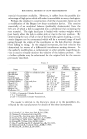
298 JOURNAL OF THE SOCIETY OF COSMETIC CHEMISTS However, for the present this is not the case, and recourse to the tradi-i tional flow measurements must be taken. Im)US•'RIA•. RUEOLOGY This picture may appear excessively complicated to the industrial rheol-I ogist. Fortunately, for application and control purposes, the rheologicall information required or desired may be considerably abridged. Thus, inl the cosmetic industry, as in most others, a few behavior parameters will often suffice to determine whether a given sample of product is up to speci- fication or not. For instance, the ease with which a hand cream or face cream can be applied may determine its suitability or reject it for commer-: cial sale. Very often this factor can readily be ascertained by a few vis-• cosity measurements carried out in the shear range of the actual application • or use. Thus, hand and face creams can be tested at high shear rates of, I say, 10,000 sec.-L Low viscosity at this shear rate signifies easy applica-• tion characteristics, high viscosity, poor ones. However, measurement ofl this characteristic at lower shear values, say 500 sec. -• could give meaning-'• less results if extrapolated into the high shear application range for the l reasons previously described and illustrated in Fig. 9. Similarly, a single measurement, or a few measurements at low shear l rates, suitable to the particular parameter controlling industrially desirable i structure of the product may be sufficient to characterize it in this region., However, it should again be pointed out that these measurements must be l made in the shear range of practical interest, and that extrapolations into l this region from measurements made at other shear rates may lead to• erroneous results. Thus, several determinations on two instruments, a l high shear device and a low shear device, may be sufficient to characterize 1 the material well industrially, whereas measurements made in the region intermediate to these shear ranges may often give insignificant and mean- ingless results. AVAILABLE VISCOMETERS No attempt is made in this paper to list or describe all the rotational viscometers or those working on similar principles which are available. However, in Table I is a listing of a few of the more common commercially available viscometers, or those having some special characteristics which may make them desirable for some phase of cosmetic research or control. As can be seen, the shear ranges covered vary all the way from a low value of 10 -ø sec. -• up to a maximum of more than 104 sec. -• for the various instruments. The shear gradient constancy leaves much to be desired in some of the more common commercial instruments. The Ferranti-Shirley cone and plate device seems to be the most versatile and covers' the greatest shear range at the greatest shear rate constancy of any of the corn-
Purchased for the exclusive use of nofirst nolast (unknown)
From: SCC Media Library & Resource Center (library.scconline.org)