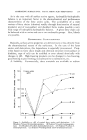
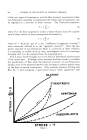
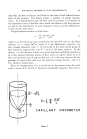
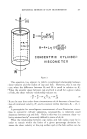
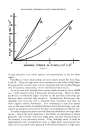
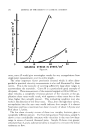
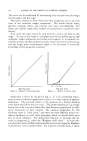
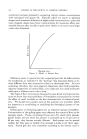
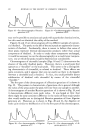
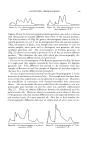
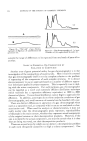
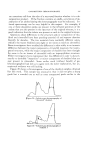
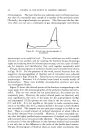
ROTATIONAL METHODS OF FLOW MEASUREMENTS 283 Itorsion wire and determined the logarithmic decrement of oscillation as the Iswing of the plate was damped by the surrounding liquid. Not until a Ihundred years later, in 1890, however, did Couette (3) construct and use •a true concentric cylinder rotational viscometer, the mathematical theory Iof which had been earlier described by Stokes (4). This was to become Ithe prototype of many of the presently employed rotational instruments. lit consisted of a rotating cup, which imparted a given moment, M, to a Ibob, suspended concentrically within the cup on a torsion wire. It was Ifound that the coefficient of viscosity, ,/, of the liquids measured by this Idevice was a simple function of the moment imparted to the bob. The •value of the coefficient of viscosity measured by this instrument was Ifound to correspond very closely with that measured on the same liquid by icapillary methods. A critical rotational velocity, where laminar flow Ichanged to turbulent flow, as earlier predicted by Reynolds (5), was also I found with this early Couette apparatus. The experiences of the last several decades have shown, however, that I the laws derived from the differential equations for "Newtonian" liquids: 1 •r pR 4 (Capillary System) (1) '•-.8 L where • is the volume extruded in unit time, and p is the differential pres- ssure on the ends of the capillary of length L, and radius R and [ RoaR? M = 4•rL•If [_Rfi • •* • (Rotational System) (2) where M is the moment imparted to the cup or the bob, L is the bob length, /47 the angular velocity of the driven member, and Ro is the radius of the cup, and Ri the radius of the bob, respectively, do not hold for a large number of industrially important colloidal solutions as well as for suspen- sions of microscopic particles such as pigment dispersions and emulsions. Under otherwise similar circumstances the rate of flow through a capillary is no longer proportional to the pressure, and the moment produced in a rotational instrument is no longer proportional to the rotational velocity of the rotating cylinder for these materials. This deviation from linearity signifies that the coefficient of viscosity is not a constant for these materials such as it is for Newtonian liquids, but that it either decreases or increases with increased shear velocity. Thus, a number of generalized typical flow patterns may result if stress is plotted against strain as shown in Fig. 1, where Curve I is classified as Newtonian flow, Curve II as pseudoplastic flow, Curve III thixotropic flow and Curve IV dilatant flow. The variable common to both capillary and rotational instruments is the shear velocity (also called the shear gradient). It in- creases with increased flow through a capillary and with increased angular velocity in rotational viscometers. Thus, it is the common denominator

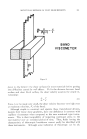
284 JOURNAL OF THE SOCIETY OF COSMETIC CHEMISTS of the two types of instruments, and the flow anomaly encountered when non-Newtonian materials are measured with either type of equipment can be regarded as a function of shear velocity. The Newtonian equation= dv F -- z/-jz 'w (3)1 where F is the force required to attain a shear velocity dv/dz for a given area of shear surface z/, must consequently be altered to: d• 'v* (4)1 F=A'•z where rt* = 'I'(dv/dz) and rt* is the "coefFicient of apparent viscosity,'", more commonly referred to as the "apparent viscosity." Since the parent viscosity of non-Newtonian fluids is a function of shear velocity,I it is necessary to confine dv/dz to close, unambiguous limits if a meaning- 1 ful value of 7' is to be extracted from the measured data. This is most clearly brought out on the basis of theoretical achievementsl of the recent past. Although many attempts had been made to correlatel the mechanisms of flow with the physical structure of non-Newtoniam liquids, most of the proposed theories only attempt to explain special casesl on the basis of special assumptions. Only recently, however, Eyring andl Ree (6, 7) have proposed a generalized theory which apparently welll OlLATENT z I THIXOTROPIC ! •o •o• ø NEWTONIAN ß PSEUDOPLASTIC STRESS - "r' Figure 1.
Purchased for the exclusive use of nofirst nolast (unknown)
From: SCC Media Library & Resource Center (library.scconline.org)