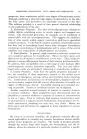
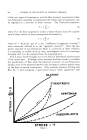
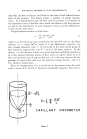
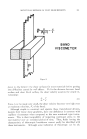
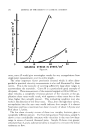
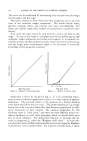
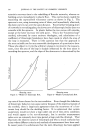
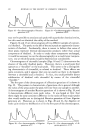
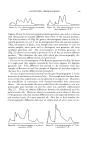
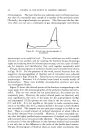
ROTATIONAL METHODS OF FLOW MEASUREMENTS 285 describes the flow of plastics and fluids on the basis of well defined param- eters of the systems. The theory makes a number of simple assump- Itions. It is hypothesized that the flow rate of a system is a function of Ithe relaxation times of the flow units which contribute to the flow process, las well as the distribution of such relaxation times, and the deformation Iof the system with stress. The generalized equation is of the form: rl* = • x,,fi,• sinh -1 l•nD (5) •where x• is the fractional area occupied by the nth flow unit on the shear isurface d• = (XX2Xa/2kT)n, where k is the Boltzmann constant Ithe average relaxation time = {1/[(X/X•)2k']} for each related group of I flow elements, respectively and F = dr/& is the shear velocity. In the labove: X is the distance a flow unit moves between equilibrium positions IX• is the distance between planes of flow units of a given kind X3 Xa is the cross-sectional area of a given flow unit k' is the rate constant for the passage of a given flow unit over the potential energy barrier and T is the absolute temperature. Since an interpretation of x, a and fi can, at the present time, be made only in terms of r/* and D, it becomes immediately apparent that only in dv dr CAPILLARY VISCOMETER Figure 2.

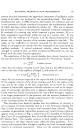
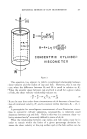
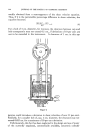
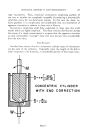
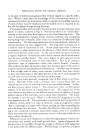
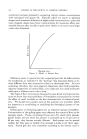
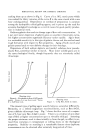
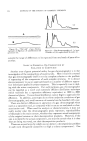
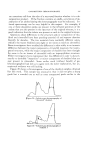
286 JOURNAL OF THE SOCIETY OF COSMETIC CHEMISTS an instrument where a constant shear velocity is obtained, can these pa-• rameters be accurately described. With an instrument yielding a distribu-• tion of shear velocities, the sum of a distribution of 7' values will be rained leading to misinterpretations of the parameters of the equation. SHEAR GRADIENT IN CAPILLARY VISCOMETERS From simple derivations the shear velocity relationships in capillary instruments can be shown to be: dv _ rp (6) dr 2L This equation describes how the shear velocity is a function of the dis- tance, r, from the center of the capillary to the concentrically moving, cy- lindrical flow elements as shown in Fig. 2, and how complicated the flow relationships must become where, in non-Newtonian liquids, n*, becomes an unknown function of dr/dr. A decided deficiency of capillary instruments in measuring liquids with anomalous flow properties consequently becomes apparent: dr/dr varies over the whole of the flowing liquid stream, from the axis of the capillary where dr/dr = 0 to the inside of the capillary walls, where dr/dr attains its greatest value Rp/2Ln. As a consequence, a whole distribution of shear velocities, which again is a function of the degree of deviation from Newtonian flow, is obtained in each measurement of extruded volume, o•, at a given pressure, p. From this a backward inter- polation of the apparent viscosity/shear velocity relationships must be made. Although a number of attempts have been made to carry out this corre- lation between • and p and dr/dr and 7*, respectively, these methods are very complicated and cumbersome and are not always reliable for fluids deviating considerably from Newtonian flow (8-11). SHEAR GRADIENT IN CONCENTRIC CYLINDER VISCOMETERS For properly constructed rotational viscometers, this limitation is not valid and definable. Relatively constant shear velocities can be readily produced over a considerable absolute shear range. This is the fact which has encouraged the use of rotational type instruments despite their comparative complexities, rather than capillaries for the measurement and study of non-Newtonian liquids. In the concentric cylinder viscometer, Fig. 3, the shear relationships, dv/dr, in the cylindrical flow laminae can readily be shown to be: r dr dr • (R? -- R?)3 (7) where//• is the angular velocity, R0 is the radius of the cup, R, is the radius of the bob and Ro r Ri.
Purchased for the exclusive use of nofirst nolast (unknown)
From: SCC Media Library & Resource Center (library.scconline.org)