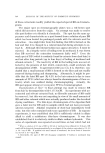
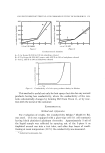
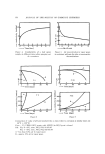
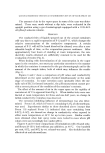
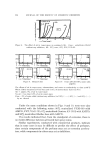
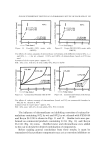
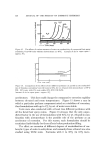
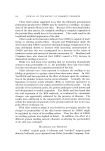
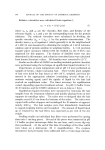
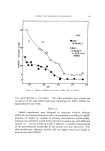
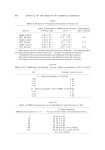
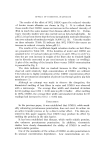
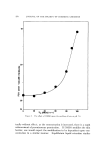
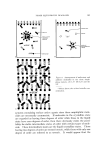
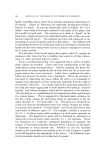
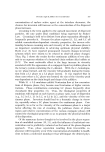
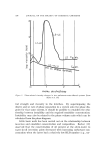
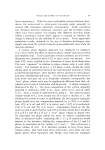
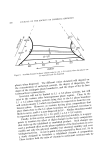
CONDUCTOMETRIC TESTING AND CORROSION STUDY OF HAIR SPRAY 153 The amount of air in the vapor space in some of the cans was deter- mined. These cans, made without a dip tube, were evaluated in the upright position using a gas chromatograph equipped with a 12-ft di-2- ethylhexyl sebacate column. RESULTS The conductivities of liquids sprayed out of the aerosol containers will vary due to a rapid evaporation of F-12 and F-11, which changes the relative concentrations of the conductive components. A certain amount of F-11 will still be found dissolved in ethanol, even after a con- siderable length of time, as the evaporation process continues. After approximately four hours of standing at room temperature, the con- ductivity results obtained are sufficiently constant to be used for the evaluation of results (Fig. 4). When dealing with determination of air concentration in the vapor space in the container, one must pay particular attention to the manner in which the container is connected to the gas chromatograph and to the amount of the sample taken, both of which may influence the results (Fig. 5). Figures 6 and 7 show a comparison of pH values and conductivity determined on the same samples checked simultaneously at the same stage of corrosion. In some corrosion cases (probably when the me- tallic salt of HC1 is formed instantly), the pH measurement cannot pro- vide a correct picture of the condition of the container's contents. The effect of the amount of air in the vapor space on the rapidity of corrosion at 48 øC is apparent from Fig. 8. When similar tests were con- ducted at room temperature for three and one-half years, no change in initial conductivity (3 mmhos) was observed. The corrosion inhibiting influence of nitromethane was also deter- mined. Freon IlS, which is Freon 11 containing 0.3% of nitromethane, was used. Experiments similar to those described above (except that Freon 11S replaced Freon 11) indicated that cans containing from 0.21ø•o-0.54% air showed no change in conductivity when exposed to either room temperature or 48 øC for up to two years. Similar results were obtained when hair spray resins were tested in cases where pH values were not exceedingly low (under pH 6). Figures 9 and 10 show comparisons of formulations with ethanol only, and Resyn 28-1310, both without any additives, at 48 øC. One hundred per cent, 95%, and 90% by wt. ethanol was used. Also included are the effects of air and nitromethane.

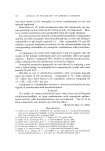
154 Figure 8. JOURNAL OF THE SOCIETY OF COSMETIC CHEMISTS The effect of air in vapor space on container's life. Cone.' auhydrous ethanol without any additives fill: 35% cone., 65% F12/11 35:65. • 01: I .• o 0 L. ...._. • ._• •_ I I 1.0,.2 4 6t 0 2 4 6 Time (mo$,) / ' Time (mo$.) no•ir 4øø I ! no•irl 2OO 2OO ! NM , oL." .... , Time(mos.) / ----'- Time (mos.) Figure 9. Ethanol only 400= . , . , 400 200 /I 2øør .,,: NM X old', , I oL.'"------- / o 2 4 6 } o 2 4 6 • • Time(mos.) ß Time(mos.) Time (mos.) • • Time(mos.) Figure 10. Resyn 28-1310 (90% neutr. with AMPD) The effects of air in vapor space, nitromethane, and water on conductivity vs. time at 48øC Where NM is mentioned, F 11S was used (0.3% of nitromethane based on Fll) Air = approx. 8% of air in vapor space No air = less than 0.5% of air in vapor space Cone.: 3% of resin solids (without any additives) in 1()0• ( ), 95(/0 (---) and 90% (' ß ß ) by wt. ethanol Under the same conditions shown in Figs. 9 and 10, tests were also conducted with the following resins: 90% neutralized VEM-640 with AMPD, PVP/VA E-735, 6% neutralized Gantrez AN-3152 with AMPD, and 90% neutralized Shellac base with AMPD. The results indicated that, from the standpoint of corrosion, there is no visible difference between all tested hair spray resins. Similar experiments, conducted with commercial products, indicate that in some eases it may be difficult to predict the effect of perfumes, since certain components of the perfume may act as corrosion accelera- tors, while components in others may act as inhibitors.
Purchased for the exclusive use of nofirst nolast (unknown)
From: SCC Media Library & Resource Center (library.scconline.org)