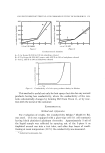
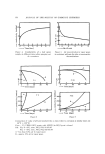
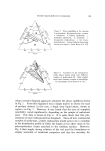
196 JOURNAL OF THE SOCIETY OF COSMETIC CHEMISTS when plotted on a phase diagram, changes as a function of temperature, systems lying close to a phase boundary may exhibit a phase change when the temperature is varied slightly. In general, an increase in tempera- ture will promote miscibility and extend the areas L1 and L2. With nonionic surfactants, when the temperature exceeds the cloud point, this trend will be reversed. On the other hand, the LC phase region will tend to decrease as the temperature of the system is raised. In order to discuss the physical stability of emulsions, which are thermodynamically unstable, some terms should first be defined. The conventional definition of an emulsion as a two-liquid dispersion stabilized by an emulsifying agent has already been mentioned. However, dis- persions of L1 q- LC, L2 q- LC, and L1 q- L2 q- LC all resemble the conventional L1 q- L2 type of emulsion, at least macroscopically. Only when microscopic evaluation of the separated phases is carried out under polarized light is it possible to confirm the number and types of phases present. It seems logical, therefore, to extend the definition of an emulsion which contains surfactant as the emulsifying agent to include these other dispersions. Instability is a difficult term to define adequately, especially as there does not yet appear to be any one consolidated theory for emulsion formation and stability. Most workers agree that emulsion formation in the systems under discussion here requires the presence of an inter- facial film that will: (1) reduce interfacial tension and minimize surface free energy, (2) be capable of withstanding rupture or, if ruptured, readily reform, and (3) effect some degree of repulsion between adjacent drops of the dispersed phase. For the purposes of the present discussion instability may be regarded as any undesirable change in the final prod- uct that is considered deleterious to its quality, function, or appearance. Such a definition may be applied equally well to solubilized and emul- sified products. In considering the physical stability of emulsions, any one or all of the three phenomena, creaming, phase separation, and inversion, may be considered as undesirable. Since these are essentially concentration- dependent properties, a knowledge of phase equilibrium diagrams should make it possible to: (1) delineate those phase regions in which a partic- ular type of instability occurs, (2) rationalize the instability in terms of a physical property or properties, and (3) take steps to overcome this instability. Within any one system, creaming will vary inversely with the viscosity of the continuous phase which, in turn, will relate to the composition of this phase. Phase separation will be facilitated as the

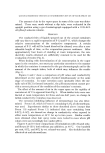
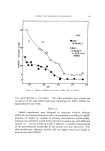
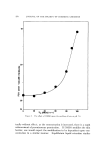
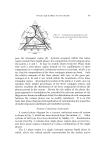
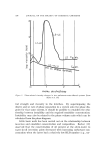
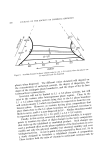
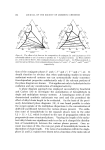
PHASE EQUILIBRIUM DIAGRAMS 1•.)7 concentration of surface active agent at the interface decreases the chances for inversion will increase as the concentration of the dispersed phase increases. Creaming is the term applied to the upward movement of dispersed particles, the rate under ideal conditions being expressed by Stokes' Law. Creaming is held to be distinct from phase separation although it frequently precedes it. Because the phase regions L1, L2, and LC all exhibit concentration-dependent viscosity properties, the inverse rela- tionship between creaming rate and viscosity of the continuous phase is an important consideration in achieving optimum physical stability. Hyde et al. (8) have reported pronounced viscosity changes in ternary systems which were shown to be related to observed phase changes. Thus, Fig. 5 shows the results for the continuous addition of two alka- nols to an aqueous solution of a branched chain sodium alkyl sulfate at 25øC. The most noticeable effect is the large increase in viscosity associated with the appearance of a conjugate liquid crystalline phase in the ternary system containing the Cs alkanol. With the C• homologue, no LC phase formed, and the viscosity fell gradually during the transi- tion from a L1 phase to a L2 phase system. It was reported that in those cases where a LC phase was formed, the size of the viscosity peak was dependent on the chain length and shape of the additive. While L1 h- L2 emulsions exhibit Newtonian flow at low concentra- tions of disperse phase, they become non-Newtonian at higher concen- trations. Phase combinations containing LC phases frequently show viscoelastic flow properties (9). Thus, the rheological properties of emulsions will depend on such factors as phase ratio, type of dispersion (e.g., LC in L1, L1 in LC, or L2 in LC), and the viscosity of the con- tinuous phase. Inversion should lead to a dramatic change in viscos- ity, especially when a LC phase becomes the continuous phase. Con- sequently, in so far as the viscosity of the continuous phase is a major factor affecting the rate of creaming, the judicious choice of phase region and relative concentration of the various conjugate phases will control the rheological properties so as to promote the physical stability of the dispersion. Of the numerous factors thought to be involved in the phase separa- tion of emulsified systems (10, 11), only the influence of surfactant con- centration can be profitably evaluated on the basis of the phase diagram approach. Thus, phase separation resulting from irreversible co- alescence will frequently occur if the concentration of emulsifier is insuffi- cient to form a condensed monolayer that will impart the desired phys-
Purchased for the exclusive use of nofirst nolast (unknown)
From: SCC Media Library & Resource Center (library.scconline.org)